

Products and services


When was the last time you had a family dinner? And when was the last time you sent a message in a family group chat?
For many of us, the answer to the second question is probably much more recently.
Family talk used to happen around the dinner table. After work or school, everyone would gather for a meal, catch up on what happened during the day, and share stories. Today, those shared mealtimes are less common. As children grow older, schedules become busier, and family members often live in different places, sitting down together for dinner is increasingly reserved for special occasions.
But that does not mean family talk has disappeared from our daily lives. It has just moved to our smartphones.
If you open your messaging app, chances are you have at least one family group chat. It might be a one-to-one chat with your sibling, your cousin, or your favourite uncle, or a larger group chatroom with the whole family. Throughout the day, we send messages, react with emojis, and share photos and videos. In particular, everyday photo-/video-sharing has become a convenient way to give quick updates about daily life with family members living near and far. This is how modern families talk and spend time together virtually.
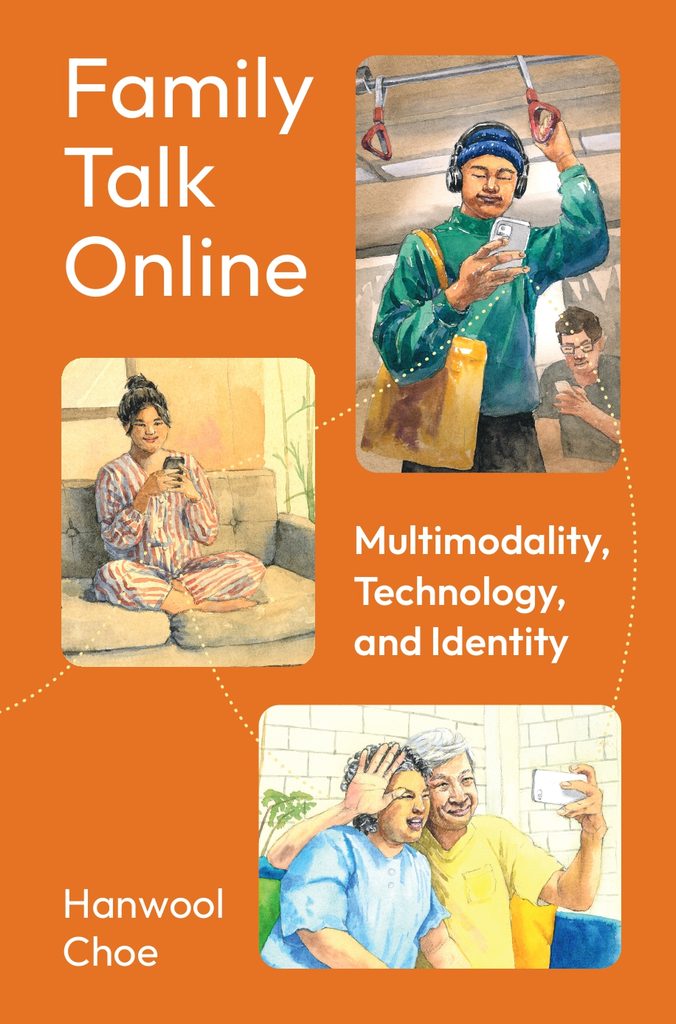
As a member of my own family chatroom and a sociolinguist who studies everyday family communication, I’ve often wondered what these family group chats can tell us about family relationships and identities in the digital age. That curiosity became the starting point for my new book, Family Talk Online: Multimodality, Technology, and Identity.
What happens in family chatrooms may seem too ordinary and too private to study, but these everyday family talks reveal how family relationships and identities are built and maintained through language, photos, videos, and other multimodal resources (e.g., emojis and stickers).
As I collected and analyzed five chatrooms of Korean families(-in-law), one pattern stood out. In many families, it is women in different family roles—i.e., mothers, daughters-in-law, grandmothers, and mothers-in-law—who take on most of the responsibility for keeping everyone informed about the children’s lives. Male family members are usually present in the chatrooms, but they are less often expected to provide children’s photos and videos or respond to requests for updates.
This also reveals subtle family dynamics. In the chatrooms I studied, mothers-in-law regularly ask for photos of their grandchildren. However, there is often an unspoken expectation about who should respond. More often than not, it is the daughters-in-law who provide the updates. Interestingly, mothers-in-law rarely ask how their daughters-in-law are doing or request photos of them. In-law communication is frequently channelled through the children. Even when grandparents babysit their grandchildren, it is usually grandmothers (i.e., mothers(-in-law)), who report back on how the (grand)kids spent the day, often through photos and videos. Everyday photo-/video-sharing has become a “new normal” housekeeping chore for women in the family.
Another fascinating pattern I observed is how grandmothers respond to photos and videos of their grandchildren as if they were speaking directly to them, even though these grandchildren are too young to participate in the group chat. This imaginary conversation is often further facilitated by daughters-in-law (i.e., the mothers of the children), who speak as and for their children. Mothers, as central facilitators of family group chats, act as interactional intermediaries between grandmothers and grandchildren. This makes children a key interactional resource in family talk online. They become a way for adult family members, especially in-laws, to connect, maintain relationships, and construct their familial identities.
What might look like simple photo-/video-sharing is actually much more than that. These new everyday digital acts have become a measure of closeness, responsibility, belonging, and even power within the family. By looking closely at what happens in family chatrooms, we can learn how everyday family life and communication are changing in the digital age.
These are just some of the fascinating interactional patterns I observed and analyzed in the book. If you’re curious to know how a family chatroom helps connect a married couple in a long-distance relationship; how the Korean language works in the family group chats, or the unwritten rules of sharing and responding to everyday photos and videos, check out the book, Family Talk Online: Multimodality, Technology, and Identity!

Hanwool Choe is Assistant Professor in the School of English at the University of Hong Kong. Using interactional sociolinguistics and discourse analysis, she studies language use a...
View profile >Keep up with the latest from Cambridge University Press on our social media accounts.




Latest Comments
Have your say!