
Products and services


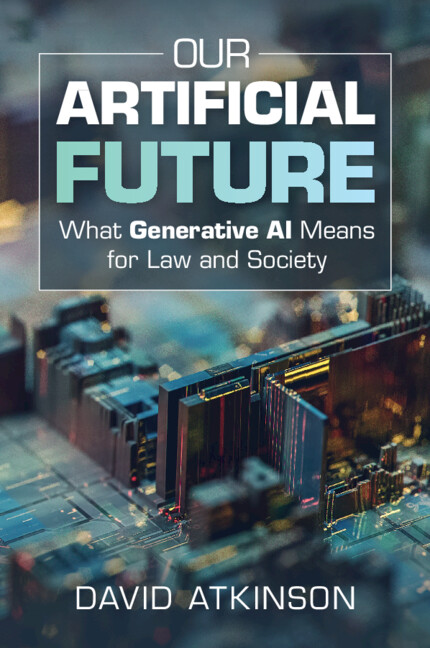
Few things stir emotions and financial markets quite like artificial intelligence, yet too few people understand how it’s made, how it’s measured, how it intersects with the law, and what its societal implications may be. The most well-known issues, such as misinformation, hallucinations, “nudify” apps, and the like, are the tip of the iceberg. I wrote Our Artificial Future to enhance AI literacy and discuss the more foundational and far-reaching consequences of AI. In short, I want society to control AI before AI controls society.
The book is not an academic tome. The chapters are relatively short, so the average person interested in AI can start and finish one in a single sitting without fuss. It’s written with the assumption that the reader has minimal familiarity with the inner workings of generative AI (GenAI; the kind that powers chatbots from OpenAI, Anthropic, Meta, Google, and others) and with legal doctrines, and that explanations are simplified rather than overly academic. Because the book’s intent is to empower readers and their communities, each chapter ends with a handful of discussion questions to facilitate thoughtful conversations. AI need not be intimidating, and there is no reason to treat its inner workings as sacred knowledge beyond the grasp or possible comprehension of democratic influence.
Every chapter of the book focuses on a new topic. For example, one chapter covers data scraping. It likely won’t surprise many readers that AI models are trained on vast amounts of data, but exactly how is that data collected? By whom? From where? What are the implications for the data creators and the websites that host the content?
Another chapter examines how AI may affect cognition. AI is often treated as an answer engine rather than a traditional search engine like Google. What might that orientation mean for the development of young minds, such as K-12 students?
For readers curious about how the law might enable or constrain AI companies, the book includes chapters on First Amendment speech rights, copyright law and fair use, contract law and terms of service, and more.
Throughout the journey, readers are encouraged to look beyond the surface statements of AI companies and to consider the second- and third-order effects of their actions on society more broadly. By the end, the reader should feel well-informed and able to fully participate in discussions about AI in their households, communities, and societies.

David Atkinson was a paratrooper (82nd Airborne Division) before earning a master's from Harvard and a JD from Georgetown Law. He has since worked with the Allen Institute for AI a...
View profile >Keep up with the latest from Cambridge University Press on our social media accounts.




Latest Comments
Have your say!