

Products and services


Both climate change and the ocean have always been topics I felt drawn to. Both felt scientific, urgent, and practical, and they somehow involved the outdoors, which, for me, as a lawyer working inside all day, sounded very tempting. When it came to writing my Master’s thesis, I just couldn’t decide which topic to explore. So I asked myself, why not try to find an issue that connects both climate change and the ocean? This is how I found a problem called ocean acidification. At the time, I had never heard of ocean acidification, and after the thesis was done, I had more questions than answers. The science was complicated, and the law and governance were anything but clear. This was the moment I realized that understanding the problem of the souring seas, or the “other CO₂ problem”, meant stepping beyond my traditional legal career. I needed to learn about policy, governance, and, most importantly, science. Years later, someone at a conference called me a “glue person.” It was the perfect description of the path that decision had set me on. It’s a lonely space. I haven’t fit neatly into any academic lane since. But this interdisciplinary middle ground is exactly where environmental solutions are born.
What I gradually realized is that the problem wasn’t just ocean acidification itself. International law and governance are often divided into distinct silos, both in terms of academic disciplines and subject-specific areas. Law, policy, and science are rarely integrated, and governance of the oceans, climate change, and land-based pollution is similarly fragmented. As a result, ocean acidification, like many other climate-ocean issues, has fallen through the cracks of this system.
The fragmentation of academic disciplines creates one challenge. Solving environmental problems, including ocean acidification, requires moving from understanding the science to building governance; otherwise, the scientific reality of the problem cannot be reflected in the policies and laws that aim to address it. A second challenge is the fragmentation of environmental governance itself. Ocean acidification is a complex problem that spans multiple Earth systems, including the ocean, atmosphere, and land, and has both temporal and spatial dimensions. While reducing CO₂ emissions remains essential, reducing land-based pollution that contributes to ocean acidification hotspots is comparatively low-hanging fruit. Unlike global emissions reductions, which require action by the international community as a whole, these measures can often be implemented at the regional or even local level and therefore within a shorter timeframe. Breaking down silos between disciplines and fields of research requires glue people who work at their intersections, connecting knowledge and governance across these boundaries.
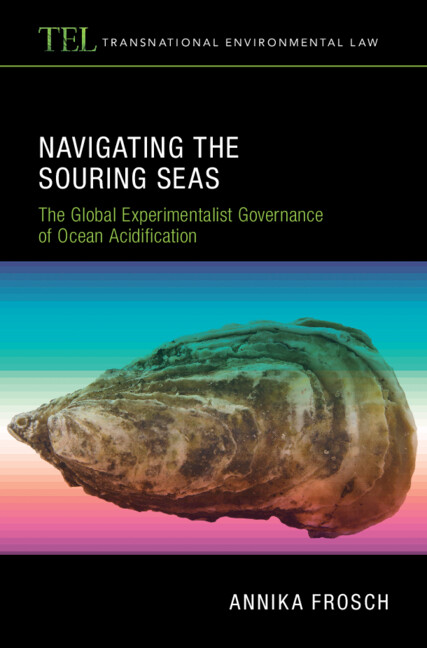
To bridge these silos, in Navigating the Souring Seas I begin by assessing what we know about ocean acidification, including both the underlying science and the existing governance landscape, before identifying governance solutions informed by these findings. The book explores whether global experimentalist governance, a flexible and adaptive approach to governance, can help address these gaps and tests this idea through real-world case studies. If you are a scientist frustrated by policy, a lawyer confused by data, or a fellow “glue person” trying to bridge a gap, this book is for you. We can no longer afford to stay in our lanes while our oceans sour.

Annika Frosch is a research fellow at University College London and a DAAD-funded Ph.D. graduate from the EUI. This book is based on funded research stays at UC Davis, NUS, and UCL...
View profile >Keep up with the latest from Cambridge University Press on our social media accounts.




Latest Comments
Have your say!