

Products and services

In the last decade of his life, my paternal grandfather suffered from undiagnosed vascular dementia. During those years, we saw sudden changes in his speech, mood, personality and behaviour, ranging from unprovoked aggression to gloomy withdrawal. His son – my father – is a committed Christian, who believes that every human soul will live forever. But once, on the drive back from my grandfather’s house, he admitted to me that sometimes he wondered where his father – the father that he knew – had gone.
Although I only realized it afterwards, this experience shaped my research. At the time, I was exploring how the inhabitants of early modern England understood mental disorders (or ‘diseases of the mind’). If you’ve ever seen or read one of Shakespeare’s plays, you’ve probably come across at least one of them: maybe the ‘melancholy’ of Jaques, or the ‘lunacy’ of King Lear. Most of the medical diagnoses invoked by Shakespeare have been well-studied by historians and literary scholars. That is, with one exception: ‘frenzy’. This word (along with its adjectival derivative ‘frantic’) has now drifted a long way from its original meaning. I’m afraid that if you have ever described yourself as ‘frantic’, you may have inadvertently diagnosed yourself with a life-threatening disease. This now-defunct diagnosis lies at the heart of my book, Frenzy in Early Modern England: Madness, Brain Disease and the Soul (Cambridge University Press, 2026).
What I discovered was that while frenzy was indeed a kind of ‘madness’, it was also understood as a quite literal brain lesion. Early modern medical experts defined it as an abscess or inflammation – either in the meninges, the cerebral cortex, or both. Today, this sort of diagnosis would lead to the sufferer being referred to neuropsychiatry rather than psychiatry. But no such distinction (or professional specialization) was available in early modern England. Instead, frenzy was differentiated from other types of ‘madness’ in two ways: its signs (it was always accompanied by a fever) and its prognosis (unlike ‘melancholy’ or ‘mania’, most sufferers died within days).
For those who survived, the diagnosis did other forms of damage: stigmatization, confinement, the loss of legal autonomy, and so on. This made it a difficult subject to write about. But as I wrote, I gradually began to realize why the story was an important one for me to tell. The book begins with a diary entry written by the non-conformist Protestant minister Oliver Heywood in the 1680s:
[on] Nov 7 81 a godly young man of our society in Warley, one Joshua Bates, fell into a kind of a phrenzy… four men had much ado to hold him, he was bound, raved, raged, in a formidable manner, made rhymes, yea (which was sad) Satan used his tongue to swear many dreadful oaths, which he never did in all his life: he was much prayed for … that evening he grew quieter, had a quiet night – in the morning I went to see him, he was a sad object, put him into the hands of God by prayer, that evening at 10 o’clock he died, buried Dec 24 81.
The death of a ‘godly young man’ was a tragedy. But what seems to have unsettled Heywood most was not the memory of Joshua Bates’s death, but of his final days alive. ‘Oh my Lord’, the minister prayed, ‘what shall I say to these things? … Doth our Lord give them grace and then deprive them of the use of Reason? doth God sanctify their hearts and then leave them to the black humours of their bodys? … what glory can God have from frantick persons that have not the use of reason?’.
Heywood was trying – and struggling – to fit frenzy into God’s plan for humanity. A temporary bout of unreason could be understood as a trial, designed to humble the recipient. In the Old Testament, Jehovah had humbled the haughty king Nebuchadnezzar in exactly this way. But this could not apply in Bates’s case, for he had never recovered ‘the use of reason’. For Heywood, the ‘reason’ was supposed to be a possession not just of the embodied mind, but of the immortal Christian soul. And that soul was supposed to be immune to the effects of bodily disease.
These days, some of us continue to believe in the promise of personal immortality. Some of us do not. But many of us have experienced the sort of pain felt by Heywood. Sometimes, parts of a person – sometimes the parts we treasure most dearly – seem to change or fade away. They seem inalienable – we feel they must be inalienable – but then, it seems, they are not. For most of the inhabitants of early modern England, this painful realization came when a loved one succumbed to a feverish disease. Today, for those of us who are lucky enough to have access to state-of-the-art medical care, it is likelier to accompany the arrival of an age-related neurodegenerative disease. Frenzy in Early Modern England is an exploration of personhood – of what it meant to early modern people, and what it means to us.
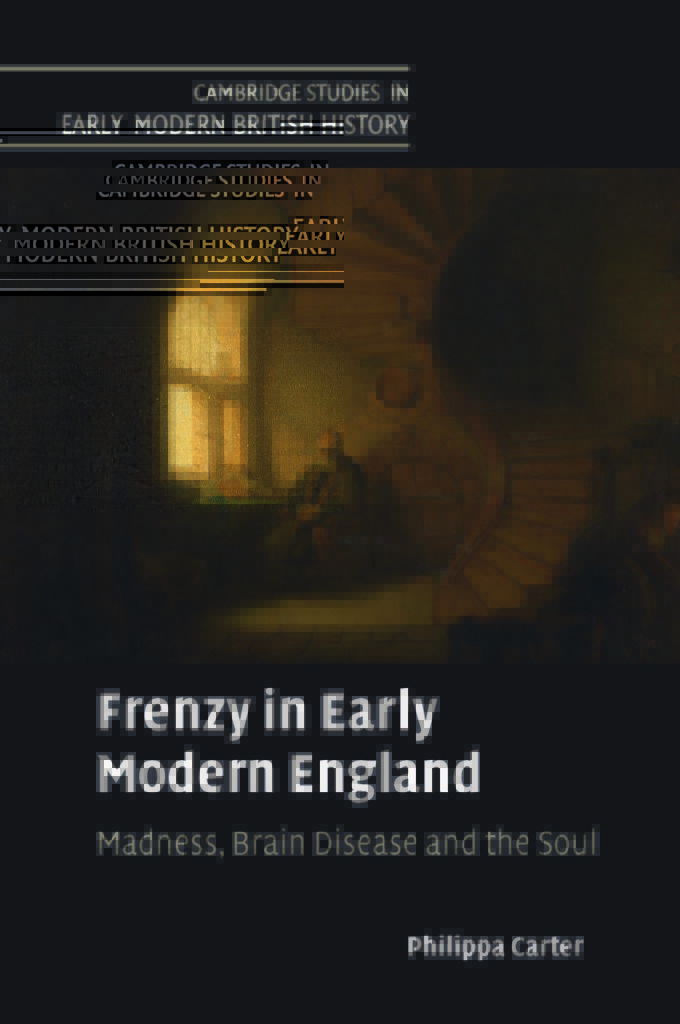
Frenzy in Early Modern
England by Philippa Carter

Philippa Carter is a historian of early modern Britain and Europe, with interests in medicine, natural knowledge, belief, and the body. She is a Fellow of Sidney Sussex College, Ca...
View profile >Keep up with the latest from Cambridge University Press on our social media accounts.


Latest Comments
Have your say!