

Products and services

In 2000, while working in the rare books collection of Mexico’s National Library, I encountered something that caught me off guard. As I flipped through the card catalogue of the Fondo Reservado, I noticed a remarkable increase in commemorative sermons printed during the first two decades of the eighteenth century. Printers in New Spain produced these works to celebrate royal births, deaths, victories, and other dynastic events during the War of the Spanish Succession (1702–1714), the conflict that placed the Bourbon dynasty on the Spanish throne.
At the time, I was a doctoral student still learning how to read the political language of the early modern world. Their sheer number surprised me. That surprise eventually grew into a question that would shape my research for more than two decades: How did supporters of the new Bourbon dynasty persuade the king’s American subjects to embrace a French royal house after nearly two centuries of Habsburg rule?
The answer surprised me as much as the sermons themselves.
Many historians associate the Bourbons with centralization, reform, and the emergence of a more modern state. Yet the men who promoted the dynasty in New Spain did not celebrate the Bourbons as modern rulers. Instead, preachers, bureaucrats, pamphleteers, and artists drew on some of the oldest political and religious ideas available to them. They presented the Bourbons as sacred monarchs destined to restore Spain’s greatness and inaugurate a new era of Catholic triumph.
One example illustrates the point. In 1708, ecclesiastics in New Spain celebrated the birth of Luis Fernando, the first Bourbon crown prince. To explain the significance of the event, they turned to centuries–old prophetic traditions. Manuel Butrón y Moxica, rector of the University of Mexico, invoked biblical imagery, classical prophecy, and medieval apocalyptic thought to argue that the prince would inaugurate a new stage of sacred history. Drawing on traditions associated with Joachim of Fiore and the Sibylline prophecies, he portrayed Luis Fernando as a providential ruler destined to defeat the enemies of Christianity and extend Catholic rule throughout the world.
Other preachers pushed these claims even further. A Franciscan friar named Juan de San Miguel declared that the young prince would rule over England, Portugal, and the Holy Roman Empire and restore Christianity across the globe. Such claims sound extravagant today, but they reveal how many contemporaries understood monarchy. They did not simply welcome a new royal family. They anticipated the arrival of a ruler who would fulfill centuries of prophecy and usher in a new age of Christian victory.
This evidence reveals a striking paradox. Historians often emphasize the relative modernity of the Bourbon dynasty, but Bourbon supporters did not build their legitimacy on modern ideas. They built a Bourbon millennium on a Habsburg foundation. They borrowed the sacred language, messianic expectations, and providential vision that earlier generations had associated with the Spanish Habsburgs and repackaged them for a new dynasty.
That strategy helped secure Bourbon rule during a moment of dynastic uncertainty. Yet it also created expectations that later Bourbon monarchs struggled to satisfy. As the dynasty centralized government, expanded its bureaucracy, and promoted reform, it increasingly emphasized efficiency, utility, and enlightened rule rather than sacred destiny. The Bourbons won acceptance by borrowing the mythology of the Habsburgs. In the long run, however, they helped erode the very sacred foundations that had secured their legitimacy.
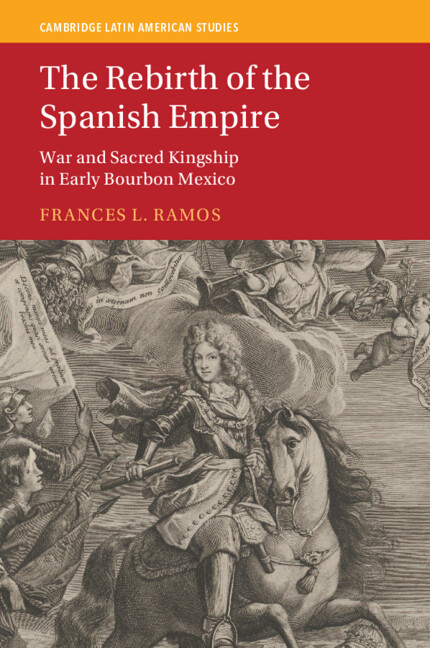
The Rebirth of the Spanish Empire by Frances L. Ramos

Frances L. Ramos is Associate Professor of History at the University of South Florida. She is author of the award-winning Identity, Ritual, and Power in Colonial Puebla (2012)....
View profile >Keep up with the latest from Cambridge University Press on our social media accounts.



Latest Comments
Have your say!