

Products and services


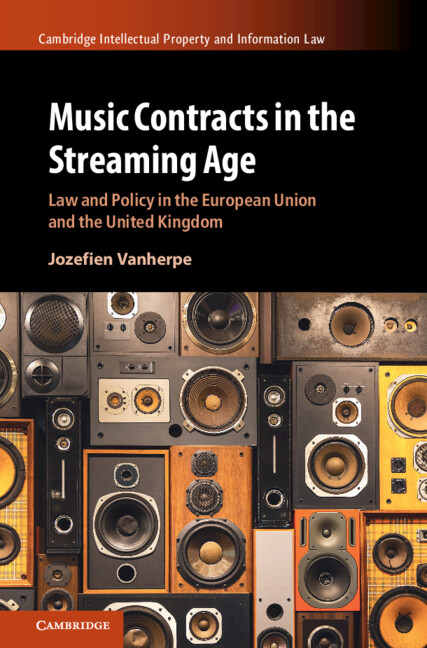
Music forms the soundtrack that accompanies and brightens our daily lives. It is one of the very few endeavours that unite us all. Its intrinsic value is undeniable. However, this often does not translate into economic value. In the streaming era, instantaneous music accessibility is the norm. It is deceptively easy to forget the artistic and commercial journey a melody must travel before reaching an audience. A fruitful collaboration between a wealth of individuals and companies is required to ensure the successful completion of the artistic and commercial process of ‘making music’. This process constitutes the common thread of the book Music Contracts in the Streaming Age: Law and Policy in the European Union and the United Kingdom, published by Cambridge University Press in January 2025.
In an era where much music-related research focuses on the consequences of the rise of generative artificial intelligence (AI) and, consequently, the balance between the interests of the music industry (including musicians) and external players, such as developers of genAI models, this book takes a different approach. It focuses on internal balance, examining the main contractual dynamics of music industry contracts between musicians and their primary corporate partners in the music publishing and recorded music sectors, as they are embedded in the age of music streaming. Where relevant to the legal analysis, the perspective is broadened to contracts with music streaming services. The book focuses on the question how the legal framework intervenes and should intervene in such contracts, both in theory and in practice. It seeks to contribute to a level playing-field that counteracts the imbalance in bargaining power between musicians and their corporate partners in a proportionate way. The book examines the applicable legal frameworks in Belgium, France, Germany, and the Netherlands, as influenced by the European Union (EU) acquis, as well as the relevant provisions in the United Kingdom.
Following an introductory Chapter 1, Chapter 2 focuses on the digital reality with which the music industry value chain is faced and explores several avenues for industry-led change. Among other things, it argues in favour of a transition from the pro-rata distribution of revenues based on consumption share to the user-centric payment system (UCPS) method, which matches users’ subscription fees to the music they listen to.
Chapters 3 through 6 analyse how the law in the chosen jurisdictions regulates music contracts in the streaming age. The bulk of the analysis pertains to the field of copyright contract law. Competition law and related applicable rules that curb business-to-business contract terms and trade practices deemed unreasonable, as well as principles of general contract law, serve as fallback mechanisms that play a background role. In addition to analysing the law as it currently stands, the book proposes a number of incremental amendments. Hereby, recognising the particular situation of the United Kingdom, it walks a fine line between advocating certain harmonised solutions at the EU level and maintaining a sound regulatory basis at the national level where appropriate, as well as between the objectives of providing legal certainty through hard law and of securing a flexible framework that is fit for the streaming age.
Chapter 3 first takes a step back, analysing the role of the law in achieving the book’s policy objective of moving towards a fair(er) balance in the streaming age. The further legal analysis follows the ‘life’ of a music industry contract. Chapter 4 analyses and evaluates the rules that bear relevance to the negotiation and formation stages of the contracts under review, seeking to establish what may qualify as a ‘fair scope’ of rights granted. Chapter 5 focuses on the law that applies to the performance of such contracts, with separate sections on exploitation and remuneration. Again, the objective is to establish what would be ‘fair’ in this context, from both an ex-ante and ex-post perspective. The book then stresses the importance of transparency for the purpose of ensuring fair remuneration and discusses applicable reporting obligations. A separate section is devoted to the potential of a residual, collectively managed remuneration right for digital exploitation. The evolving nature of this matter is illustrated by the ongoing proceedings before the Court of Justice of the European Union concerning the system Belgium established in this context in 2022 (C-663/24). Chapter 6 investigates the legal framework surrounding the end of the researched music industry contracts. It focuses on parties’ abilities to terminate the contractual relationship, as well as the consequences of contract termination in terms of scope, exploitation and remuneration. It considers these consequences to act as switching costs in practice.
Chapter 7 discusses the tools that are available to enforce the law. Among other things, it focuses on the appropriate qualification of certain aspects of the protective legal framework as mandatory law and the potential conflict between the objective of securing transparency throughout the music value chain and the qualification of relevant audience data as trade secrets. Subsequently, the book puts forward opportunities for individual empowerment and the enhancement of a collective voice, including through policy action, self-regulation and collective enforcement. Then, it assesses the potential of alternative dispute resolution within the music industry.
The road towards a level playing-field for all music industry stakeholders in the streaming age is long and somewhat rocky. The law faces several obstacles. First, the use of broad, abstract concepts is not conducive to fairness, since this allows significant divergences between national laws to persist. Second, many aspects of the contractual relationship remain unharmonised at the EU level, such as those relating to the negotiation, formation and termination of the contract. Third, the law currently pays little to no attention to the specifics of digital exploitation of protected content. This book seeks to mitigate these obstacles, by operationalising the broad applicable concepts using concrete criteria that take due account of the ubiquity of the digital sphere.
At the very end, the book circles back to its overarching objective, namely: to move towards a fair(er) contractual balance in the streaming age. Has this goal been attained? Honesty requires us to give a nuanced answer.
On the one hand, looking at the substantive legal framework in the EU in particular, the overall assessment is rather positive. The relevant regulatory regimes in Belgium, France, Germany and the Netherlands provide detailed rules on how contracting parties’ freedom of contract is limited in a bid to further considerations of distributive justice. These national laws aim to work to the advantage of those ‘least fortunate’ in the Rawlsian sense, encompassing a group of people (musicians) who are often at the losing end of the contracting equation and suffer from a systemic imbalance in bargaining power. While there is a margin for improvement, the essence of the legal framework may be said to engender hopefulness. On a substantive level, we are moving in the right direction, towards enhanced fairness. It is hoped that the UK legislator may find inspiration in the regulatory framework offered by continental EU jurisdictions.
On the other hand, there is no straight line between idealistic theory and modern-day music industry practice. If the application of the legal framework ‘in action’ is found wanting, what is the point of a balanced, well-thought-out law ‘in the books’? From this perspective, further bolstering the development and application of ‘fair trade’ principles in music contracts and encouraging stakeholders to speak up in case of unfairness is key. Moreover, if efforts in this direction prove to be insufficient, the only credible solutions left may be to further collectivise through (mandatory) collective bargaining and (equally mandatory) collective management.
With some imagination, the legal framework surrounding the music industry may be likened to a mixing desk, with multiple channels and inputs, as well as filters and equalisers. There are many stakeholders whose voice deserves to be heard—and sometimes amplified—while some influencing factors, such as the winner-takes-all nature of the music industry and its tendency towards the mainstream, should be somewhat filtered out in order for an equalised, level playing field to emerge. Just like sound engineers, we must bear in mind that minor adjustments may have major consequences, and be weary of excessive compression of input that does not do justice to the diversity in the music industry.
Contrary to what is the case for sounds, legal ‘engineering’ requires a continuous feedback loop with industry stakeholders, whereby regulatory action is guided and inspired by empirical evidence. The book identifies a number of avenues for potential bottom-up initiatives and possible regulatory action, opting for incremental modifications to the law instead of the proverbial ‘mic drop’. May this contribute towards a more balanced legal soundtrack for the music industry in the streaming age. This balance, both between musicians and labels/publishers and between the music industry and the tech world, should be at the forefront of the (EU) legislative agenda for culture—especially now, as the genAI revolution risks leading us into the (complete?) unknown.
Keep up with the latest from Cambridge University Press on our social media accounts.





Latest Comments
Have your say!