

Products and services

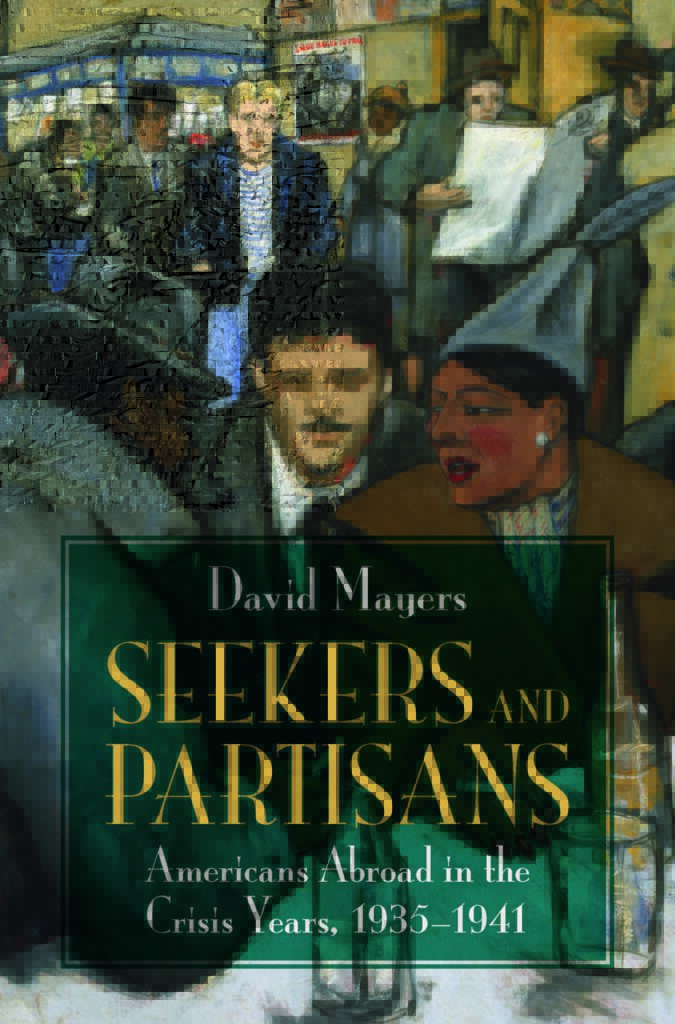
At a moment when many Americans fear the rise of a zealous, sometimes racist, form of populism, when the “bonds of affection” between citizens have demonstrably frayed, and a version of authoritarianism has emerged in Washington, an unsettling question has arisen: should a reasonable person leave the United States? Interestingly, the question is not a new one.
From history’s standpoint, quitting the country has sometimes made sense, notably in the case of enslaved Black Americans in the antebellum South, who risked life and limb to seek refuge in Canada. In Harriet Beecher Stowe’s Uncle Tom’s Cabin, a defiant George Harris tells a well-meaning but uncomprehending white acquaintance, “I don’t want anything of your country, except to be left alone—to go peaceably out of it; and when I get to Canada, where the laws will own me and protect me, that shall be my country.” In the twentieth century, in quest of liberty routinely denied Black citizens, theorist W. E. B. Du Bois, entertainer Josephine Baker, and writer James Baldwin left the United States for permanent residence abroad. Du Bois made his final home in Ghana, Baker and Baldwin in France. In a similar spirit, Jewish Americans such as Golda Meir and her husband emigrated to Mandate Palestine in 1921 to escape a society saturated in Judeophobia. During the Vietnam War, perhaps as many as 100,000 Americans crossed the border into Canada to flee military service; a fair number of these did not wish to fight in what they considered an unjust war.
Disillusioned idealists, of extreme leftist and rightest bent, have also fled. Revolutionist Anna Louise Strong felt suffocated and harried in the United States, which she imagined to be less free than Stalin’s USSR or Mao’s China. Strong devoted her intellect and energy to the Soviet Union, harbinger, she believed, of a radiant future. Class justice, racial harmony, gender equality, and modernization unencumbered by rapacious capitalism and liberal cant would reign. To her, the triumph of the proletarian republic in the Second World War vindicated Stalin’s leadership. Her mind fixed on a remote and conjectured future, she failed to grasp the horrid reality or legacy of Stalinism.
In the 1930s, the poet Ezra Pound, on the opposite side of the philosophical spectrum, was appalled by American politics and society, judging them inferior to what he imagined were fascist Italy’s glories. Enthusiasm for Mussolini led Pound to write and speak on Fascism’s behalf throughout the 1930s and beyond. He had hoped that the United States would abstain from European hostilities, to which end he lobbied Washington congressmen.
Less politically inclined people, yearning for an aesthetically fuller life than available in the United States, once gravitated toward Europe with its layers of artistic richness and textured traditions. This category of cultural pilgrims has included James Whistler, Edith Wharton, Gertrude Stein, and T. S. Eliot. Each of them seemed to support Henry James’s words (lifted from another context), when he wrote in 1878, “Life at home has never been strikingly agreeable” for many people. Therefore, “we shall probably for a long time continue to see numbers of Americans absenting themselves from the United States.”
In contrast to the above catalog of discontents, other Americans have left for plainly affirmative reasons: to lend talent and labor to presumably lofty causes, an attitude in secular form near to that of Christian missionaries. Thus, for example, Thomas Paine, one-time agitator for American independence (Common Sense), installed himself in Paris in the 1790s and cheered the French revolution (Rights of Man). Along with philhellenes from Germany, France, Italy, and Britain, a few Americans—among them Dr. Samuel Gridley Howe and George Jarvis—sailed to Greece in the early 1820s to assist the anti-Ottoman rebellion.
Before the United States became a belligerent in the Great War in April 1917, thousands of citizens had flocked to Europe. Most identified with the Allied side, but not all, such as the iconoclast H.L. Mencken, who trailed alongside German soldiers marching through Lithuania. One hundred and eighty volunteer pilots enrolled in the fabled La Fayette Escadrille and served under French command. No pictorial representation of the war surpassed that painted by portraitist John Singer Sargent, who in summer 1918 visited the Western Front. Sargent’s massive canvas, “Gassed,” depicted British solders devastated by clouds of mustard poison. Ernest Hemingway drove a Red Cross ambulance in Italy; care for wounded Italian soldiers won him Rome’s Silver Medal of Military Valor.
The years before U.S. involvement in World War II produced additional groups of Americans who hurried abroad to aid disparate causes. Black pilot John Robinson went to Ethiopia in 1935, when Mussolini launched his invasion of that African kingdom. Robinson there commanded its small air force; in fighting for an African nation, he also helped advance the struggle against white domination in America. Collectively remembered as the Abraham Lincoln Brigade, several thousand Americans went to Spain in 1936-1939 to support the Republic against the Franco-led insurgency. From July 1937 through December 1941, when the United States allied with the Nationalist leader Chiang Kai-shek, weak China stood alone against Japan’s invasion. During this time, numerous private U.S. citizens worked on behalf of China, some on the side of the Nationalists, such as washed-out U.S. Army Air Corps officer, Claire Lee Chennault, and some with the anti-Japanese Communist faction, such as the vehement Agnes Smedley. Their Chinese careers involved military boldness—Chennault’s volunteer air force, the Flying Tigers—and radical zeal in Smedley’s case.
Since 2000, repeating an earlier pattern, American Jews volunteered on Israel’s behalf after Gaza-based Hamas massacred and kidnapped fourteen hundred people on 7 October 2023. Israel’s massive and prolonged retaliation has doomed tens of thousands of Palestinians (predominantly civilians). In April 2024, Jacob Flickinger, a thirty-three-year-old dual American-Canadian citizen, was killed (with six colleagues) by an Israeli missile while delivering World Central Kitchen food aid in Gaza. Among a legion of medical volunteers, Dr. Samer Attar, a professor of medicine at Northwestern University, performed orthopedic surgeries and amputations in Gaza’s Kamal Adwan hospital, where patients included numbers of malnourished children.
Following Russia’s war on Ukraine, thousands of Americans, reliable statistics unavailable, rushed to fight or perform noncombatant service for Kyiv. Many of these enrolled as soldiers in Ukraine’s International Legion, created by Volodymr Zelensky in the first days after the start (February 2022) of Moscow’s “special military operation.” Not every American performed at the level needed, and some were rejected on account of mental or other unfitness. The mismanaged Mozart Group disbanded in January 2023 as recriminations flew between its feuding founders. Yet most Americans, particularly survivors of the misbegotten Iraq and Afghanistan wars, felt that in aiding Ukraine they were this time part of a deserving cause: the Republican Spain, as it were, of their generation. In Ukraine, reckoned an Iraqi war veteran, Matt (surname withheld) one could find “absolution” for participating in America’s “forever” wars, “which no amount of money or time could make clean.” Explained another volunteer in Ukraine, James (surname withheld), a medic tested in Iraq and Afghanistan, “It’s the innocent people being attacked—the kids. It’s the kids man. I just can’t stand by.”
This essay must end with the question earlier posed: Should a reasonable person leave the United States, given the gathering dangers and uncertainty now menacing the nation? Needless to elaborate, thoughtful answers will vary among readers. My own view, for what it’s worth, corresponds with abolitionist Frederick Douglass in 1855, when he urged those Black Americans who had taken refuge abroad to return to help overthrow slavery and oppression: “Come home brethren . . . There never was a time when your services were more in requisition than now.”

David Mayers teaches at Boston University, where he holds a joint professorship in the history and political science departments. His principal books are George Kennan and the Dile...
View profile >Keep up with the latest from Cambridge University Press on our social media accounts.



Latest Comments
Have your say!