

Products and services


Three decades ago, I came across an old report on the state of legal education in the colonies of the British Empire. I learned from the report that there were very few law schools in most of the empire. However, colonial India had a highly developed system of legal education. In fact, there were more law schools, law students, and law professors in India than in Britain. That surprising fact made me wonder what kind of legal education these institutions provided. What exactly were law students in India taught?
The conventional view was that colonial law schools simply transmitted Western ideas. However, the legal system of colonial India, as well as those of many other British colonies, was highly complex. It combined English law with local religious and customary laws. Did these features affect the nature of legal education and legal scholarship in colonial India, or indeed in other parts of the British Empire? The question stayed with me for years. I kept waiting for someone else to write about it, but no one did.
Eventually, I decided to investigate this topic myself by comparing the history of legal scholarship in colonial India, which I knew little about, with that of Mandatory Palestine, with which I was more familiar. I discovered a rich and exciting world. Local scholars working in these territories certainly drew on English legal thought. But because they worked in legal systems that combined English law with religious and customary traditions, they recognized that legal theories developed in Britain did not always fit colonial realities. Inspired by nationalist ideas, they also argued that Hindu and Jewish legal traditions contained concepts that echoed modern ideas such as constitutional government and individual rights. This is the history I reconstruct in Legal Theory in the Colonies: Hindu and Jewish Scholars under British Rule.

Image caption: The University of Calcutta in the nineteenth century
While working on my book, I encountered fascinating sources: long-forgotten textbooks on jurisprudence used in colonial Lahore and Jerusalem; student magazines produced at the University of Calcutta College of Law and the Tel Aviv School of Law and Economics, riddled with wormholes; and academic articles about the unique attributes of Hindu and Jewish law published in obscure and dusty periodicals whose pages had never even been cut apart since they were printed. The people who wrote these works were equally fascinating. Among them was the Indian scholar Radhabinod Pal, a prolific writer on Hindu legal philosophy who is now both celebrated and criticized for his role as a judge at the Tokyo War Crimes Trial, and Samuel Eisenstadt, a scholar of Jewish law whose life and writings bridged the seemingly contradictory worlds of Zionism and communism.
The ideas I discuss in my book are not merely of historical interest. The jurists of colonial India and Mandatory Palestine sought to portray their ancient legal traditions as compatible with democracy and liberalism. At a time when non-Western normative traditions are often mobilized to advance authoritarian agendas, the work of these forgotten scholars reminds us that ancient legal traditions are multivocal and can be used not just to divide and exclude, but also to advance humanist and universal ideals.
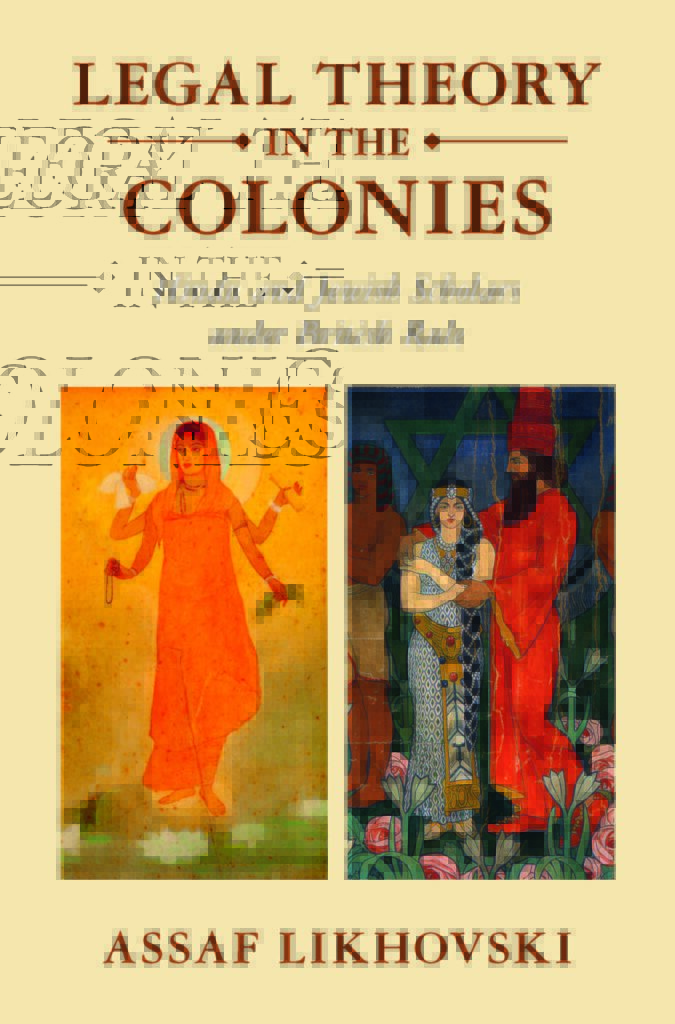
Legal Theory in the Colonies
by Assaf Likhovski

Assaf Likhovski is the Danielle Rubinstein Professor of Comparative Law and Jurisprudence at the Tel Aviv University Faculty of Law. He is the author of the award-winning Law and I...
View profile >Keep up with the latest from Cambridge University Press on our social media accounts.


Latest Comments
Have your say!