
Products and services

When Michel de Montaigne asked his famous question, “What do I know? (Qui sçay-je?)” in the longest of his essays, “An Apology for Raymond Sebond,” what he was asking was whether he could know God’s will with certainty, especially as it applied to the argument made by some Protestant and Catholic polemicists and even some clergymen of both confessions that killing those of the other religion during the sixteenth-century religious wars was God’s will. Montaigne firmly rejected this view and made clear that anyone who claimed to know God’s will with certainty was claiming to be God. But many, though certainly not all, French men and women believed that killing someone of the other religion was justified, because God had willed it. Religious wars certainly predated the French wars of religion (1562-1598), but it was in sixteenth-century France that killing for religion was not simply the result of crusading armies by professional soldiers, but where ordinary civilians took up arms to kill their neighbours of the opposite faith. Indeed, France was the only state in western Europe where Protestantism took root during the Reformation that resulted in more than two generations of civil war. Why was this the case? And why would people kill their neighbours over religion?
The new edition of my book The French Wars of Religion, 1562-1629 addresses these questions and many others. It shows that after decades of attempts to suppress Protestantism by force of prosecution and execution for heresy under Francis I (1515-47) and Henry II (1547-59), Henry’s widow Catherine de Medici tried to forge a policy of peaceful coexistence between the two faiths under the reigns of her sons Francis II (1559-60), Charles IX (1560-74), and Henry III (1574-89). This clearly was unsuccessful as neither side was willing to accept such a policy. For Catholics, the toleration of heretics in their midst was out of the question, as they viewed Calvinism as a threat to their community, identity, and even their salvation. For Protestants, they were equally unwilling to accept the Queen Mother’s terms, which explicitly limited their right to freedom of worship to certain specified places in the successive peace edicts that followed each civil war, making them second-class citizens of the crown.
This new edition of my book is almost completely re-written to reflect two decades of research since the last edition in 2005. Every chapter has been revised and some of them have been completely rewritten. Indeed, new research has changed the narrative in places, such as the massacres of St. Bartholomew’s in 1572. Moreover, a completely new section has been added to the last chapter, showing that even as fighting on the battlefield ended by 1629, the two faiths continued to battle in print over control of how the wars would be remembered. Sadly, killing for religion still occurs in the world today, and the religious wars of the sixteenth-century thus remind us how much this bloody history is connected to the present.
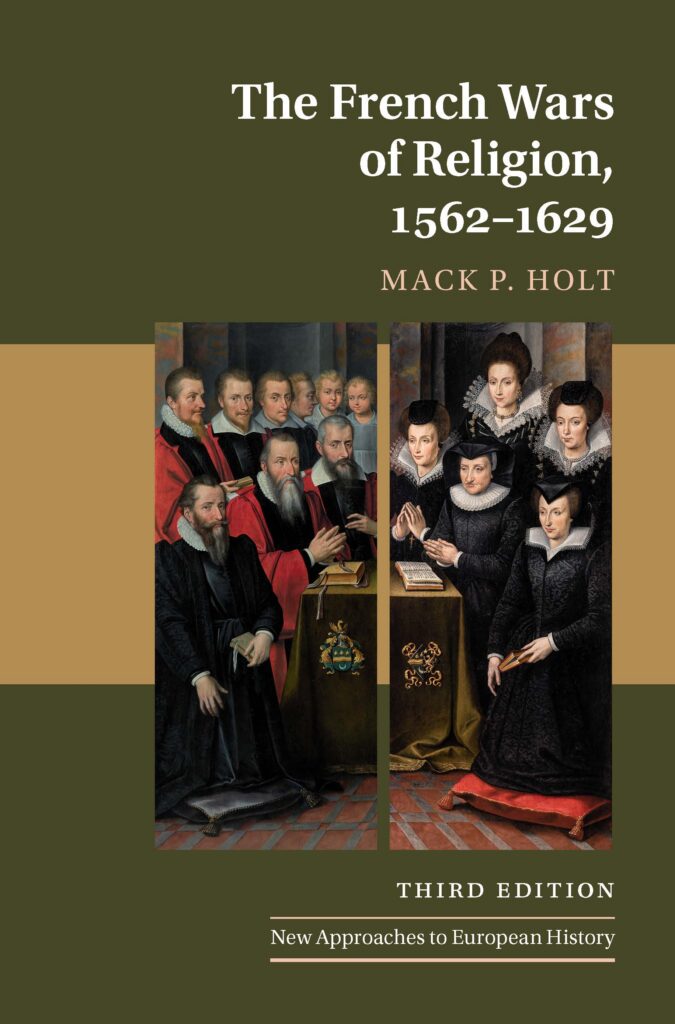
The French Wars of Religion,
1562–1629 by Mack P. Holt

Mack P. Holt is Professor of History Emeritus at George Mason University. Recent publications include The Politics of Wine in Early Modern France: Religion and Popular Culture in B...
View profile >Keep up with the latest from Cambridge University Press on our social media accounts.


Latest Comments
Have your say!