

Products and services

The year 2026 marks 40 years since publication of the first edition of my book ‘Motivational Systems’ by C.U.P.. So, 2026 is an important year for the publication of the 2nd edition of the book. This time it has the sub-title ‘A Biopsychological Introduction’. The reason for the addition of the subtitle is that this edition is designed to be accessible to students in their first year of studying psychology. However, it should also be valuable to teachers of psychology and researchers.
Looking back on the 1st edition from the perspective of 2026 biopsychology, it is somewhat amazing that it contained no reference to the neurochemical dopamine. In the 40 years since then, the insights into the role of dopamine in motivation have been profound. The work of Kent Berridge and Terry Robinson, known as the incentive salience theory, has revolutionized our view of motivation. It is fitting then that Kent Berridge was the person who first suggested a second edition of this book. He supported the project throughout and gave masses of valuable advice. Dopamine takes a central place in the 2nd edition.
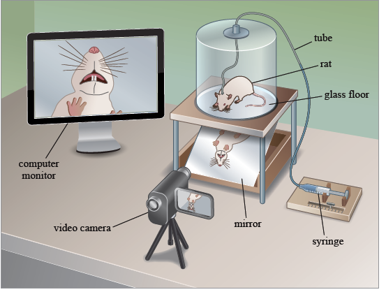
The figure here (taken from the 2nd edition) shows the taste-reactivity test, the apparatus that was used to determine the role of dopamine in motivation. It was known that dopamine-depleted rats stopped eat. Was this because the food lost all its value? Alternatively, was it because the rats were simply unmotivated to approach the food? Until the development of the taste-reactivity test, it was impossible to decide between these possibilities. The test permitted the experimenter to apply a small morsel of food to the tongue of rats and to observe the reaction, acceptance or rejection. If dopamine underlies liking/pleasure, a rat that is depleted in dopamine should show a rejection reaction. In reality, dopamine-depleted rats gave almost the same reaction to nutrients as control rats. This showed the dopamine was not at the basis of ‘liking’ but rather ‘wanting’. This experiment is described in the 2nd edition.
Also emerging into prominence in the last 40 years is the discipline of evolutionary psychology. A source of support for the 2nd edition has been Lance Workman, co-author of the C.U.P. text ‘Evolutionary Psychology’. Evolution featured little in the 1st edition, but it is a central feature of the 2nd edition.
There are several key intentions behind writing the 2nd edition:


Frederick Toates is emeritus professor of Biological Psychology at The Open University, United Kingdom. He is the author of Motivational Systems (1986), Understanding Sexual Serial...
View profile >Keep up with the latest from Cambridge University Press on our social media accounts.




Latest Comments
Have your say!