

Products and services


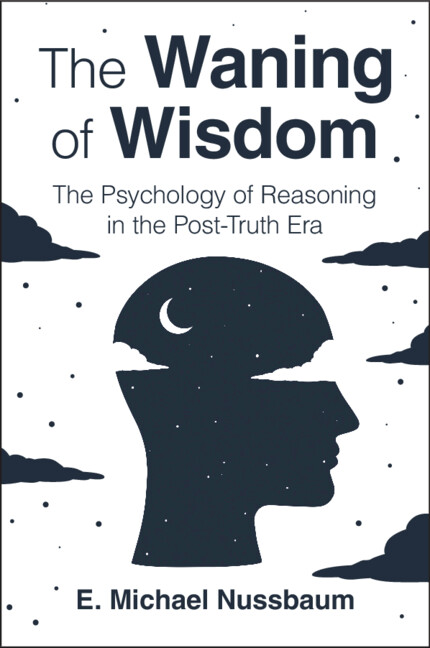
Although there is no credible evidence that the results of the 2020 U.S. presidential election were illegitimate, about one-third of Americans (as of 2024) continued to believe that the election was stolen. Why this belief persists is one of several questions I explore in my book, The Waning of Wisdom: The Psychology of Reasoning in the Post-Truth Era (Cambridge University Press, 2026). Although written as a primer on foundational and contemporary research on reasoning for graduate courses, the book is also intended for general readers. It examines the psychological foundations of “irrational” beliefs and behaviors across the political spectrum.
Several familiar explanations have been offered for why beliefs about election fraud persist. First, such beliefs may serve psychological needs, including identity protection and group affiliation. Second, today’s digital environment often places people in ideological echo chambers where they encounter little contradictory evidence. Third, human reasoning is subject to well-known cognitive biases, such as the illusory truth effect (the tendency to believe claims that are repeatedly encountered) and confirmation bias (the tendency to preferentially attend to information that supports existing beliefs). Finally, many people engage in only limited critical evaluation of the information they encounter and instead react passively to memes, headlines, and misinformation.
Two additional factors, however, deserve greater attention: what the human cognitive system treats as evidence and the central role of trust. Both can be understood within a Bayesian framework, which describes how rational belief should change when new evidence is encountered.
Human beings evolved to treat many different kinds of information as evidence, including personal experiences, stories, and testimony from trusted individuals. At the same time, the cognitive system must decide which sources deserve trust. Judgments of trustworthiness often rely on cues such as reputation, familiarity, confidence, eye contact, vocal tone, and perceived expertise. In the environments in which humans evolved, these cues were often adaptive because people interacted primarily within small communities where reputations could be directly observed.
This helps explain why testimony from political leaders can strongly influence public beliefs. When President Donald Trump confidently asserted that the 2020 election had been stolen, many supporters accepted his claims as credible evidence. Many viewed him as competent (as a “successful businessman”) and as benevolent because they believed he understood the economic struggles of working Americans in geographically depressed regions. Peter Sears refers to this perception as empathetic understanding. Trump’s long public career—including his role as host of The Apprentice—also made him highly familiar. Familiarity itself often increases trust.
To many critics, however, Trump has a reputation for making false or misleading claims. His supporters, however, often reach different conclusions because they do not keep track of all these claims or distrust journalists, government officials, or academic experts who challenge their veracity. Also, many of these claims, such as the crowd size at his 2016 inauguration, are not personally relevant and so do not trigger epistemic vigilance.
The broader point is that people often rely on cognitive strategies that were adaptive in small-scale social environments but are less reliable in modern societies. Today we depend heavily on epistemic institutions—including courts, scientific peer review, election administration, and investigative journalism—to generate trustworthy knowledge. Yet many people have only a limited understanding of how these institutions operate or why they deserve trust. Our educational system could do much more to help students understand both these institutions’ strengths and their limitations.
Modern digital environments create additional challenges. Rationality depends on using strategies that fit the environment. As our information environment has changed dramatically, our reasoning strategies must evolve as well. These include fact-checking claims, consulting multiple independent sources, evaluating source credibility, understanding statistical evidence, and developing strong digital and media literacy skills.
Searching for information involves more than gathering additional evidence; it also requires considering alternative explanations for that evidence. This is another central insight of Bayesian reasoning. For example, when Rudy Giuliani and Sidney Powell presented surveillance footage from Georgia that they described as a “smoking gun” proving election fraud, one interpretation was that election workers were secretly removing ballots by stuffing them into suitcases. A competing—and ultimately more plausible—explanation was that the suitcases simply held ballots being securely stored overnight after election workers had finished counting for the day. Rational reasoning requires actively comparing competing hypotheses rather than evaluating evidence in isolation.
It is tempting to conclude that election deniers simply fail to seek additional evidence, but this explanation is incomplete. Human beings are naturally information seekers because successful adaptation requires exploration. The real question is how much effort people invest in searching and evaluating information. Oftentimes the search is minimal—for example, turning on the television and switching the channel to CNN or Fox News. Both outlets provide abundant evidence and explanations, although not always of equal quality. The internet—and increasingly AI—makes broader searches easier than ever before, but verifying the accuracy of what one finds still requires substantial effort.
People invest additional effort only when they perceive that the benefits outweigh the costs. Those judgments themselves, however, can be biased. Paul Krueger and colleagues describe this process as bounded resource rationality: people attempt to reason efficiently under constraints of limited time, information, and cognitive resources. These limitations affect people across the political spectrum and further underscore the importance of education in critical thinking, digital literacy, and information evaluation.
Psychological research also demonstrates that reasoning improves when people deliberate together under the right conditions. Groups that employ what I call wise discourse practices—including skilled facilitation, exposure to diverse viewpoints, and norms that encourage evidence-based argumentation—possess greater collective cognitive resources than individuals working alone. When participants share a commitment to accuracy rather than simply winning an argument, these groups generally produce better judgments and more effective solutions.
Creating more of these deliberative spaces—both online and face-to-face—is therefore part of the solution. Civic organizations, schools, and community groups can all foster productive dialogue across political differences. Organizations such as Braver Angels have demonstrated that structured conversations about election integrity and other contentious issues can reduce polarization, increase mutual understanding, and improve the quality of public discourse.
Although I frame many of these ideas using Bayesian reasoning, the book also examines dual-process theories of cognition and argues that, with appropriate modifications, the two perspectives can be fruitfully integrated. Ultimately, everyone is susceptible to reasoning biases. The goal is not to divide society into “rational” and “irrational” people but to become more reflective reasoners ourselves.
As Keith Payne has observed, most of us like to think of ourselves as good and reasonable people. We need not affirm that self-image by viewing those with opposing political views—whether election deniers, democratic socialists, or anyone else—as ignorant, malicious, or unintelligent. Instead, civil discourse offers the opportunity to listen carefully, evaluate evidence together, and recognize our shared humanity. That aspiration lies at the heart of wisdom.

E. Michael Nussbaum is a professor of educational psychology at the University of Nevada, Las Vegas, USA. He combines expertise in educational and cognitive psychology, public poli...
View profile >Keep up with the latest from Cambridge University Press on our social media accounts.



Latest Comments
Have your say!