

Products and services


In our work with English language educators across the globe, we are frequently asked questions such as: How should different languages be used in the English classroom? How do we assess students fairly? and What approaches help to deepen understanding or critical thinking?
In response to these and other questions, we find translanguaging theory useful as practical tool to help English teachers explore the range of complex issues that they face in their work today (Anderson, 2024; Li, 2018). Translanguaging theory helps multilingual students and teachers to value their preferred ways of communicating to facilitate effective learning. It rejects the widespread assumption that languages should be kept separate in education, and encourages both teachers and learners to use different languages and other resources within their multilingual repertoires1 to communicate and learn more effectively. It has important implications for how our work fits into the educational and social worlds around us. This is because the language choices made by an English teacher and their students are linked to a wide range of factors such as learners’ language repertoires, their identities, societal aspirations and local policy recommendations. In this sense, to step into an English language classroom is to step onto contested political ground (Flores, 2014). Yet, until now, English teachers had very few practical resources to help them navigate this complex territory.
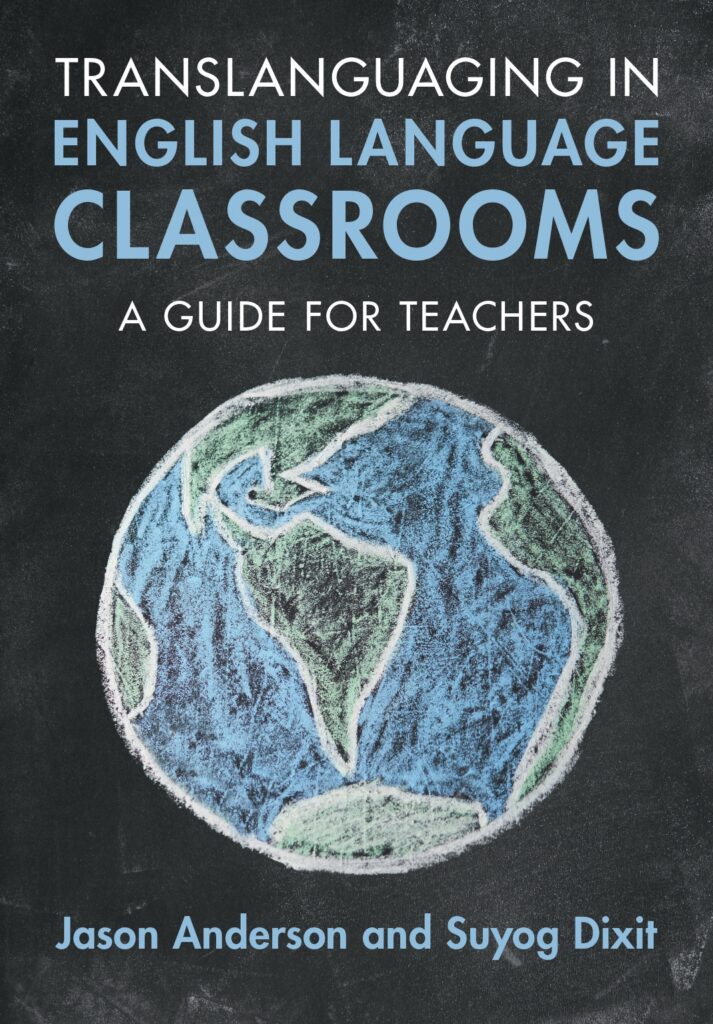
Our book Translanguaging in English Language Classrooms: A Guide for Teachers (Anderson & Dixit, 2026) aims to empower practicing teachers of English (including TESOL, EFL, ESL and CLIL2) to make the right decisions for their own classrooms so that they and their learners can benefit from it in practice. It does this, not only by discussing the theory of translanguaging, but also by presenting numerous examples from a wide range of contexts to unbox the core ideas, challenges, and opportunities for learning in English language classrooms. We aim to provide a grounded conceptual framework that helps teachers to navigate high-stakes decisions across diverse global contexts. The book introduces a range of strategies and ideas for the classroom and encourages teachers to explore these in their own contexts, helping them strengthen the efficacy and impact of their teaching.
The initial chapters, in addition to laying the foundations of translanguaging theory and practice, present key implications of translanguaging for different stages of education, pointing out that our role as English language teachers is to add to our learners’ expanding multilingual repertoires, and not to restrict these to a monolingual mode of communication. Depending on the policies teachers have to work with, we help them to explore and justify their own language use beliefs and practices. This helps each teacher to get a clear idea of how translanguaging might work in their own, unique classroom.
We take the discussion ahead by exploring four classrooms from different national contexts and explore the factors influencing translanguaging opportunities. Chapters 5 and 6 discuss teacher and learner translanguaging. We explore how teacher translanguaging may move flexibly along a continuum from principled to responsive and spontaneous translanguaging, and identify nine functions of learner translanguaging. In Chapter 7, the topic of how to select, adapt, and prepare texts is discussed. In addition to ample examples throughout the book, a wide range of activities are given in Chapter 8 for teachers to help visualise how the ideas discussed in the chapter look in the classroom. The question of assessing students is discussed in Chapter 9 before concluding the book with a call for classroom research on translanguaging.
Translanguaging in English language classrooms: A guide for teachers does not present translanguaging as a fixed, rigid methodology to be passively implemented, but as an evolving practice shaped by local needs, norms and identities. Instead of offering a one-size-fits-all solution, the book offers the conceptual tools and practical frameworks necessary for teachers to exercise their professional judgment, navigate their local constraints, and make confident, decisions for the linguistic life of their classrooms.
References
Anderson, J. (2024) Translanguaging: A paradigm shift for ELT theory and practice. ELT Journal, 78(1), 72-81. https://doi.org/10.1093/elt/ccad057
Anderson, J. & Dixit, S. (2026). Translanguaging in English language classrooms: A guide for teachers. Cambridge University Press.
Flores, N. (2014, July 19). Let’s not forget that translanguaging is a political act [Blog post]. The Educational Linguist. https://educationallinguist.wordpress.com/2014/07/19/lets-not-forget-that-translanguaging-is-a-political-act/
Li, W. (2018) Translanguaging as a practical theory of language. Applied Linguistics, 39(1), 9–30. https://doi.org/10.1093/applin/amx039
Footnotes:
1. In translanguaging theory, a language user’s ‘repertoire’ is the full range of words, expressions, bits of grammar, body language and use of symbols across all the languages, registers and genres that they communicate through.
2. TESOL: teaching English to speakers of other languages; EFL: English as a foreign language; ESL: English as a second language; CLIL: content and language integrated learning.

Jason Anderson is Associate Professor at the University of Warwick, UK. He is a multi-award-winning teacher educator, author and researcher with experience working in education sys...
View profile >
Suyog Dixit is based in India. He is a teacher and teacher educator with twenty years' experience of classroom teaching in different contexts. He has worked on teacher development ...
View profile >Keep up with the latest from Cambridge University Press on our social media accounts.




Latest Comments
Have your say!