

Products and services


While infrastructure development has long been associated with social progress, economic development and advanced living standards, it has likewise given rise to challenges including disruption, environmental harm and inequity. On the one hand, infrastructure development has been described as presenting both ‘immaterial ideals and material notions necessary to change the world’.[1] It speaks to both ‘physical forms and social supports’[2] that are necessary to the functioning of an orderly and healthy society. On the other hand, ‘ill-conceived infrastructure stifles and suppresses human development and produces inequitable social and economic systems’.[3]
Much of how infrastructure is viewed, the aspirations it fulfils and the values it reflects are determined by the processes that give rise to its conceptualisation and implementation. Whether it is established through corruption, greed and indifference or through a process that responds to the aspirations of those for whom the infrastructure serves determines the extent to which it advances social good. A key element of responsive infrastructure development is driven by the attention placed on pre-project community–investor consultation and communication channels.
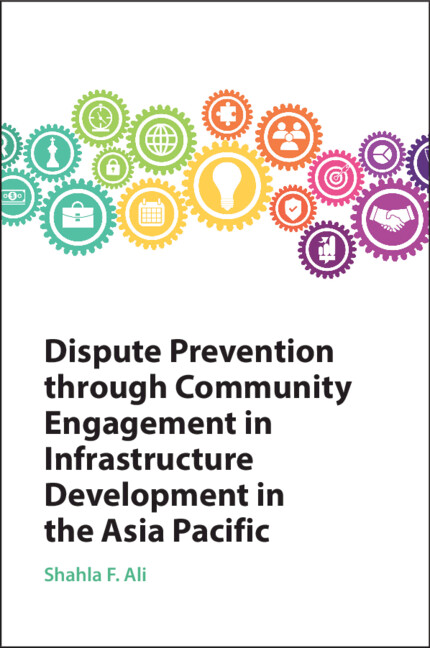
This book explores the emergent development and challenges in implementing community–investor consultation, dispute prevention and facilitation mechanisms amongst multilateral and national development banks operating in the Asia Pacific region. In the several decades since the development of the first multilateral community–investor dispute resolution and accountability mechanisms, much has been learned about public facilitation, community engagement and dispute prevention during the early stages of major infrastructure development programs.
Drawing on a qualitative triangulating approach that compares public facilitation policy design with case-based practice, the book analyses the International Finance Corporation (IFC), Asian Development Bank (ADB) and Asian Infrastructure Investment Bank (AIIB) community–investor dispute resolution policy design. Case studies, surveys and interviews of select private non-state actors in the Asia Pacific region address the question of whether, and if so how, multi-stakeholder community–investor public facilitation methods contribute to the prevention and early resolution of infrastructure disputes and advance sustainable development objectives.
* The author thanks the Government of Hong Kong’s University Grants Committee for its support through CRF Grant (C7030-24G).
[1] Mahmoudi, H., Roe, J., & Seaman, K. (Eds.). (2022). Infrastructure, Wellbeing and the Measurement of Happiness. Abingdon: Taylor & Francis.
[2] Ibid.
[3] Ibid.

Shahla F. Ali is a professor of law at the University of Hong Kong where her teaching and research focus on arbitration, governance and law and sustainable development in a compara...
View profile >Keep up with the latest from Cambridge University Press on our social media accounts.




Latest Comments
Have your say!