

Products and services


This year marks the 250th anniversary of the American Declaration of Independence. Few documents in world history have been as extensively studied and analyzed, and it is fair to ask if there is anything new to be said about the Declaration.
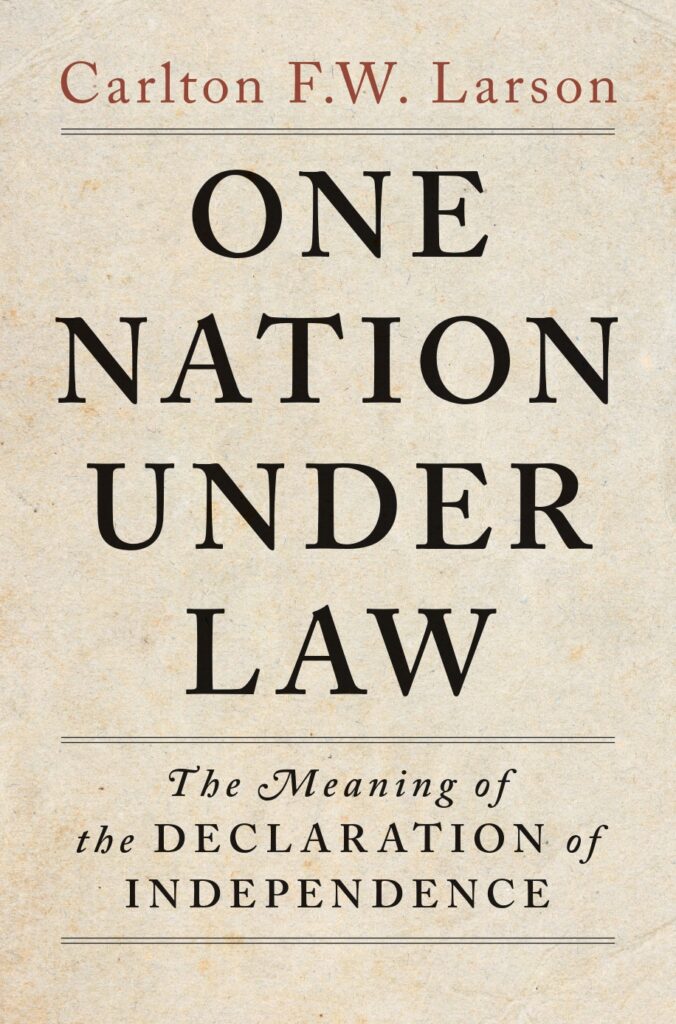
There certainly is. Much of the scholarly and popular writing on the Declaration has been marred by fundamental misunderstandings of the document and its historical context. My book One Nation Under Law: The Meaning of the Declaration of Independence counters two such misunderstandings.
First, scholars such as Garry Wills have insisted that the Declaration did not create one American nation, but thirteen entirely separate ones, each bearing no more legal relation to each other than they did to France or Russia. This view is profoundly mistaken. The Declaration of Independence announced the legal existence of the “United States of America,” in which the states were legally confederated together from the moment of independence. That confederation would later be reduced to written form and explicitly confirmed in 1781, but in its first five years, the United States operated under an unwritten constitution, a form familiar from English practice. Although the details of its internal structure were far from clear, and difficult questions of sovereignty were never conclusively resolved, anyone looking at the United States from abroad would have seen the emergence of one nation, not thirteen. Such a view is amply supported by the Declaration’s text, by the history surrounding its adoption, and by the views of later Americans in the political, judicial, and popular spheres, looking back at what the Declaration had accomplished. One little-known illustration of this point: the first appeal from a state court to a federal tribunal was filed on July 4, 1776 (resulting in a reversal of the state court decision), a fact entirely inconsistent with the thirteen-independent-nations view.
Second, the Declaration is often portrayed as an ode to a minimalist night-watchman state. Yet the Declaration’s extensive charges against George III are as much about ineffective and incompetent government as they are about tyrannical actions. The very first charge is that the King had vetoed laws that were “the most wholesome and necessary for the public Good.” It is a demand for more and better law, not less. The charges also have much to say about constitutional structure, illuminating how legislative, executive, and judicial power should be appropriately constituted to most effectively secure the people’s right to self-government.
Along the way, the book seeks to counter other myths that have hindered our understanding of the Declaration. For example, the correct text of the Declaration of Independence is not to be found in the parchment copy currently enshrined in the National Archives. Instead, it is in the first printing issued by Philadelphia printer John Dunlap on the night of July 4, 1776, and subsequently reprinted in newspapers across the country. Similarly, it is a mistake to view Thomas Jefferson as the primary author the Declaration; the Declaration was authored by the Continental Congress in the voice of the American people. And although the Declaration is not “law” in a strictly formal sense, it is nonetheless a legal document of continuing legal significance.

Carlton F. W. Larson is Martin Luther King, Jr. Professor at University of California, Davis School of Law, where he teaches constitutional law and legal history. He is the author ...
View profile >Keep up with the latest from Cambridge University Press on our social media accounts.




Latest Comments
Have your say!