
Products and services


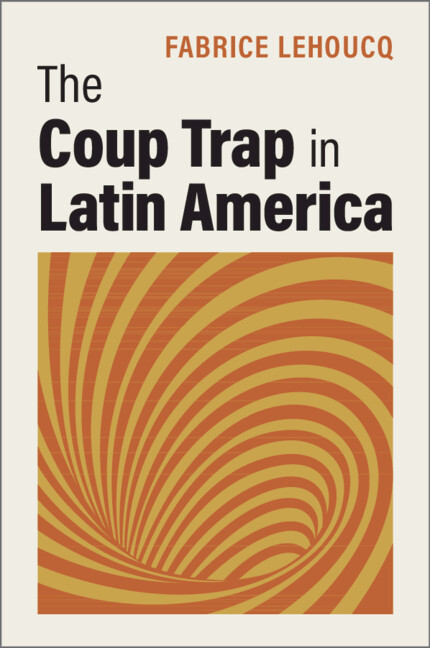
Why do governments get overthrown? Why are many political systems chronically unstable? The Coup Trap in Latin America answers these questions by explaining why political systems fall prey to endless cycle of golpes and contra golpes. It provides an innovative explanation of why officers and civilians (“the coup coalition”) overthrow presidents – and will be of interest to political scientists, historians, sociologists, journalists, and, of course, everyone interested in the causes and persistence of political instability.
This book uses a new dataset of more than 320 military coups in eighteen countries between 1900 and 2014, slightly less than half of which managed to unseat the president. It develops a theory and a pioneering research design to conclude, in a nutshell, that the structure of political competition – its formal and informal rules – determines whether a political system falls into the coup trap.
But this book also explains why half a dozen political systems escaped from chronic instability, either by forging constitutional, often democratic, political orders or by establishing durable autocracies. In Chile, Colombia, Costa Rica, and Uruguay, civilian-led coalitions survived assaults on their authority to negotiate electoral salidas out of the coup trap. In Mexico and Nicaragua, incumbents punished sedition by purging the security forces of their rivals and co-opted or exiled their civilian opponents to build dictatorships notable for their longevity.
The Coup Trap in Latin America pioneers a prediction-centered multimethod research strategy to integrate cross-national, statistical models with case studies in a novel way. It uses event history models to generate probability estimates of the likelihood of successful military coups, which accurately predicts 80 percent of them. Qualitative sources, especially those that draw upon interviews, memoirs, and newspapers, also verify that the political mechanisms invoked by my theory do in fact explain why and when coup coalitions overthrow presidents.
Case studies also generate an additional pair of insights. On the one hand, they suggest that half of the false-negative predictions (type 2 errors) – or 10 percent of the coups that my statistical model did not predict – occurred in the initial decades of the twentieth century, when officers revived an old technology, that of the military coup d’etat, to replace executives. The other 10 percent were the product of titanic struggles between the elected branches of government, many of which also were the result of ideologically charged confrontations between the left and the right. Both types, I show, are consistent with the political thrust of my theory of the coup trap.
On the other hand, a careful reading of secondary and primary sources reveals that false-positive predictions (type 1 errors) – prognostications of ousters that turn out to be false – uncover something intrinsic – toxic – about the politics in the coup trap. It is what I call the “atmosphere of crisis” – the widely held expectation that, given its unpopularity and failures, a president’s days in office are numbered. Case studies confirm that coup coalitions capitalize upon the conflict and uncertainty characteristic of chronic instability to topple presidents – and how, to use Machiavelli’s language, virtú (e.g., prowess) and fortuna (e.g., the fortunate confluence of circumstances and trends), also help to explain when and therefore why sedition succeeds.

Fabrice Lehoucq is a Professor of Political Science at the University of North Carolina Greensboro. He is the author of Stuffing the Ballot Box (2002) and The Politics of Modern Ce...
View profile >Keep up with the latest from Cambridge University Press on our social media accounts.



Latest Comments
Have your say!