

Products and services

In 1915, Robert Chenault Givler published the results of his PhD thesis, which he had undertaken at the Harvard Psychological Laboratory. The work was entitled ‘The Psycho-physiological Effect of the Elements of Speech in Relation to Poetry’ and consisted of Givler strapping a series of readers to an early blood-pressure device in the hopes of measuring which poems from literary history were the most affective, which poems really got the body moving. The result? Drawing from 540,000 poetic speech sounds, Givler suggested that Lord Byron was the most arresting poet in literary history, having beaten his runner-up, Keats, by ‘eighteen meters’.
Studies like Givler’s were stunningly and even banally commonplace throughout the late nineteenth century and the early twentieth, partly because the professionalisation of literary studies had not yet fully occurred and people were debating what kind of language, method and politics should encrust literary criticism. Scientists and scholars counted the word-frequency of hundreds of novels and measured the lengths of sentences from different periods of literary history; they debated which ‘scientific’ method should be applied to literary criticism, from the statistical to the classificatory or the inductive. In fact, key questions about how to read a text-about how it is possible to produce knowledge about literature-were very much in the air during this period. What explanatory mechanisms, what techniques and technologies of critical explanation, underpin criticism’s forms of knowing? What links can and should be established between the knowledge that is supposedly proper to literary studies and political economy, between the singularity of an emerging disciplinary reason and the fantasms of ideology?
This book charts this search for a science of verse from 1880 onwards, and in writing it, I had three major goals. The first was to try and understand this post-Enlightenment-post-Kantian, in a way-project, to track its movements, politics and impact on the present. For example, when reading papers by researchers in the fields of Artificial Intelligence and Large-Language Models, it was striking to me that they would often invoke these nineteenth- and early-twentieth-century studies in poetics as historical models for their technology. For all the theories of language that literary criticism has championed throughout the twentieth-century-from structuralism to ordinary language philosophy-it was the statistical, measurable and mathematisable dimension of language at work in the late nineteenth-century scientific study of poetry that seems to have become the most important and relevant today. The dystopian politics that often accompany AI technologies could find a historical precedent here too, as the desire for a pure science of verse carried (and carries) with it a set of political commitments: to clarity and clear communication, for example, which were often part of the rationale for studying literature scientifically.
Books are, of course, products of their milieu-and I wrote a good chunk of this one under lockdown during the COVID-19 pandemic in Melbourne and Sydney. I simply could not believe what was happening with Universities around the world and especially in my home country (or rather, I could believe it but couldn’t understand it!): that the cuts, the restructures, the damage, the willingness to simply hand-away disciplines with long and proud histories, could all happen so easily, with so little actual resistance. And as Universities were doing this, I spent a lot of time on Twitter reading the protests of my fellow comrades, shocked by how impotent their well-meaning contributions came across. That led me to the second task of this book, which, I think, is largely its prevailing spirit. Disciplinary histories often talk about this moment in time as synonymous with the ‘professionalisation’ of literary studies-the moment where producing knowledge about literature became a profession, where reading literary work amounted to what Laura Riding would acerbically call a ‘technique of comment’. The conception of knowledge adopted by certain corners of literary criticism was shaped by these scientific studies of literature. In this epistemological vision, the knowledge produced by literature is self-generating, infinitely proliferating, and artificial, having no natural critical object. I think you really see this today in the fact that we still, almost endlessly, discuss and debate ‘method’ in literary studies. A physicist, for example, doesn’t worry about the nature of physics when they’re doing an equation-and the same might be said about a historian, who doesn’t necessarily worry about the nature of historiography when writing a historical study. Only in literary studies are we so anxious about ‘method’ that, through reading one poem published in a journal, we might call into question the structure of the discipline itself. The book is in part, then, a history of the discipline’s meta-anxieties, which I attempt to show developed out of its conversations with scientific criticism.
This book also embarked on a third task, the most important of them all: the question of how poems actually work and think, of their ‘truth’ in an era of scientific reproduction, of how their thinking might constitute a form of truth barred by post-Enlightenment thinking. The scientific spirit of this burgeoning professional culture saturated the verse-thinking of several twentieth-century poets, who worried about the rationality of their own poetry in an era that was increasingly only able to recognise scientific knowledge. William Carlos Williams, Laura Riding, George Oppen and Veronica Forrest-Thompson-each of whom were incredible verse-technicians, recognising the importance of prosodic organisation to their verse-produced poetry that sought to dialectically rethink the science they encountered. Williams’s theory of poetic ‘measure’, for example, re-thought the epistemology of the measurement-based studies of poetry such as Givler’s; Riding’s theory of poetic exactitude sought to rival a newfound discourse about exactness in critical reading.
Beyond the historical specificity of their theories, The Search for a Science of Verse puts forward a general theory of poetic ‘truth’ in an era of post-Enlightenment knowledge, which I locate in the category of poetic artifice. As the book argues, the very best verse actualises instances of meaning-making that are entirely singular-fleeting instances wherein the phonic and visual component parts of a poem take on new, unprecedented and fundamentally unrepeatable meaning. This occurs, for example, when Williams transforms the word ‘deadliness’ into ‘dead lines’ in a passage dedicated to poetry and new forms of measurement or when Oppen’s verse re-tunes our ears to a recurrent sound-particle (‘us’) as it travels across distinct poems in his oeuvre (such as ‘numerous’). This ‘non-identical’ meaning cannot be repeated out of context or predicted and modelled by scientific rationality, and so constitutes a knowledge in excess of scientific determination. As I argue in the book, the positivist fascination with poetry paradoxically ends up illustrating what scientific positivism cannot know about its object. The truth of aesthetic singularity is actualised through artifice and craft, and if literary studies has a future, then it’s in unleashing the sheer and uncontrolled truth of its objects.
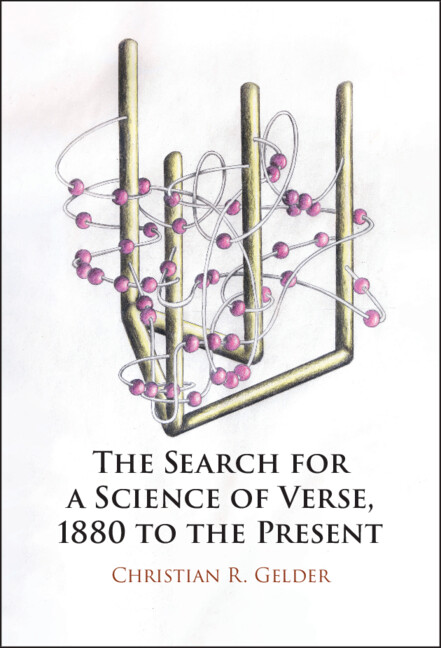
The Search for a Science of Verse, 1880 to the Present by Christian R. Gelder
Christian R. Gelder is a Research Fellow in Literature at Macquarie University, Sydney. His work has appeared in Modernism/modernity, Literature and Medicine, Psychoanalysis and Hi...
View profile >Keep up with the latest from Cambridge University Press on our social media accounts.



Latest Comments
Have your say!