

Products and services

As a pre-teen, I was fascinated with how cosmological and biological evolution led to humanity. Every new book checked out from the library led me to rewrite increasingly long, detailed lists of every step along the way. One day as I was writing the newest one, my father suggested that I call my list “How the Universe Discovered Itself”. Since that moment I struggled to hold together two very different ways of understanding what it is to be a human being.
On the one hand, there is the humanistic project that takes its orientation from Terence: “I am human, therefore nothing human is alien to me”. Despite all the very many failures, biases, and lapses, I maintain that there is a grandeur to the ideal of an egalitarian, inclusive, and cosmopolitan that runs from antiquity to the Enlightenment to the radical humanism of today. On the other hand, there is the naturalistic project of explaining the real hidden causal forces that constitute the universe and that account for our place in it. How the humanistic and naturalistic projects hang together is the story of how the universe discovered itself; in a less pantheistic tone, how one infinitesimally small part of the universe developed the capacity to develop increasingly more accurate models of the universe in which it finds itself, and of itself in relation with that universe.
Many decades after I stopped writing my lists, I discovered the American philosopher Wilfrid S. Sellars (1912-1989). I adopted the zeal of the converted. In “Philosophy and the Scientific Image of Man,” I discovered a philosopher who brought all the tools of analytic philosophy to bear on the problem of how to hold together in a single vision the humanistic and the naturalistic. The 19th and 20th century call for a scientific humanism had received, in Sellars, an articulation and defense of extraordinary conceptual sophistication, honed with the tools of analytic philosophy.
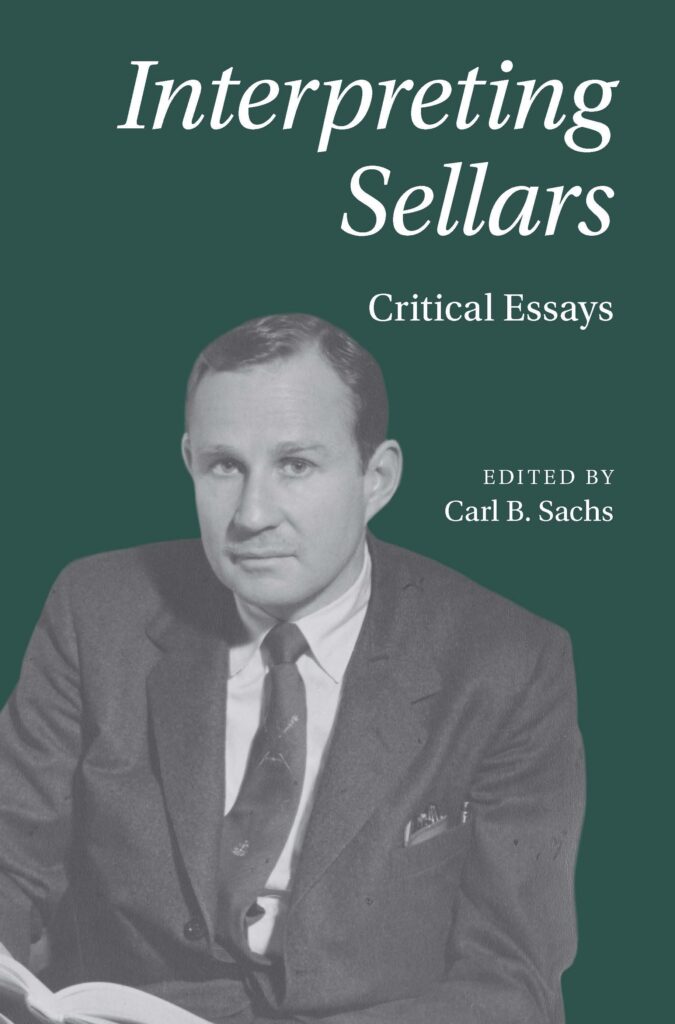
I was honored that Cambridge asked me to edit the new collection of essays, Interpreting Sellars. For the philosophers in this collection Sellars is not just a figure from the history of philosophy but also a source of enduring insights that can be brought to bear on a range of contemporary problems, from the rationality of ethics to the semantics of AI. Though Sellars was very much an analytic philosopher’s analytic philosopher, two of the essays in this collection (Sacilotto and Christias) testify to how rich the interaction between Sellars and Continental philosophy can be, while others (Seiberth, Buholzer, Legg, Beasley, and Breunig) show much more work there is to be done locating Sellars in the history of philosophy.
There is much work to be done in developing and defending scientific humanism in the 21st century; I hope that others will join me in finding Sellars an invaluable resource for doing so.

Carl B. Sachs is Professor of Philosophy at Marymount University. He is the author of Intentionality and the Myths of the Given (2014) and is vice-president of the Wilfrid Sellars ...
View profile >Keep up with the latest from Cambridge University Press on our social media accounts.



Latest Comments
Have your say!