
Products and services

In March 1979, the government of dictator General Jorge Rafael Videla, submitted a law proposal to overhaul Argentina’s revenue-sharing regime. Following the rules of this regime, the bill was duly presented to the Legislative Advisory Commission, a legislative body created by the dictatorship and staffed by military officers. The provincial governors, who were also appointed military officers, communicated their opposition to this bill to the members of the Commission in meetings and letters. In its final report, the Commission rejected a crucial element in the government’s bill. This element was eliminated from the bill which caused the enacted law to differ significantly from the executive’s original version.
In November 1957, the government led by Spanish dictator Francisco Franco, submitted a law proposal that overhauled the tax and expenditure rules employed by the central government. Following the rules established by the regime, the bill was submitted to the Spanish Cortes. Its members proposed 44 amendments to the bill. However, Franco rejected most of those amendments and the bill was enacted essentially as proposed by the government in the first place.
What explains this variation in the outcomes of lawmaking processes across these two autocracies? Why are legislatures in some authoritarian regimes more powerful than others? Why does influence on policies and politics vary across dictatorships?
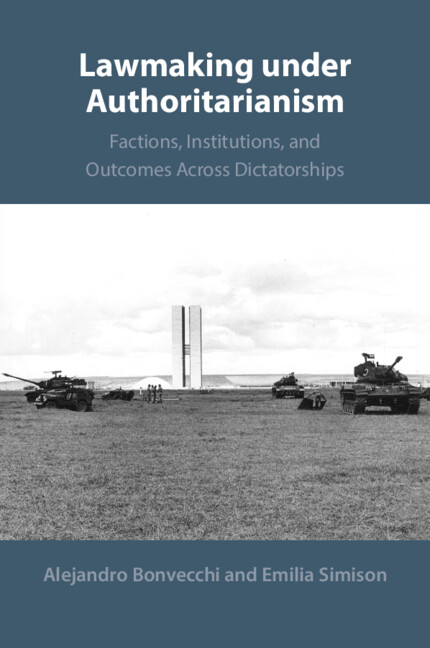
These questions guide our book, Lawmaking under Authoritarianism. In it, we argue that lawmaking institutions and outcomes in autocracies depend on the nature and dynamics of factional politics. When the factions within the regime are united and embedded, they are powerful enough to resist imposition by coalition partners. This leads to high levels of power-sharing and legislatures with greater influence. On the contrary, when the factions are not united n/or embedded, they are not powerful enough to resist imposition by coalition partners. This results in lower levels of power sharing and legislatures with a more limited role in policymaking.
To test these ideas, we combine methodologies and primary and secondary sources to comparatively analyze three authoritarian regimes with different factional politics: the Proceso de Reorganización Nacional in Argentina between 1976 and 1983; Franco’s regime in Spain between 1943 and 1976; and the military dictatorship in Brazil between 1964 and 1985.
In each case, we dive into archival collections, official documents, biographies, oral history archives, and historiographic accounts to identify, describe, and explain the nature and trajectory of the factions in the regime, the characteristics of the lawmaking institutions and outcomes, and the mechanisms linking them to the factional politics of the regime.
This book improves our understanding of lawmaking under authoritarianism, specifying how and under which conditions legislatures perform their lawmaking function within authoritarian regimes, and by helping to elucidate how legislatures may be consequential to policy and politics. It also provides new perspectives on how the authoritarian regimes of Argentina, Brazil, and Spain operated and their place within the universe of authoritarian governments.

Alejandro Bonvecchi is Professor of Political Science at Universidad Torcuato Di Tella. He is also an Independent Researcher at the National Council of Scientific and Technical Res...
View profile >Emilia Simison is Lecturer in Latin American Politics at Queen Mary University of London. Her research focuses on the comparative political economy of policymaking and policy chang...
View profile >Keep up with the latest from Cambridge University Press on our social media accounts.




Latest Comments
Have your say!