

Products and services

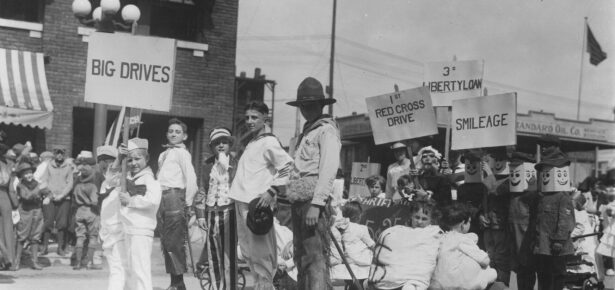
Several boys are standing at attention in the middle of the street during a parade in Kansas City, Missouri, May 18, 1918. Courtesy of the National Archives at College Park, Maryland.
On May 18, 1918, fourteen thousand high school students from St. Louis, Missouri, public schools, accompanied by fourteen drum corps and seven professional bands, paraded through the city’s Forest Park. Each school marched behind the US flag and its banners. Boys were dressed like soldiers and girls like nurses, in white uniforms bearing a tiny red cross. Battalions of young drummers, followed by legions of adult nurses, closed the parade. As the young people passed by, spectators applauded the inspiring sight. One journalist noted that “the present generation of children are learning that Service means sympathy as well as sacrifice, a desire and willingness to help others as well as a feeling that it is one’s duty and obligation to do so.” Across the nation that day, children paraded through their cities and towns, singing the national anthem, and saluting the Stars and Stripes. Two thousand such parades took place – an unprecedented public celebration of youthful patriotism.
Months before Congress declared war on the Central Powers, patriotic leagues, women’s societies, and humanitarian organizations had already mobilized children. In 1914, for instance, when Lillian Bell organized a Christmas ship for Europe’s children, American youth provided it with gifts, food, and clothing. When Paris-based American women established the American Fund for French Wounded in New York City in 1915, children raised funds to collect blankets, pillows, and clothes for hospitalized French soldiers.
However, all the initiatives that had sought to engage American youth were rapidly eclipsed by the two junior organizations that emerged following US intervention. Both the American Junior Red Cross and the United States School Garden Army, established in September 1917 and February 1918, respectively, surpassed all the local and state initiatives that had developed. Both national organizations excelled in mobilizing children. Working through the infrastructure of the nation’s schools, the American Junior Red Cross led children in humanitarian activities, instilling the idea that they belonged to an exceptionally altruistic nation. Students sewed clothes, made items for hospitals, collected books for US troops, and crafted wooden toys for European orphans. Similarly, the United States School Garden helped adults feed the nation. Armed with spades and pitchforks, children “hooverized” and canned food as part of the war effort when the United States could not simultaneously feed Europe and its own population.
Through these two national entities, American children learned they had a role to play and the duty to serve the nation. For many, the experience of American youth during World War I blurred the line between childhood and adulthood, fostering the sense that those lucky enough to live far away from war-torn Europe had a responsibility to aid those in distress. Both the American Junior Red Cross and the United States School Garden Army reveal to a certain extent how the federal government positioned itself when it came to the place and role American children should play in wartime. Children, they contended, could not be cocooned from the real world, especially in such catastrophic times. Young people should be engaged in wartime civic and patriotic activities. They needed “to do their bit” and help protect the nation. Federal authorities sought to instill feelings of belonging and loyalty in the nation’s youth and thus shaped children’s everyday experiences in wartime.
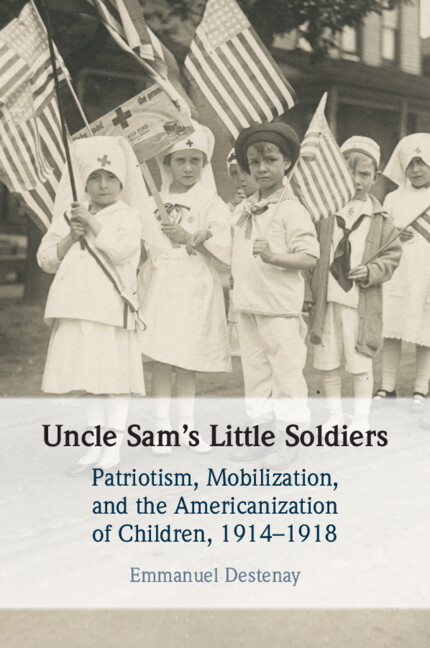
Uncle Sam’s Little Soldiers by Emmanuel Destenay

Emmanuel Destenay is a research fellow at Sorbonne University and is specialized in World War I. He has contributed articles to numerous journals in both French and English and is ...
View profile >Keep up with the latest from Cambridge University Press on our social media accounts.



Latest Comments
Have your say!