

Products and services

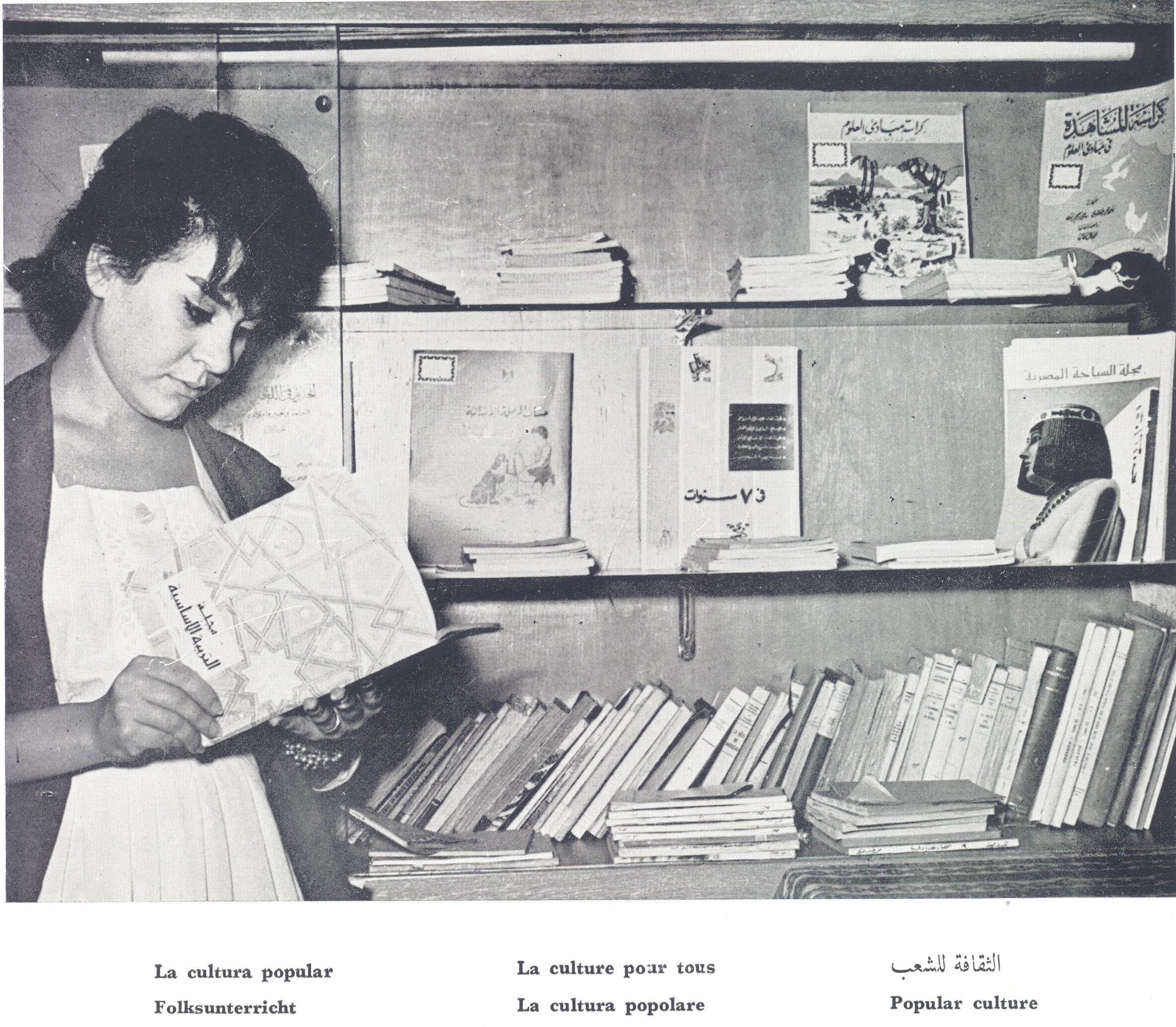
From The United Arab Republic, 1963 (Cairo: Information Department)
When I started researching the Egyptian Ministry of Culture (formerly National Guidance), I wondered why the government would dedicate an entire ministry to something as abstract as ‘culture’. I was familiar with the theoretical debates about the concept of culture in modern-day social science, but it struck me that the term’s use among Egyptian bureaucrats was somewhat more instrumental.
The banner image illustrates what I mean. This photograph was printed in a glossy hardback book simply called The United Arab Republic, 1963. The book is full of pictures about Egypt’s achievements since the 1952 revolution, in sectors such as industry, agriculture, transportation, construction, education, and indeed, ‘culture’. Images of new mechanical equipment, new buildings, new infrastructure, peasants in fields, workers in factories, or students in schools collectively illustrate the nation’s progress. Progress in ‘culture’, here, is portrayed through an ostensibly middle-class young woman, donning a fashionable dress and haircut, attentively leafing through the latest books printed by the Ministry of Culture.
The image is a visual instantiation of a famous slogan at the time, ‘Culture for the People’, which is used as a caption. After the revolution, the Egyptian Ministry of Culture and National Guidance became invested in circulating cultural products across the country, both as a way to cultivate the wider population and as a way to show what ‘the state’ was doing for its citizenry. The books displayed in the banner image, as well as the very book in which the image was initially printed, show the postrevolutionary state’s work in circulating tangible ‘cultural’ materials to tangible libraries across the newly independent nation.
Constructing the Achievement State is, in part, an attempt to understand how Egyptian bureaucrats have instrumentalised such ‘culture’ in different ways from the 1950s to this day. It is also an attempt to describe the unified idea of ‘the state’ to which bureaucrats have committed over the same period. ‘The state’, here, is imagined by officials at different administrative ranks as an achievement machine, making things happen for the People in a rapid, cumulative, progressive, and self-referential way. The achievement state is not just an abstract rhetoric, but an everyday practice among bureaucrats, which is visible in governmental books as well as images and statistics; in everyday administrative work as well as great projects.
Building an emerging idea of the state is what culture was for. In postrevolutionary Egypt, a certain form of cultural work became necessary to unify the republican state apparatus and mobilise its bureaucrats around a common project. This is not only interesting in light of academic debates about the concept of culture, but more so in light of the concept’s imbrication in state rhetoric and practice. Whether or not one finds it analytically useful, ‘culture’ is being appropriated and put to work by governments in pursuit of their rather prosaic agendas. It is striking, to me, that the culture concept’s various uses by national cultural institutions remains underdiscussed among its academic critics. This is, perhaps, a project worth considering in future.
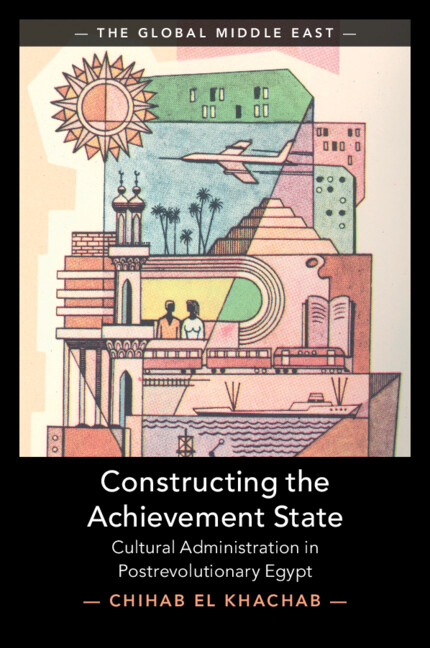
Constructing the Achievement State
by Chihab El Khachab

Chihab El Khachab is Associate Professor in Visual Anthropology at the University of Oxford. He is the author of Making Film in Egypt (2021) and Al-Fahhama (2022). He delivered the...
View profile >Keep up with the latest from Cambridge University Press on our social media accounts.



Latest Comments
Have your say!