
Products and services

As we live through the transformation of the post-Cold War international order, politicians, diplomats, and scholars have fastened upon the pre-First World War era as a guide to what might emerge in its place. They portray a world, then and now, beset by rivalries between rising and falling powers, wars of territorial conquest, spheres of influence, imperial predation, and economic competition. The warning from history is clear – this kind of international politics magnifies the risk of systemic war between the major powers.
As ever, historians emphasise the complexity of the past, a complexity that can also provide a starting point for asking other questions of our present. Historians have to explain not only why war broke out in 1914, but also how the European great powers maintained peace between themselves for over four decades after the Franco-German War of 1870-1, the longest period of great power peace in Europe until the late 20th century. What were the restraints on great power rivalry and why did those restraints fray before snapping in 1914?
My book seeks to answer this puzzle, by examining the effects of economic interdependence (part of a wider process of globalization, with which we are also familiar in the present day) on great power politics in the late 19th and early 20th centuries. The decades before 1914 witnessed a deepening of flows of people, goods, and capital between European societies. This economic transformation reshaped power politics in ways that explain both the maintenance of peace and the coming of war and how the balance between cooperation and conflict shifted in the early 20th century.
Commercial and financial ties between countries restrained great powers from risking major war. The prospect of losing access to critical supplies and markets, financial catastrophe, and the resulting political and social upheaval meant that political leaders were acutely sensitive to the limits of military force as an effective tool of great power politics. Some observers, such as Norman Angell, made well-founded arguments that wars between the leading powers could not serve any economic rationale.
The economic ties that bound societies also provided great powers with different instruments of power politics. Loans, trade treaties, expert missions, and infrastructure projects all became ways to pursue foreign policy objectives. The ‘plumbing’ of the international economy – shipping, telegraph networks, and the Gold Standard – were sources of influence for powerful states. Measures of power moved from counting naval vessels and soldiers to an appreciation of the multiple dimensions in which power could be exercised in an economically interdependent world.
These changes in the conduct of power politics created winners and losers. Governments in Britain and France were most effective at using economic interdependence to project their influence, enhance security, and achieve foreign policy goals. Despite its industrial growth, the German economy was vulnerable, particularly to financial setbacks. And leaders in Italy, Austria-Hungary, and Russia found they were unable to secure vital interests through economic instruments. Those powers that were vulnerable and losing out were readier to resort to military force to compensate for their limited economic influence. Between autumn 1911 and spring 1914, leaders in Berlin, Rome, Vienna, and Saint Petersburg militarised their foreign policy following setbacks in strategically significant areas and issues. Once they embarked on military build-ups, colonial wars, and ultimatums backed by military threats, other states responded with their own military measures.
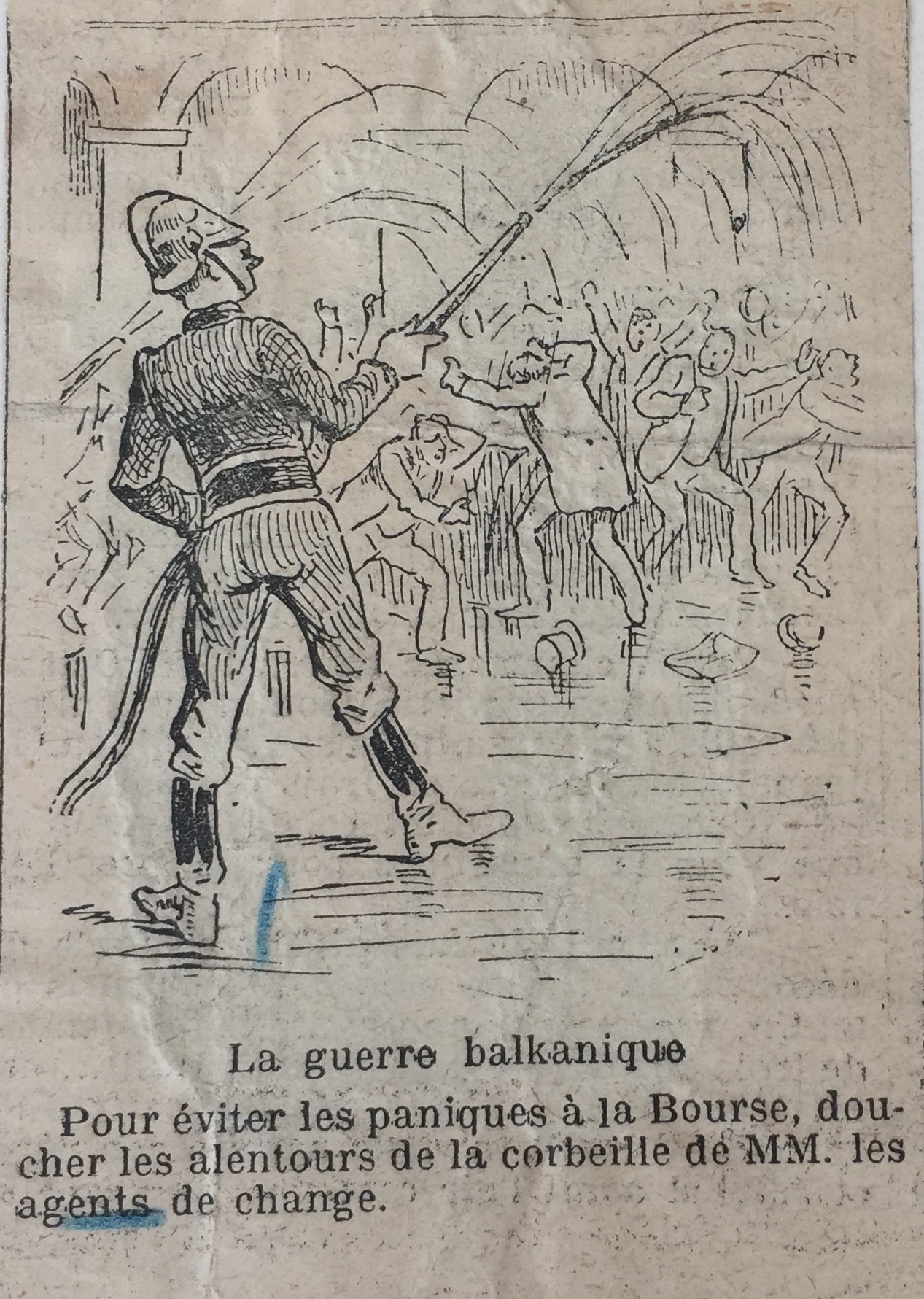
Caption: ‘To avoid panics on the stock exchange, shower the area around the stockbrokers’ trading floor’ (Cartoon from November 1912, during the First Balkan War).
None of the leaders that took these decisions wanted a general European war, but the cumulative effect of their decisions was to militarize economic interdependence and produce the very catastrophe that they had sought to avoid for over forty years.
The Fraying Bonds of Peace
by William Mulligan

William Mulligan is professor of history at University College Dublin. He has written widely on international history, including The Origins of the First World War (2010) and The G...
View profile >Keep up with the latest from Cambridge University Press on our social media accounts.


Latest Comments
Have your say!