

Products and services


This book brings together two vibrant academic discourses that have rarely interacted beforehand: religious epistemology and comparative hagiography. Inspired by Austin Farrer’s provocative claim that ‘the saint is our evidence’, it presents what I propose we call the ‘hagiological argument for the existence of God’- that is, the idea that human lives of remarkable holiness are evidence for divine reality. The book consists of three parts, each of which are intended to make an independent contribution to their respective subject-matter, but also to form a cumulative case for the book’s final conclusion.
Part I: Evidence
Chapter 1 begins by surveying the landscape in contemporary religious epistemology, mostly focusing on analytic philosophers such as Alvin Plantinga and Richard Swinburne. It concludes by looking at the neglected epistemological work of pragmatist Jeffrey Stout and his debate with Sabina Lovibond on the contested rationality of religious belief within the ‘hypercontext’ of modernity.
Chapter 2 maintains the basic focus on evidence but shifts from the primarily analytic mode of the first chapter to consider Farrer’s understanding of ‘saints’ as ‘evidence’ for God, drawn primarily from his sermons. It then provides a biographical study of the man Farrer thought was a saint: the Anglican priest, labor union organizer, and British Army officer Hugh Lister (1901–44).

Image: Alfonse Borysewicz, St Joseph (2008–10), St. Francis College, Brooklyn, New York. Photo: Eduardo DiFarnecio.) [This is the painting for the cover image of the book and thus used with permission.
Part II: Sainthood
Chapters 3 and 4 present multiple definitions of saints drawn from six different academic disciplines: philosophy of religion, ethics, Christian theology, church history, comparative religion, and cultural studies. The global phenomenon of human holiness cannot be confined to a single religion or disciplinary framework, and it is too important to be ignored by those who are concerned with the rationality of religious belief or the truth-claims of theology. These chapters thus survey many meanings attributed to the term ‘saint’ and therefore what it might mean to claim with Farrer that ‘the saint is our evidence’.
Part III: The Hagiological Argument-Three Versions
Chapter 5 considers the ‘propositional’ version of the argument defended by Sarah Coakley and Alexander Pruss. Here sainthood is understood in terms of radical altruism, and evidence is understood in propositional explanatory terms. More specifically, the concept of ‘inference to the best explanation’ is invoked to argue that the best explanation of some radically altruistic lives is that they both point to and participate in a self-giving transcendent divine reality, namely the Christian Trinity.
Chapter 6 considers the ‘perceptual’ version presented autobiographically by Peter van Inwagen but supported conceptually by figures such as William James and David Brown. Here sainthood is understood in terms of providing an embodied source of religious experience, and evidence is understood in perceptual terms. More specifically, the perception of divine reality is indirect and materially mediated through the saintly source, and examples are provided from Christianity, Judaism, Islam, Hinduism, Buddhism, Taoism, Japanese folk religion, and secular media.
Chapter 7 considers the ‘performative’ version presented in various ways by Paul Moser, Rowan Williams, and Stanley Hauerwas. Here sainthood is understood in terms of intentional witness to the reality of God, and evidence is understood in performative terms as somehow ‘personified’ or enacted over the course of a whole life-narrative. However, this chapter also discusses Jean Vanier and considers the possibility that ‘performances’ can also undermine the evidence for specific religions such as Christianity.
Conclusion:
The conclusion draws these various epistemological and hagiological threads together. Following a generative proposal by C. Stephen Evans, I conclude that saints in the relevant moral and religious senses identified in Part II are ‘natural signs’ pointing to the existence of God or the divine, and that each of the three versions of the hagiological argument needs to be considered on its own terms in regard to the relevant sign and its respective evidential value before their individual and cumulative force can be properly evaluated.
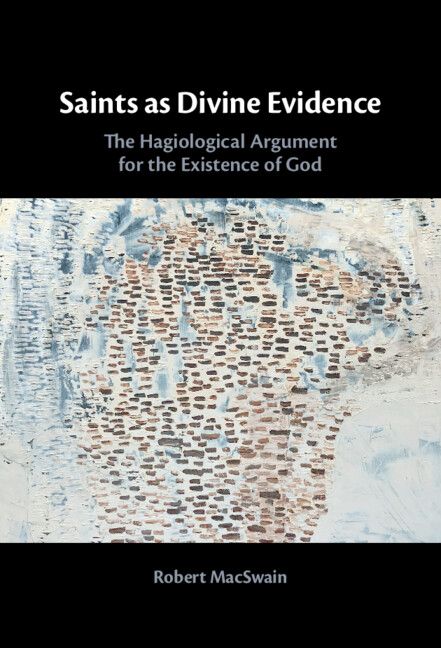
Saints as Divine Evidence by Robert MacSwain

Robert MacSwain is Associate Professor of Theology at the University of the South in Sewanee, Tennessee. He is the author of Solved by Sacrifice: Austin Farrer, Fideism, and the Ev...
View profile >Keep up with the latest from Cambridge University Press on our social media accounts.


Latest Comments
Have your say!