

Products and services


Political arguments often appeal to fundamental moral intuitions about right and wrong. Politicians highlight the moral basis of their views and positions. For example, in the context of the recent U.S. and Israeli attacks on Iran, Senator Steve Daines explicitly appealed to morals in his post on X saying that he “support[s] President Trump’s actions to keep our nation safe and aid the people of Iran… and the President’s strong moral clarity.” Even positions against the attacks can have moral argumentation. Pedro Sánchez, the Prime Minister of Spain, is prominently against the strikes and said in his official statement that Spain is “[against] the breakdown of international law that protects us all,” “not going to be complicit in something that is bad for the world,” and “on the side of international law and peace.”
These appeals to moral intuition are interesting in part because they are not the only way to explain and justify one’s views. Positions can also be framed using more pragmatic arguments that focus on costs versus benefits-oriented consequences. Senior officials of the Trump administration remarked in their briefings that a diplomatic solution was “not a tangible and realistic option” and that the “amount of casualties and damages would be substantially higher” if the US had waited and Iran had struck first. Sánchez’s message also emphasized that the attacks have “serious consequences for the economy” and are a repeat of the mistakes of the past.
These rhetorical dynamics exist in other issue domains too—whether international or domestic—and between political sides within a country as well. But how should we wrap our heads around such moral rhetoric in political communication? What do they look like across contexts? Are they consequential for political competition? What does it mean for democratic representation?
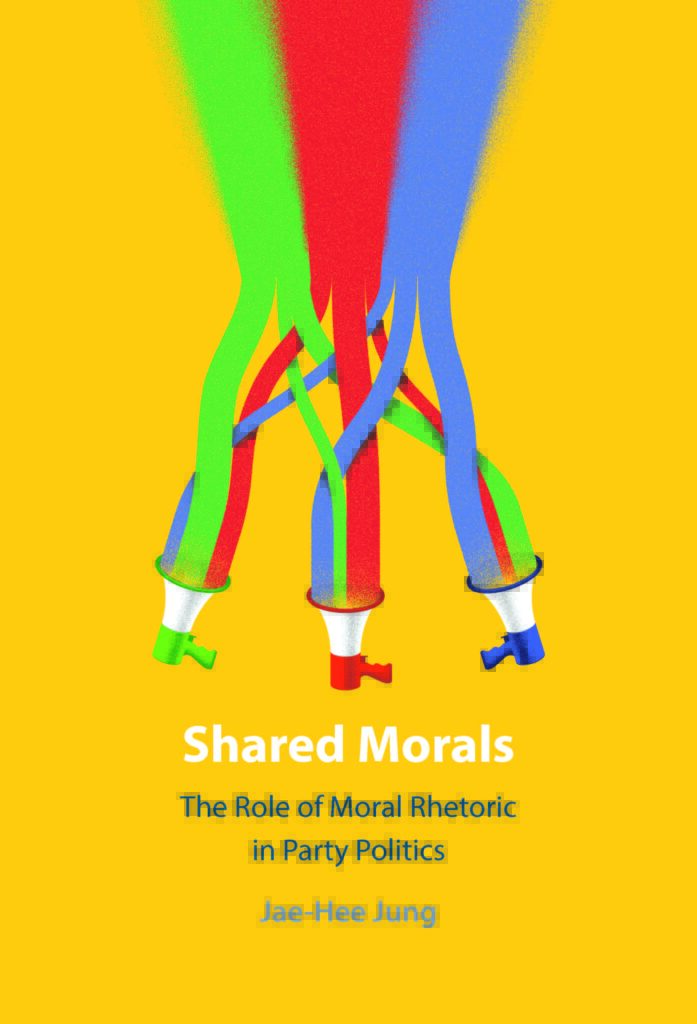
My new book, Shared Morals: The Role of Moral Rhetoric in Party Politics, provides answers. Using election manifestos from English-speaking democracies; interviews, surveys, and survey experiments in the British context; and survey data from six Western democracies, I show that moral rhetoric is a distinct aspect of political communication, can be consequential for voter attitudes and behaviors, and is integral to democratic representation. Analyses indicate that there is a lot of common ground in the ways that parties use moral language. Moral rhetoric is certainly not a silver bullet but can be used to mobilize and persuade. Many voters in fact expect morality to be a part of politics.
The book therefore leans into the potential for moral rhetoric to be inclusive, appeal to shared common grounds, and bring together rather than divide. This complicates extant research and narratives around morality in politics, which have predominantly focused on its contributions to disagreement and polarization. But morality, at its core, consists of deeply rooted, intuitive notions of right and wrong that people can understand and empathize with. The book highlights the importance of investigating the nuances and complexities of morality: how it can be a bad as well as good force for democratic politics.

Jae-Hee Jung is an Assistant Professor in the Department of Political Science at Rice University. Her research focuses on party politics, political behavior, and political psycholo...
View profile >Keep up with the latest from Cambridge University Press on our social media accounts.




Latest Comments
Have your say!