

Products and services

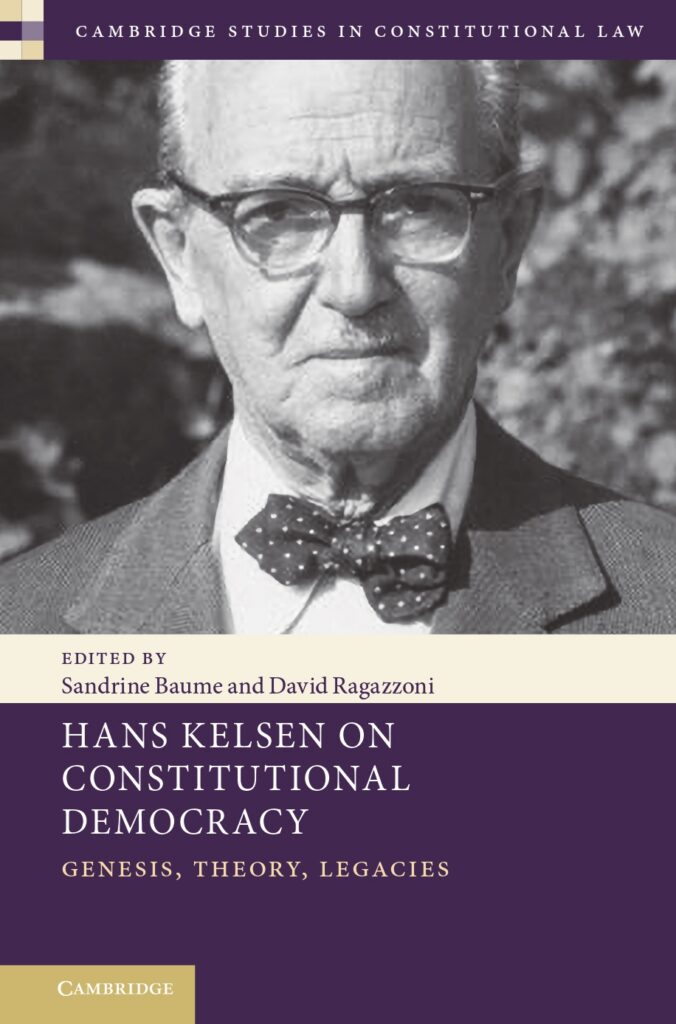
As liberal democracies around the world are increasingly under pressure, facing the converging challenges of populism, technocracy, and widespread disaffection, the writings of Hans Kelsen offer compelling resources for our exceptionally unsettling times. Arguably the greatest jurist of the 20th century, he wrote in an age of single-party dictatorships and witnessed the downfall of constitutional governments at the hands of totalitarian leaders. His theory of liberal democracy – growing out of a lifetime meditation on its procedures and institutions and the principles underpinning both – stands in sharp opposition to populist and authoritarian thinking and provides a powerful antidote to its contemporary manifestations.
Kelsen unequivocally rejects what has become one of the main tropes of the populist rhetoric: namely, the opposition between “the People” and the political “elites”. For him, this dichotomy rests on a dangerous fiction: the belief that a unified, homogeneous entity (the Volk) exists outside representative institutions whose will can and must be directly embodied by a single leader (the Führer), self-professedly untouched by the corruption of the political establishment and thus best positioned to champion the interests and claims of the “true”, hard-working people. Against this dangerous simplification and deliberate illusion, Kelsen emphasizes pluralism, social conflict, and the (often uncomfortable) complexities of party democracy. Political will, he argues, is not discovered or revealed but constructed through institutionalized processes of mediation, negotiation, and compromise. Political indirectness, intermediary bodies, and the challenges of electoral representation – specifically, the relationship between majority rule and minority rights and the tension between inclusivity and accountability of elected governments – are best understood not as a betrayal of democracy but as structural conditions of its very possibility in complex mass societies.
Kelsen’s sophisticated analysis of political leadership is especially relevant in democracies increasingly tempted by authoritarian figures. Democratic leadership, on his account, differs fundamentally from autocratic rule. In a liberal democracy, leaders do not govern by virtue of superior insight, charismatic authority, or privileged access to transcendent truths. They remain contestable, accountable, and – crucially – peacefully removable (by means of periodic, free, and truly competitive elections). Whereas democratic authority is constantly forged through an open-ended process of creation and circulation that empowers citizens’ critical thinking, autocracy relies on the myth of exceptional leaders who claim a monopoly of Truth and cast themselves as messianic redeemers. By doing so, they set themselves above and beyond the democratic principles of accountability, moderation in the exercise of executive authority, legitimate opposition, and rotation in office – that is, the backbones of party democracy.
In an era pervasively marked by populist simplifications and authoritarian temptations, Kelsen’s sober, procedural, and pluralist vision of democracy remains a vital source of insights for thinking about democratic resilience, and for recognizing the first symptoms of an autocratic involution of democratic leadership.
Finally, one of the distinctive strengths of Kelsen’s contribution lies in his sustained attention to the gap between the ideal image of democracy and the way it actually works in mass, heterogeneous societies where partisanship and disagreement are inevitable. Rather than concealing this gap behind tempting abstractions or moralizing rhetoric, Kelsen insists on confronting it directly. Democracy, in his view, is not weakened by the acknowledgment of its imperfections. Rather, it is strengthened by a vision of politics that places social conflict and partisan views at its core, promotes an ethics of compromise that genuinely respects the legitimacy of political antagonists, and thus prevents its drowning at the hands of populist ventriloquists and potential autocrats in disguise clothing themselves in the mantle of electoral legitimacy.

David Ragazzoni is a tenure-track assistant professor in Liberal Democratic Theory at the Political Science Department of the University of Toronto. Previously, he was a postdoctor...
View profile >Sandrine Baume is a full professor at the University of Lausanne. Her research lies at the crossroads of democratic theory and the history of political thought. She has particularl...
View profile >Keep up with the latest from Cambridge University Press on our social media accounts.




Latest Comments
Have your say!