

Products and services

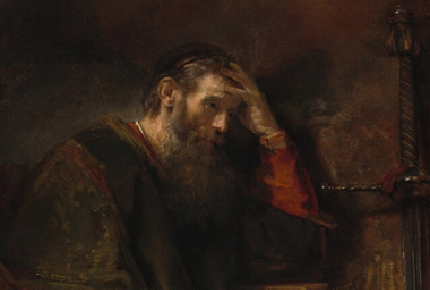
It’s another dull, grey Tuesday morning. A colleague asks you how you are. Reflecting on the seemingly endless flow of tedious meetings in the day ahead, you reply that you’re “losing the will the live”. Your co-worker chuckles and walks back to wherever they need to be.
I think most people understand the context of this comment concerning the will, whether you interpret it as a literal statement or as hyperbole. Saying that you’re “losing the will to live” conveys that you are fed up or frustrated with some aspect of your life. What is less clear perhaps is the qualities of the “will” that lies at the heart of this well-known phrase. If we can “lose” something, we must possess it in some way. Right?
You’ve probably been put in the position where you’ve questioned your own willpower – the control that we may, or may not, have over our own impulses. Will you only have one biscuit on your lunch break, or maybe four? Maybe you’ll have the whole packet. What’s stopping you? Most of us have been in a situation involving temptation, but how often do we think pointedly about the quality of this thing we like to call “will”? When’s the last time you called your own willpower into question, and what did you conclude about it?
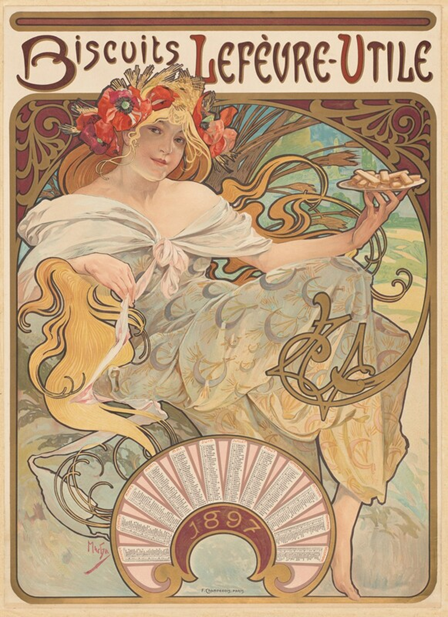
Alphonse Marie Mucha, Biscuits Lefèvre-Utile (1896). National Gallery of Art, Washington D.C.
Let’s develop this idea through an extremely popular piece of fiction. It is probable that you’ve read or seen The Lord of the Rings. One prominent moment when the will is referred to occurs when Boromir tries to take the ring from Frodo at the conclusion of The Fellowship of the Ring. Fearing for his safety, Frodo puts on the ring, escapes from Boromir, and comes to a realization about his future. He must journey alone to Mordor. At this moment, the narrator states that “Frodo rose to his feet. A great weariness was on him, but his will was firm and his heart lighter” (Fellowship of the Ring, 523). Frodo demonstrates a firm will to continue in his quest despite the mental or physical adversity he faces; he is resolved to complete the arduous journey to Mount Doom alone. Again, I think most people would understand the general context of this moment – concerning a person’s ability to muster the strength, determination, or energy to continue in their endeavours – without perhaps paying too much attention to the concept that lies at its core: the quality of the will and the control we can seemingly impose over it. What is our relationship to this rather elusive, but seemingly important, concept?
I’m fascinated with the way that writers have attempted to explain human behaviour throughout history. While modern neuroscience may have dispelled the myth of the will being a discrete, identifiable part of the human mind, it was popularly understood to take an important role in conscious and intentional actions in sixteenth- and seventeenth-century culture. My book, The Will in Renaissance Drama, examines how deeply important notions of will were to a period of history characterized by theatrical, philosophical, scientific, and theological innovation. In it, I explore how writers of the period tried to rationalize why we do the things we do by considering how the faculty of the will functioned. We may look no further than the most familiar passage of possibly the most famous English Renaissance play to see this idea in action.
When deliberating upon the nature of human existence, Prince Hamlet reckons that it is the “dread of something after death, / The undiscover’d country” which “puzzles the will” (3.1.78-80) and thus indelibly narrows the range of potential choices we make in life. For Hamlet, the will’s potential to be drawn into a state of confusion informs how our “conscience does make cowards of us all” (3.1.83). This renowned moment in Hamlet illustrates a key aspect of the will’s perceived status in Shakespeare’s time. The will was regarded as a part of the soul which directly shaped the quality of one’s personal temperament and fate: its operation directly influenced who we are and the actions we take. Human will and divine will were thought to influence every aspect of one’s life, in addition to the quality of our afterlife!
Considering the qualities of the will and the extent to which we can control it offered many writers like Shakespeare an opportunity to reflect on our relative (in)ability to shape our fate in this life and the next. From sonnets to sermons, the impulsive imperfection of human willing was commonly distinguished in relation to the supreme authority of God’s divine will. Our will was primarily viewed as an unruly part of the soul that hinders our ability to achieve what we desire, though the performance of the will was not merely localized to the body or psyche. Another way of enacting one’s will upon the world was achieved for some through the production of a last will and testament. These documents recorded the final wishes of their testators and were used to transfer both fixed and moveable property to a series of chosen beneficiaries. Last wills, in other words, acted as tools for testators to impose their will upon the living, dictating who will, and who will not, benefit from their death. In their immaterial and material forms, wills shaped the conditions of one’s life and afterlife.
The Will in Renaissance Drama explores the important place that these forms of wills took in English Renaissance drama, shedding new light on the key place that willing and will-making took in the plays developed through the reigns of Elizabeth I (1558-1603) and James I and VI (1603-1625). Drama was both an incredibly popular and potent technology for speculation about existence, and, as I show, many playwrights showed an interest in questioning the reasons for and consequences of human willing. Reflecting on the nature of the will allowed playwrights to scrutinize the limits of human ambition and what is in our power to achieve.
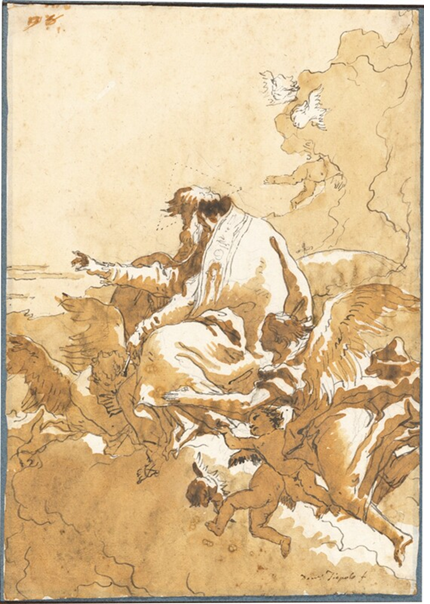
Giovanni Domenico Tiepolo, God the Father Seated in Clouds Surrounded by Angels and Putti (1753/59). The National Gallery of Art, Washington, D.C.
What I emphasize throughout this book is that the faculty of the will and the documentary will were commonly depicted as instruments of self and social regulation, and both these forms of will took a key role in determining human fate. English playwrights consistently framed the lives of their characters through a struggle to achieve one’s will, in tandem with (or despite) another’s will. The expression of the will (as a faculty and as a legal document) helped reveal the limits of an individual’s ability to resist the detrimental lure of their own desires, the political authority of patriarchs, and the supposed will of God. It is my hope that The Will in Renaissance Drama provides you with a new appreciation of this fascinating world of literary wills.
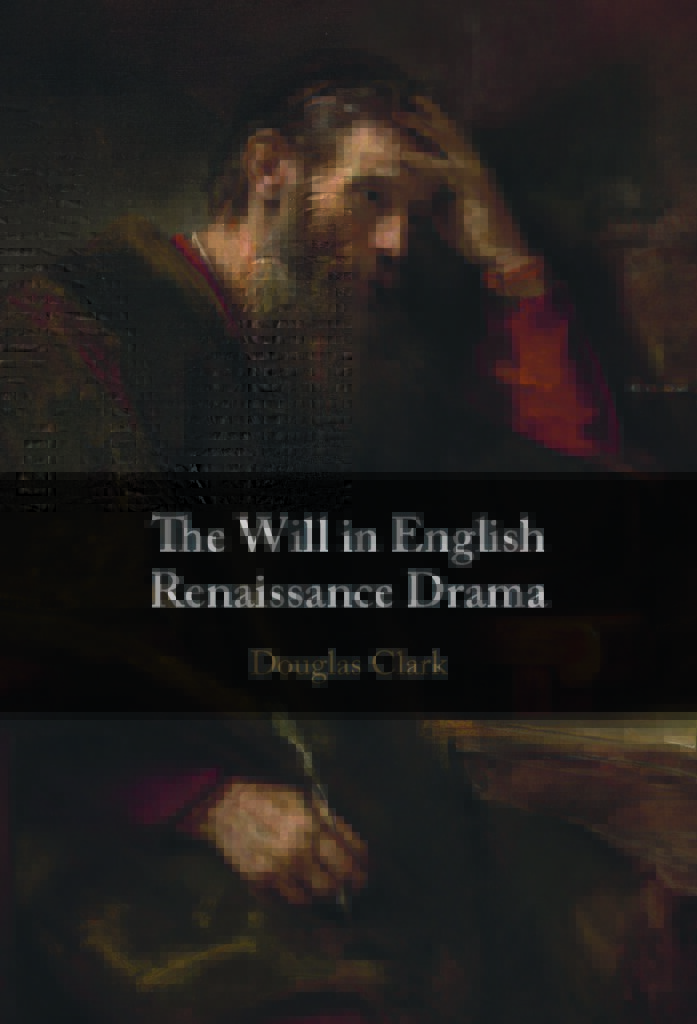
The Will in English Renaissance
Drama by Douglas Clark

Douglas Clark is a tutor in English Literature at the University of Oxford. He has published widely on English Renaissance drama and poetry. His scholarship has been supported thro...
View profile >Keep up with the latest from Cambridge University Press on our social media accounts.



Latest Comments
Have your say!