

Products and services

Nostalgia has become a defining emotion of twenty-first-century Western culture. From endless film franchise reboots, to the Eras Tour, to the 1980s world of Stranger Things, our media seems perpetually transfixed by the past. Nostalgia—the bittersweet yearning for an absent home—has a remarkable power to enchant us, for good or ill. It can, in the wrong hands, be a tool of manipulation. Fixation on an imagined past too often blinds people to the possibilities of the present.
But can nostalgia also offer something of value? Something more than entertainment or pleasant self-deception?
My book, Nostalgia and National Identity in the British and Irish Modernist Epic, looks at the work of six writers to argue that nostalgia can be a powerful tool of identity formation. James Joyce, Mina Loy, T. S. Eliot, Lynette Roberts, David Jones, and Derek Walcott all had complicated national identities. Joyce and Loy were perpetual migrants; Eliot was at home neither in England nor America; Roberts and Jones, born to Welsh parents outside Wales, experienced alienation from their motherland; Loy and Walcott grappled with multi-cultural identities.
We are familiar with the image of the immigrant nostalgic for the distant homeland. But these writers exhibit nostalgia for the places they inhabit as well as for the lands they have left behind. In their work, nostalgia becomes a tool to lay claim to a homeland.
Take Lynette Roberts. Born in Argentina to Welsh parents, she moved to the rural Welsh village of Llanybri after her marriage to fellow poet Keidrych Rhys. In her “Parts of an autobiography,” she records that during her first conversation with Rhys, he asked, “You have a Welsh name, are you Welsh?” to which she replied, “I don’t know.” After moving to Llanybri, she struggled both with the difficulties of rural life and with her status as an outsider. Yet her poetry uses nostalgia to claim Welsh identity.
Her magnificent heroic poem Gods with Stainless Ears (1951) depicts life on the home front during World War II, following a soldier and his lover, evidently based on Rhys and Roberts. In vivid, experimental language, the text juxtaposes the nation’s past, with unblemished landscape and ancient traditions, against the violence, mechanization, and environmental degradation of the present. Tentatively, the poem suggests that the past may not be dead and might, in fact, offer hope for cultural renewal.
One symbol of this longed-for renewal in Gods with Stainless Ears is the dragon, both the emblem of the Welsh flag and a mythic presence slumbering beneath the hills. In the first section of the poem, British troops tear down the flag, which “crept back like myth / Into folds of earth: grew greener shafts of resilience.” The dragon returns in the poem’s final lines, when the soldier-protagonist, defying the oppressive forces of modernity, “Frees dragon from the glacier glade”—releasing this mythic force from its resting place. Gods with Stainless Ears ends with this fantastical hope, declaring its author’s allegiance to the Welsh nation, with its bleak landscape nonetheless full of nostalgic promise.
Roberts’ writing exemplifies nostalgia’s potential as an artistic and theoretical tool. It may, in some cases, armor a militant and exclusionary nationalism, but it also provides a way to embrace and navigate cultural hybridity. These six writers construct alternative modes of national identity, reactivating lost memories, values, and possibilities for the modern world.
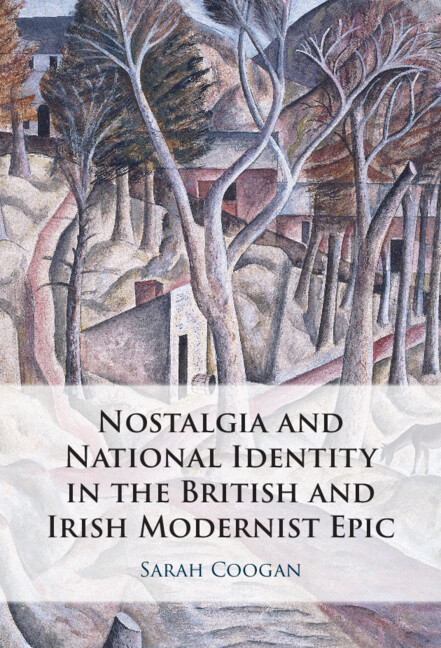
Nostalgia and National Identity
in the British and Irish Modernist
Epic by Sarah Coogan

Sarah Coogan, Ph.D., is a literary scholar and writer based in the San Francisco Bay Area. She is the Associate Director of the David Jones Research Center and a seminar leader for...
View profile >Keep up with the latest from Cambridge University Press on our social media accounts.



Latest Comments
Have your say!