

Products and services


For much of the past decade, corporations occupied a very visible place in public life. They spoke after Charlottesville and January 6, opposed the withdrawal from the Paris Agreement, intervened in immigration and voting debates, and redesigned internal policies—from reproductive healthcare to gun sales—in response to political change. In the process, the boundary between economic activity and political authority became harder to draw. Corporate engagement during this period appeared salient and forceful.
That boundary is now being redrawn under the political conditions of the second Trump presidency, where corporations and their leaders are openly pressured and singled out. This has prompted renewed scrutiny of whether earlier corporate visibility reflected lasting commitments or more contingent forms of engagement.
The question today is no longer whether corporations belong in politics. Practice settled that question years ago. The more pressing issue is how corporate involvement operates once politics becomes openly transactional—once regulatory discretion, enforcement, and retaliation move from background risks to overt features of the political environment. It is against this backdrop that corporate silence has become noticeable, if not troubling—at least for some observers.
Over the last decade, corporate involvement moved well beyond traditional lobbying. Firms engaged contested issues directly, embedded social commitments into internal policies with external consequences, and, at times, performed functions typically associated with public authority. This was not episodic or symbolic. It became a recurring feature of how policy outcomes were shaped across a range of socioeconomic domains, contributing to the expectation that corporations might function as public-facing actors in moments of political dysfunction.
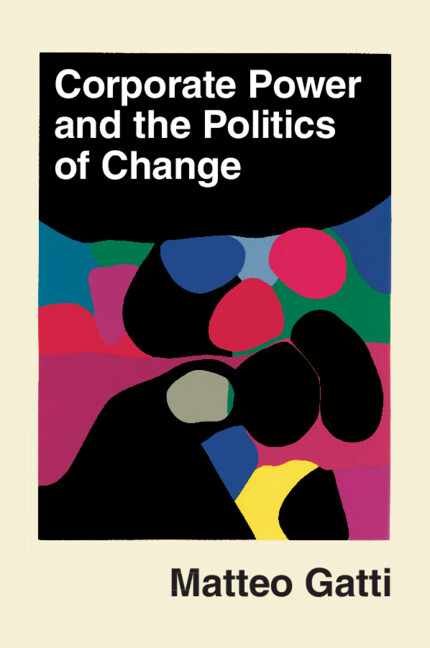
Corporate Power and the Politics of Change (Cambridge University Press, 2026) offers a framework for understanding this phenomenon, which I describe as “corporate governing.”
What changes in the second Trump presidency is not corporate governing itself, but the political environment in which it operates. More centralized authority, more aggressive use of regulatory discretion, and greater tolerance for retaliation do not eliminate corporate governing; they make its constraints, limits, and vulnerabilities harder to ignore.
One consequence of this shift is divergence rather than convergence in corporate behavior. Some firms retreat from visible engagement. Others continue to act, but with less public signaling and greater reliance on internal policies, operational decisions, and compliance architectures. Still others persist openly, often because they face different exposure, operate in different markets, or have less to lose. What looks like corporate silence, in other words, is not the disappearance of corporate governing but a predictable response to heightened political cost and uneven constraint.
Some have described the current corporate silence as hypocrisy. That critique misses the point. Corporate engagement was never stable or principled in the way public governance is expected to operate. It was always contingent—responsive to incentives, pressure, and risk. As political conditions shift, so does the visibility and form of corporate involvement. The present moment reveals not moral backsliding, but the structural limits of relying on corporations to perform public functions.
This book does not evaluate these developments as virtues or failures. Nor does it express a view on the desirability of the underlying policy choices corporations have made over the years. Instead, I advance an organizing argument: rather than an aberration or a solution, corporate governing is a structural response to political dysfunction, market pressures, and legal permissiveness. In some settings, it can facilitate change. In others, it can distort accountability, fragment pluralism, and displace democratic processes.
To make sense of these effects, the book separates questions that are often conflated. Is corporate governing consistent with corporate law and fiduciary duties? Often yes. Is it strategically rational for firms? That is for firms themselves to determine. Does it benefit society? At times, but not necessarily. Does it pose risks to democratic institutions? Possibly.
By disentangling these questions, the book moves the debate beyond slogans—whether celebratory or critical—and toward institutional analysis. It explains why backlash was predictable, why corporate behavior varies across firms and issues, and why neither blanket activism nor enforced silence offers a stable equilibrium.
Seen from this perspective, the second Trump presidency does not mark a break with the past so much as a clarifying moment—one that brings into sharper focus both the reach and the limits of corporations acting as political and governing actors.

Matteo Gatti is a Professor of Law at Rutgers Law School and a Research Member of the European Corporate Governance Institute. His research on corporate law and political economy h...
View profile >Keep up with the latest from Cambridge University Press on our social media accounts.




Latest Comments
Have your say!