

Products and services

“Your cattle are public enemies now,” a state veterinary scientist tells Homer Bannon, an aging cattle rancher in Larry McMurtry’s 1961 novel Horsemen, Pass By, shortly before he compels Homer to drive his livestock into a large pit to be slaughtered and buried. This haunting scene in the novel (and in its film adaptation, Hud) follows from the discovery of foot-and-mouth disease (FMD) in Homer’s herd. A highly contagious pathogen affecting hooved animals, FMD, as the veterinarian tells Homer, “will hardly ever kill an animal,” but it indelibly weakens them after infection, leading to lower milk and beef production. To protect its cattle industry, the United States has therefore managed FMD outbreaks within the country through the mandatory quarantine-and-slaughter method illustrated in this scene.
This method of managing large-scale animal disease outbreaks originated in the early 18th century in Europe, when the continent was reeling from a far deadlier and equally contagious cattle pathogen called rinderpest. After the deaths of over 100,000 cattle in the areas around Rome threatened the health and well-being of its growing population, in 1713, Pope Clement XI appointed his personal physician, Giovanni Maria Lancisi, to study the disease and to determine a plan for controlling the contagion. Lancisi’s response, adopted separately but almost simultaneously in England, was to ‘stamp out’ the disease by requiring cattle owners to kill, burn, and bury of all herds with sickened animals.
By wresting long-standing powers over the treatment of cattle from ranchers and investing such powers in the state, these new biopolitical mandates recast sickened animals and those who cared for them as potential “public enemies.” Such associations generated a great deal of fear and anger within pastoral settings, while resistance to these mandates encouraged Italian and English governments, in turn, to develop elaborate surveillance systems to ensure the carrying out of the slaughters. At the same time, people far removed from the immediacy of these pastoral dramas, including prominent literary figures such as Jonathan Swift, Tobias Smollett, and Thomas Gray, began to speculate on how the biopolitics of stamping out might be extended from animal to human management practices.
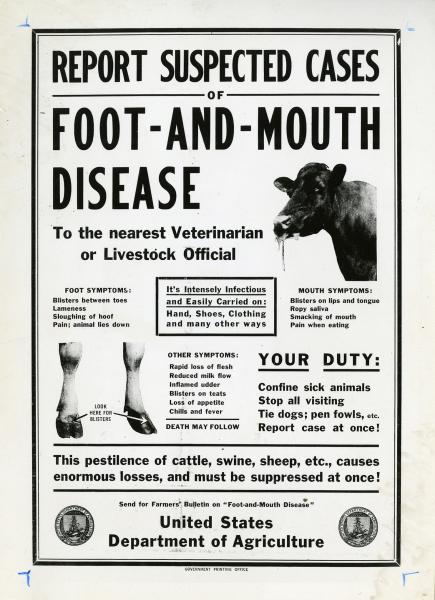
Image: Report suspected cases of foot-and-mouth disease poster. Historical Photography. Row 5 Draw 1, 23. Foot-and Mouth-Disease. Folder 1. USDA National Agricultural Library.
This tendency to reexamine ourselves—our values, our politics, our communities—during moments of widespread animal suffering is not unique to that era. Before executing his favourite steer amid the culling, for example, Homer Bannon tells his grandson “It’s almost like leveling on a neighbor.… I wish that shit the heifer caught was catching to human beings.” Writing within the same mid-century context of FMD in North America, William Burroughs invokes the same stamping-out method to link American attitudes towards cattle management with its management of another kind of “public enemy,” the drug addict: “You know of course that it is a common measure of prophylaxis to shoot a cow with the aftosa [FMD] and that a reasonable cow would not object to this procedure if that cow had been indoctrinated with the proper feelings of duty toward the bovine community at large.”
Animal Illness and the Literary Imagination addresses these surprising comparisons and other kinds of intertwined, messy, and troubling responses to wide-spread animal diseases as they appear in literary and cultural texts from 1713 to our post-COVID present. Because these texts place animal disease outbreaks within the context of human-centered narratives, they reveal intimate, enduring, and often surprising connections between the health and well-being of human and nonhuman creatures. Animal diseases and their management have a rich and troubled history deeply intertwined our own, and reexamining this history through literature can therefore encourage us to rethink the way we manage these diseases and the creatures who suffer from them today.
Keep up with the latest from Cambridge University Press on our social media accounts.



Latest Comments
Have your say!