Number of articles per page:
-
Thomas Gift
In a high-profile address to US generals earlier this week, Secretary of War Pete Hegseth declared, “We don’t fight with stupid rules of engagement. We untie the hands of our war fighters to intimidate, demoralize, hunt, and kill the enemy.” His words are exactly what US President Donald Trump has been advocating: not just loosening […]
Read More
-
Taylor Aucoin
Autumn is most definitely here: leaves crunch underfoot; the air is crisp and cool; pumpkin and apple spices waft from the coffee shops. But while the season brings many changes, it does not alter work patterns dramatically for most modern people, though teachers might disagree. Of course, things were quite different in the agrarian society […]
Read More
-
Melissa J. Ganz
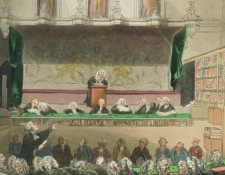
The law underwent significant developments in eighteenth-century Britain as jurists and legislators adapted older doctrines to fit the needs of an increasingly commercial, industrial, and imperial society. These developments at once shaped and were shaped by the period’s imaginative writing. In an era when disciplinary boundaries had not yet hardened, some men trained for the […]
Read More
-
Jonathan Valk
Social groups dominate public discourse. The news, social media, scientific reports, and everyday conversations all refer to groups of every kind: women, conservatives, Muslims, immigrants, Nigerians, lawyers, and a virtually endless list of others. In their own contexts, each of these categories makes sense. We know, roughly, whom each term describes. But when we stop […]
Read More
-
Sarah Burton, Jem Poster
When we wrote our handbook for fiction writers (The Book You Need to Read to Write the Book You Want to Write, published by CUP in 2022) we excluded a component of our taught courses, the writing exercise – not because we thought it wasn’t important, but because we knew it was. While many creative […]
Read More
-
Soroush Saghafian
Why Analytics Matters Now More Than Ever In today’s world, data and algorithms are everywhere, but real impact comes not from numbers alone—it comes from how we use them. That belief is at the heart of my new book, Insight-Driven Problem Solving: Analytics Science to Improve the World. The book was born out of years […]
Read More
-
Yuval Feldman
Every policymaker knows the dilemma: should governments trust people to do the right thing, or make sure they do it? The safer option has usually been enforcement. Write the rules, monitor behavior, punish violations. Citizens obey because they have to. Yet most regulators also know something they rarely act on: people tend to follow rules […]
Read More
-
Eleanor Helms
Section 1: What are Thought Experiments For? Thomas Kuhn famously asked how it was possible for thought experiments to lead to new scientific knowledge in the absence of new data. In philosophy, research on thought experiments has mainly followed the trajectory established by Kuhn, focusing on their role in the sciences. Kuhn’s asks what thought experiments […]
Read More
-
Thomas Gift
In a high-profile address to US generals earlier this week, Secretary of War Pete Hegseth declared, “We don’t fight with stupid rules of engagement. We untie the hands of our war fighters to intimidate, demoralize, hunt, and kill the enemy.” His words are exactly what US President Donald Trump has been advocating: not just loosening […]
Read More
-
Taylor Aucoin
Autumn is most definitely here: leaves crunch underfoot; the air is crisp and cool; pumpkin and apple spices waft from the coffee shops. But while the season brings many changes, it does not alter work patterns dramatically for most modern people, though teachers might disagree. Of course, things were quite different in the agrarian society […]
Read More
-
Melissa J. Ganz
The law underwent significant developments in eighteenth-century Britain as jurists and legislators adapted older doctrines to fit the needs of an increasingly commercial, industrial, and imperial society. These developments at once shaped and were shaped by the period’s imaginative writing. In an era when disciplinary boundaries had not yet hardened, some men trained for the […]
Read More
-
Jonathan Valk
Social groups dominate public discourse. The news, social media, scientific reports, and everyday conversations all refer to groups of every kind: women, conservatives, Muslims, immigrants, Nigerians, lawyers, and a virtually endless list of others. In their own contexts, each of these categories makes sense. We know, roughly, whom each term describes. But when we stop […]
Read More
-
Sarah Burton, Jem Poster
When we wrote our handbook for fiction writers (The Book You Need to Read to Write the Book You Want to Write, published by CUP in 2022) we excluded a component of our taught courses, the writing exercise – not because we thought it wasn’t important, but because we knew it was. While many creative […]
Read More
-
Soroush Saghafian
Why Analytics Matters Now More Than Ever In today’s world, data and algorithms are everywhere, but real impact comes not from numbers alone—it comes from how we use them. That belief is at the heart of my new book, Insight-Driven Problem Solving: Analytics Science to Improve the World. The book was born out of years […]
Read More
-
Yuval Feldman
Every policymaker knows the dilemma: should governments trust people to do the right thing, or make sure they do it? The safer option has usually been enforcement. Write the rules, monitor behavior, punish violations. Citizens obey because they have to. Yet most regulators also know something they rarely act on: people tend to follow rules […]
Read More
-
Eleanor Helms
Section 1: What are Thought Experiments For? Thomas Kuhn famously asked how it was possible for thought experiments to lead to new scientific knowledge in the absence of new data. In philosophy, research on thought experiments has mainly followed the trajectory established by Kuhn, focusing on their role in the sciences. Kuhn’s asks what thought experiments […]
Read More
Number of articles per page: