

Products and services

When we wrote our handbook for fiction writers (The Book You Need to Read to Write the Book You Want to Write, published by CUP in 2022) we excluded a component of our taught courses, the writing exercise – not because we thought it wasn’t important, but because we knew it was. While many creative writing handbooks relegate exercises to the margins of their discussions, and other books simply offer bundles of unmediated prompts, we wanted to devote an entire book to fiction-writing exercises, contextualising each of them in relation to key themes and guiding our practitioner-readers in subsequent reflection. The result was The Prompts You Need to Help You Write the Book You Want to Write.
At the new book’s heart lies the idea of creative play – serious play maybe, but play nonetheless. Early-stage writers can find themselves oppressed by the weight of tradition and their own ambition; a well conceived writing exercise encourages them to work in ways that are light-footed and inventive, without the burden of unreasonable expectation. We go so far as to include, in our book’s final section, suggestions for writing based on forms of wordplay – lipograms, puns, verbal collages – which might seem, at first sight, to have only the most tangential bearing on the literary matters discussed up to that point, but which nevertheless serve the book’s larger design: to liberate its readers into a world of creative experimentation.
Confiding in her diary on 26 January 1920, Virginia Woolf spoke of her ambition to discover in the writing of her next novel ‘a looseness and lightness … a gaiety – an inconsequence – a light spirited stepping at my sweet will.’ The novel she was contemplating was Jacob’s Room, published almost three years later, of which she would remark in her diary entry of 26 July, 1922: ‘There’s no doubt in my mind that I have found out how to begin (at 40) to say something in my own voice.’
Shadowed by the First World War and, on a more personal level, by the death of Woolf’s older brother Thoby in 1906, Jacob’s Room is by no means a uniformly light-spirited work, but its playfulness is unmistakable. We see it early on in a paragraph which introduces and then summarily dismisses an unnamed young man whose only role in the novel before he vanishes from its pages is to take the reader back through the history of Scarborough; in an inconsequential scene in which the reader is led upstairs to Jacob’s college rooms only to discover that he isn’t there; and in an extended passage that teases the reader with the notion that the narrator knows nothing of what is going on in the college rooms beyond what her fixed vantage point in the courtyard allows her to see, before blowing the constraint apart with a contradictory suggestion of imaginative omniscience: ‘And then before one’s eyes would come the bare hills of Turkey – sharp lines, dry earth, coloured flowers, and colour on the shoulders of the women, standing naked-legged in the stream to beat linen on the stones.’
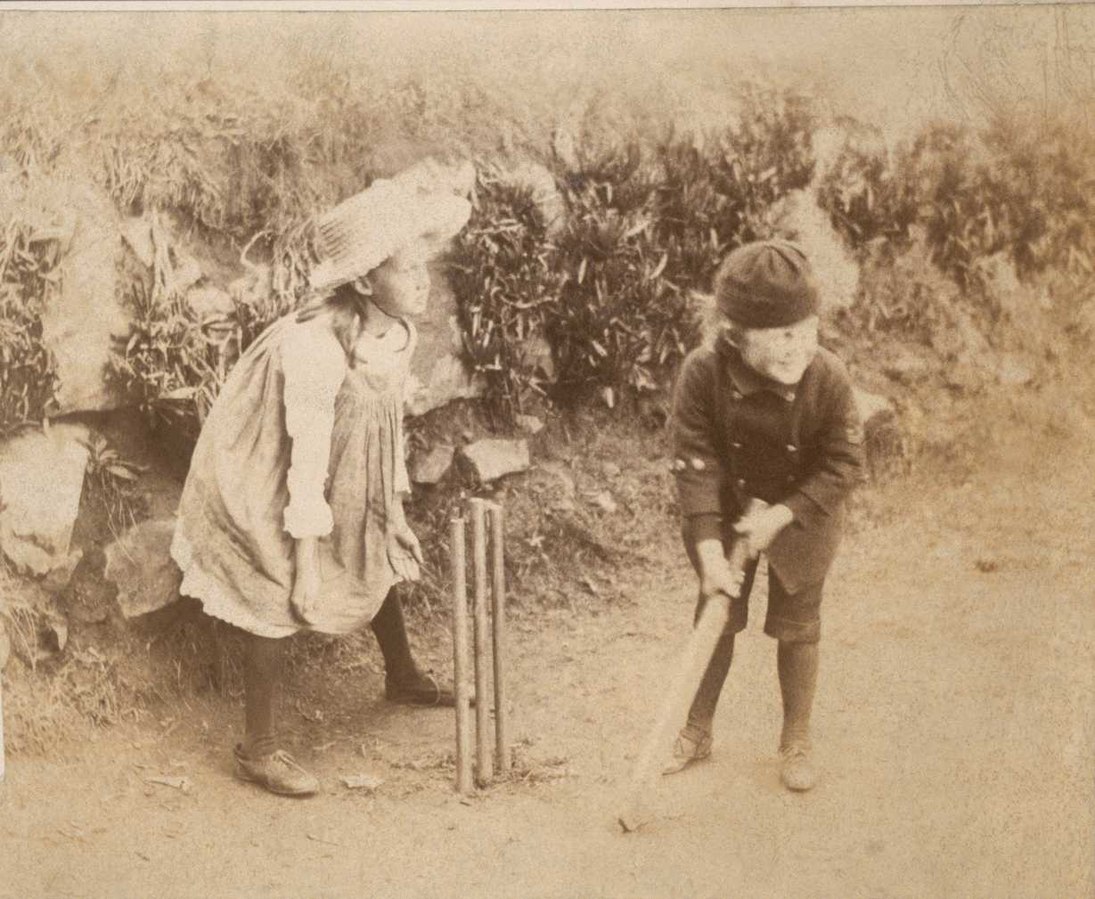
Virginia and her younger brother Adrian playing cricket at Talland House in 1886
This is obviously play of a very high order, but the relevant point is that the novel’s playfulness was essential to Woolf’s development as a writer, a necessary preparation for the three great novels that followed: Mrs Dalloway, To the Lighthouse and The Waves. Woolf’s genius was unique, but many aspiring writers who want to develop a serious talent will find it useful to approach their task, in the first instance, with a certain lightness of step. It’s our hope that The Prompts You Need… will help them to do so.
The Prompts You Need to Help
You Write the Book You Want to
Write by Sarah Burton and Jem Poster

Co-founders of Cambridge University's Master's programme in creative writing, Sarah Burton and Jem Poster draw on a wealth of teaching experience in a variety of contexts, from inf...
View profile >Co-founders of Cambridge University's Master's programme in creative writing, Sarah Burton and Jem Poster draw on a wealth of teaching experience in a variety of contexts, from inf...
View profile >Keep up with the latest from Cambridge University Press on our social media accounts.


Latest Comments
Have your say!