

Products and services


How do scientists interpret the results of an experiment? How do they draw conclusions from experiments? In January of 1939, the young Alan Hodgkin decided to break in some new lab equipment and he had a simple question in mind. He accepted the then-standard view—based on Julius Bernstein’s membrane hypotheses—that when an axon is depolarized, it generates an action potential that falls close to zero. He wondered how close. When running the experiment, he was surprised to find that the action potential overshot zero and concluded that Bernstein’s theory was, therefore, problematic.
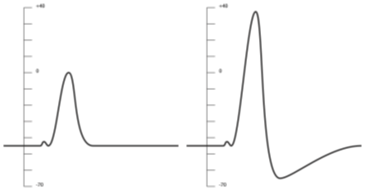
Figure 1. Hodgkin’s expectation: the action potential approaching zero. (left). Hodgkin’s measurement: the action potential overshooting zero. (right).
How did Hodgkin reach this conclusion? How did he reason his way from his measurement to his doubt about Bernstein’s hypothesis? A Bayesian account is implausible, as Hodgkin did not propose to revise a prior probability assignment. Throughout his published works on the action potential, Hodgkin never framed issues in such terms. Logical empiricists would have proposed that Hodgkin used hypothetico-deductive confirmation: If Bernstein’s hypothesis is true, then the action potential falls close to zero, the action potential does not fall close to zero, therefore Bernstein’s hypothesis is not true. This is just an instance of modus tollens. Yet, most philosophers of science have moved on from the hypothetico-deductive theory of confirmation in much the way that they have moved on from the deductive-nomological model of explanation. Both theories succumb to technical counterexamples stemming from their reliance on formal logic. A common moral from these problems is that hypothetico-deductive confirmation and deductive-nomological explanation fail because they try to capture scientific reasoning using first-order predicate logic, whereas scientists apparently reason about non-logical ontological relations, such as causation.
To better understand Hodgkin’s reasoning, the historian and philosopher has to look more closely at Hodgkin’s background beliefs about Bernstein’s mechanism for the action potential. Following Bernstein, Hodgkin believed that the resting potential depended on a selective permeability of the axonal membrane to potassium ions, thereby giving rise to an excess of potassium inside the axon. Bernstein hypothesized that depolarization of the axon rendered the axon permeable to all ions, so that the ions would move to the same concentrations inside and outside of the axon. Thus, during the action potential, the transmembrane potential should fall to nearly zero. To link this point to the idea of ontological relations, one of the physical consequences of Bernstein’s hypothesis is that action potentials should approach zero. Hodgkin’s thinking is not captured in terms of a logical consequence between sentences; it is captured in terms of physical consequences of things in the world. To propose matters another way, Hodgkin believed that Bernstein’s hypothesis could not explain why measured action potentials did not approach zero. Hodgkin engaged in abductive reasoning, wherein failure to explain counts as disconfirmation.
Scientists also sometimes attempt to confirm hypotheses. After the interruption of World War II, Hodgkin sought some hypothesis that could explain his 1939 experimental results. After initially being ambivalent on the matter, Hodgkin came to believe that extracellular sodium played a role in generating the action potential. He hypothesized that an influx of sodium into the axon would explain the overshoot of the action potential. In January 1947, he tested this by lowering the sodium concentration of the external medium of the axon, which indeed reduced the size of the overshoot. Logical empiricists would have interpreted this reasoning as an instance of the logical fallacy of affirming the consequent: If sodium is responsible for the overshoot of the action potential, then reducing external sodium reduces the overshoot. Reducing external sodium reduces the overshoot. Therefore, sodium is responsible for the overshoot of the action potential. But the historian and philosopher of science can do better than interpret Hodgkin as committing an elementary logical fallacy. To do better by Hodgkin, one must again examine his background beliefs about the underlying mechanism of the action potential. Hodgkin was thinking that the overshoot is a physical consequence of the influx of sodium. In other words, what explains the initial rise of the action potential and its overshooting zero is the influx of sodium ions. This explanation provided Hodgkin with a reason to believe that sodium was part of the mechanism of the action potential. The explanation was part of Hodgkin’s abductive reasoning regarding the action potential.
The foregoing account proposes that if some hypothesis explains an experimental result, then that is a reason in favor of the hypothesis. Moreover, if some hypothesis fails to explain an experimental result that it should explain, then that is a reason to doubt the hypothesis. One might take this to be the thought that explanatory considerations have confirmation-theoretic importance. This observation will, in turn, invite many philosophers of science to propose that Hodgkin was using “inference to the best explanation,” according to which a scientist should infer that the “best” explanation of the available experimental results is true.
Yet familiar accounts of inference to the best explanation have little, if anything, to say about failure to explain. Moreover, familiar accounts of inference to the best explanation are aimed at scientific knowledge, which are supposed to identify a single “best” explanation. They are aimed at how scientists come to know some hypothesis, in part, by the idea that they eliminate all rival hypotheses. Abductive reasoning, as described in these examples, does not presuppose that Hodgkin ruled out all rival hypotheses. In 1939, the most Hodgkin takes himself to have accomplished is casting doubt on Bernstein’s membrane hypothesis. He was far from having settled on a new hypothesis that “best” explains his experimental results.
Compositional Abduction and Scientific Interpretation is a work in the history and philosophy of science that articulates a non-Bayesian abductive theory of confirmation, which, in some cases, serves as a plausible successor to the logical empiricist’s HD confirmation. It is grounded in a close consideration of scientific experimental literature. It develops a theory of compositional explanation that characterizes examples, such as Hodgkin’s explanations regarding the action potential. It develops a theory of experimental results in contrast to experimental data. It describes how scientists sometimes abductively interpret experimental results in making their case for one or another hypothesis. The reasoning is abductive, because it embeds explanatory considerations. It is compositional, because the explanations are of the activity instances of wholes—things like action potentials—in terms of the activity instances of their parts—things like changes in membrane permeability and movement of ions. It also articulates how the theory differs from the Peircean theory of abduction and prominent versions of inference to the best explanation.


Kenneth Aizawa is Professor of Philosophy at Rutgers University, Newark. He is co-editor (with Carl Gillett) of Scientific Composition and Metaphysical Ground (2016), co-author (wi...
View profile >Keep up with the latest from Cambridge University Press on our social media accounts.



Latest Comments
Have your say!