

Products and services

The interests of historians have been formed by many factors. Politics, identity and personal grievances, for example, have all played a part. For me and many others, it was marriage that shaped my trajectory as an historian at a particular point. Prior to this my interests were broadly within labour history which at the time was rather fashionable. Thus my thesis and subsequent publications investigated aspects of the history of East London where I happened to live. My marriage to an Indian woman, however, created something of a detour as I embarked on a journey to learn of a cultural background about which I knew little.
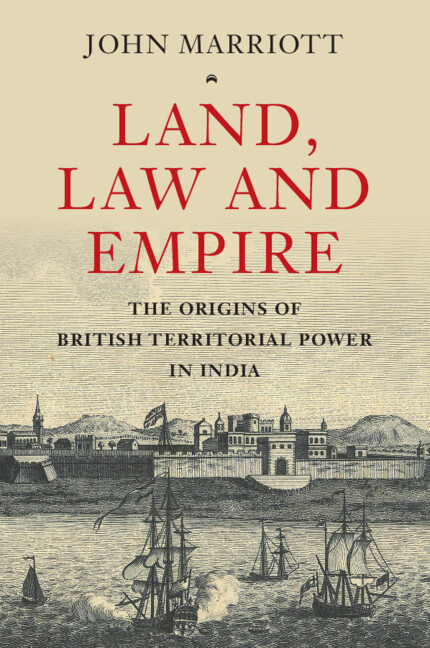
Not that I abandoned the East End entirely; rather it was the nexus between London and India which began increasingly to attract me. This conveniently served another purpose. Without knowledge of Indian languages I was reticent to write about Indian history per se. Since I recognized there were many fine studies by historians with the same handicaps, this was not a big issue for me, just one about which I felt uncomfortable. And so my interests have tended to cohere around what I would describe as the British presence in India. Land, Law and Labour: The Origins of British Territorial Power in India is my latest contribution.
When historians have talked of British territorial power in India it was almost always to the experience of eighteenth century they referred. For good reason. That was, after all, when the Raj annexed vast swathes of the subcontinent. Yet I suspected that the foundations had been laid earlier, and so set out on detailed research into the seventeenth century, that is, the early years of colonial endeavour. The historical problems were evident enough. How was it possible for the East India Company – a private joint-stock trading company – to become a fully-fledged colonial power, particularly when faced with the might of the Mughal empire and rival European powers, notably Portugal and the Netherlands? Despite the legitimation in its founding charter of 1600, it soon became apparent that the company could not simply take land into its possession. Legally, its actions were defined by the tradition of English Common Law and the Law of Nations, a shared legal code which set the boundaries to European exploitation of overseas territories. Furthermore, there were interrelated political, economic, military and cultural problems that had to be address. How was land embedded in power relations? What, if any, were the economic benefits of acquiring land? How did English conceptions of the multidimensionality of land compare with those of, say, the Mughal Court? Was land defensible?
These are some of the themes explored in the book. At one level, the whole can be seen as a revisionist history of the British Raj in the seventeenth century, but I hope that it also raises some vital historical question around colonial endeavour. I do not wish to offer any spoilers but one of the issues that captured my attention was the ad hoc nature of company endeavour. The pragmatism of its course of action was driven largely not by the Court of Directors in London but by a loose cabal of company agents who, with some justification, could claim that only they understood the political and economic landscape of India, and should be left to pursue policies in company and their own interests as they saw fit. Their legacy was as troubling as it was profound.

John Marriott is a Visiting Fellow at Kellogg College, Oxford and has published extensively on the nexus between London and India....
View profile >Keep up with the latest from Cambridge University Press on our social media accounts.


Latest Comments
Have your say!