

Products and services

Last year, the Nobel Prize in Economics was awarded to Daron Acemoglu, Simon Johnson, and James Robinson “for studies of how institutions are formed and affect prosperity.” While the citation may sound almost trite in the abstract, it reflects a major intellectual achievement. Thanks in part to their groundbreaking work there now exists a broad consensus that institutions, that is the formal and informal rules societies erect to govern economic activity and their enforcement mechanisms, are significant determinants of long-term economic performance. Contested is the more ambitious claim that institutions are the primary determinant of long-term economic performance, outweighing other factors such as geography or culture. Part of this debate arises from attempts to apply institutional analysis to explain the origins of the Industrial Revolution in England – a world-historical event marking humanity’s transition from universal economic stasis to sustained growth. Critics argue that there was no obvious improvement in English institutions during the period such that could explain the Revolution’s onset.
It is in this context that my new book examines ‘wardship’ between 1485 and 1660. Wardship had first emerged in the century after the Norman Conquest, when freehold lands were usually held of the Crown or some other feudal lord in return for rendering such lord military service. Wardship constituted three rights pertaining to the landholder’s feudal lord when such land, usually held in ‘knight-service’ tenure, descended to a child:
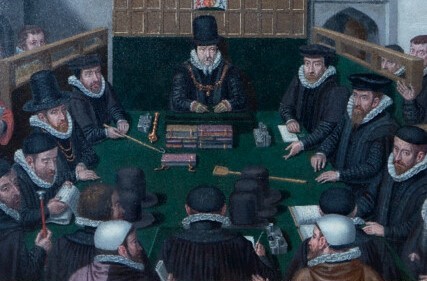
As its military justification fell into abeyance during the thirteenth and fourteenth centuries, so also had wardship, although it was then vigorously re-imposed from the time of Henry VII (r.1485-1509) onwards, emphatically for fiscal purposes. Forcible changes to the land law and an expanding bureaucracy meant that by the eve of the civil war, roughly 150 to 180 children entered wardship every year. Illustrative is the case of one Dorothy Dethicke. On the death of her father in 1594, she inherited a freehold estate yielding approximately £250 per annum. As a portion of these lands were held of the Crown by knight’s service and given that Dorothy was only six and yet to reach her majority, the Crown claimed custody of her body, her lands and to choose her marriage partner. As was customary, Dorothy’s wardship was sold on to a third party, who in turn sold her to a neighbour in Derbyshire, John Harpur – little wonder contemporaries often compared wardship to cattle markets. Harpur then married Dorothy off to his youngest son, thereby securing for him a mid-sized estate and one that stayed in his family for 225 years. What Dorothy or her surviving family thought of all this is unrecorded and the case of Dethicke was typical of thousands of other wardships during this period. Moreover, wardship had tangible economic consequences. Wards’ lands were essentially asset-stripped, with woods chopped down, lands over-cropped and the wards themselves left neglected and uneducated – “sheep committed to the wolf” in one contemporary comment.
Conceivably, if the state had been capable of collecting and allocating the funds raised by wardship effectively, this might have countervailed some of the economic costs it imposed. However, due to the malfeasance of its officers, only a very small proportion of potential revenues accrued to the Crown: wardship was emblematic of the atrophying capacity of the early modern English state prior to the Civil War. Returning to Dorothy Dethicke, when the Crown first sold her wardship the price was £53. When she was re-sold by a third party, the sales price was £866, a mark-up that was representative of the secondary market in wardships. For all the damage wardship inflicted, physical and emotional, the Crown was capable of appropriating only a very small fraction of the potential proceeds.
The book also shows how secure property rights, that is the right to draw an income from a property, to alter and/or transfer it to other parties (including heirs), and to maintain it from intrusion were all undermined by wardship; this partly helps to explain why the jurist William Blackstone believed that the Tenures Abolition Act (1660), which abolished wardship and the feudal-military tenures underpinning it, was the “great[est] acquisition to the civil property of this kingdom than even Magna Carta”. It also means that institutional change during this period, of which the abolition of wardship was only one component, was such that it might be invoked as the leading cause of the industrial revolution.

Institutional Change and
Property Rights before the
Industrial Revolution by
Sean Bottomley
Keep up with the latest from Cambridge University Press on our social media accounts.




Latest Comments
Have your say!