

Products and services

Our current understanding of philosophy is a relatively recent invention. It took shape in late eighteenth-century Germany, when a small group of scholars redefined what philosophy was and how its history should be told. In his “What Counted as Philosophy in the Italian Renaissance?” (2013), Christopher Celenza mentions Johann Brucker, who, in his Historia Critica Philosophiae (1742), contrasted the traditional canon with a new framework he sought to construct.[i] The older canon conceived the history of philosophy as a gallery of moral exemplars, told through the lives of eminent figures. The new canon, by contrast, shifted the focus to the systematic articulation of abstract ideas and problems; above all, epistemological and metaphysical ones. Brucker, however, was not alone. As Peter Park and Daniel Smith have more recently shown, other influential figures included Christoph Meiners, Dietrich Tiedemann, Wilhelm Tennemann, and, most famously, Hegel, all of whom shaped what we now take for granted as philosophy and its history.[ii] Collectively, these scholars persuaded generations of thinkers that philosophy originated in ancient Greece, was transformed in the modern era by Descartes, and evolved further through the works of Locke, Spinoza, Leibniz, Hume, and Kant, as a seamless historical continuum of coherent and self-contained intellectual systems, each unfolding from the other in an unbroken chain of logical succession.
This new philosophical canon not only excluded most non-European thinkers; it also marginalized the Renaissance and the humanist tradition.[iii] The idea of “philosophy” as concocted in the late eighteenth century admitted only what fit within its newly circumscribed definition. Humanists, poets, historians, rhetoricians, indeed, anyone engaged in forms of knowledge that did not aspire to the icy slopes of certainty, were largely omitted. Philosophy’s history was redefined as humanity’s timeless quest to solve abstract, perennial problems, and presented as the teleological evolution of “pure” reason.[iv]
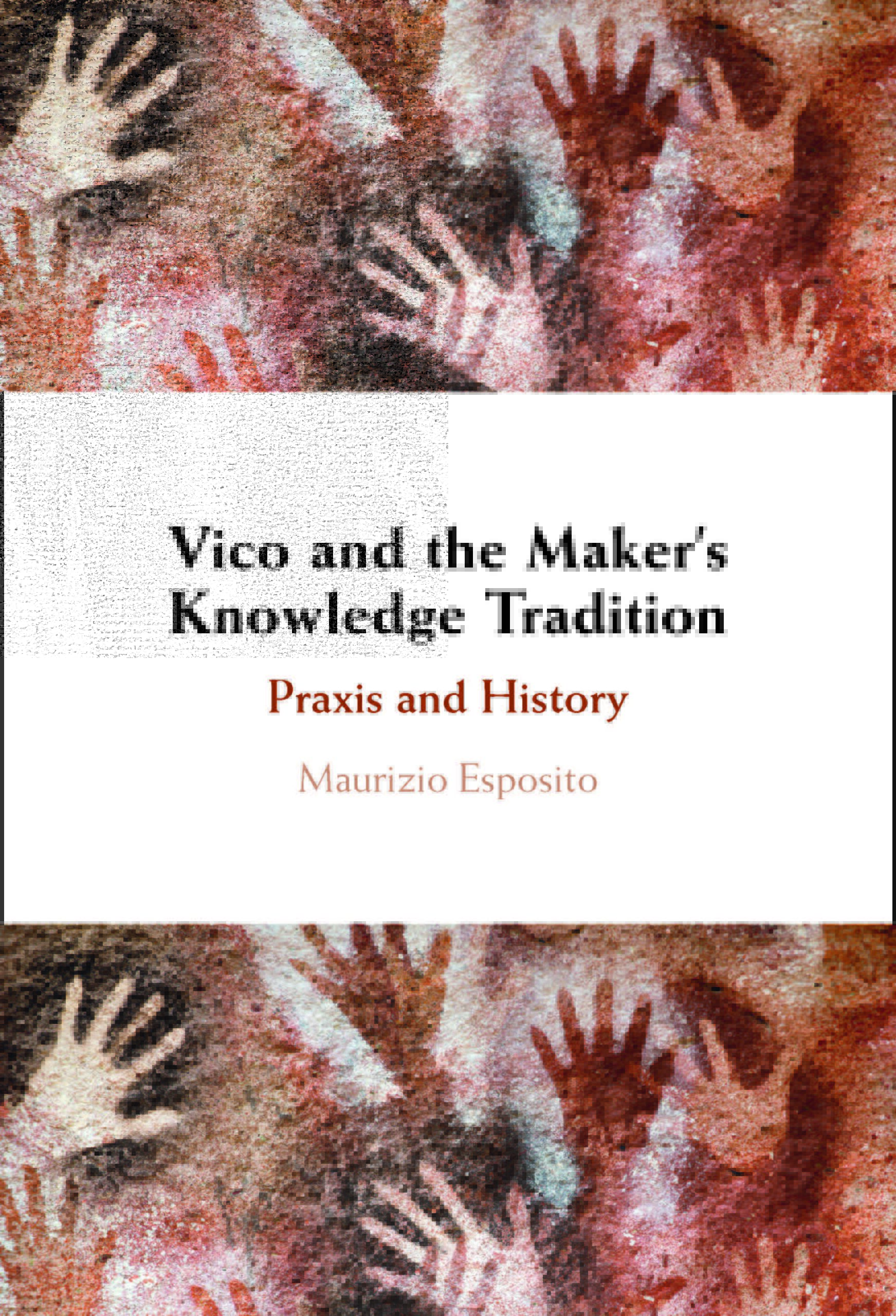
The book Vico and the Maker’s Knowledge tradition situates Giambattista Vico within the larger history of exclusions and redefinitions that have shaped philosophy’s modern identity. Vico, of course, was unaware of these later developments, nor could he have foreseen how philosophy would be redefined at the turn of the eighteenth and nineteenth centuries. Nevertheless, he was already concerned that an older form of philosophical wisdom was being displaced by the Cartesian notion of ahistorical rationality. At the same time, however, Vico was not a nostalgic voice clinging to the past. He was, after all, in pursuit of a new science. Rather than rejecting any kind of modernity, he sought to redefine it by re-establishing philosophy within the human realm, upholding the humanities as our most vital instruments for understanding ourselves and the world we inhabit.
If one theme runs through all the chapters of this book, it is Vico’s provocative claim (perhaps more disquieting to us today than at Vico’s times) that human sciences form the true foundation of knowledge. We are more accustomed to thinking of the natural sciences as the firm ground upon which human sciences stand. For Vico, however, the relationship is reversed: the abstractions of the natural sciences become intelligible only when set against the human historical world, the proper domain of the human sciences. Central to his thought is the principle that we only know what we ourselves have made. From this premise, Vico raises a series of provocative questions about the nature of human knowledge: Can we truly know what we have not made? Do we construct abstract entities, such as numbers, lines, figures, analogies, metaphors and the like, to comprehend a world not of our making? How does this abstract, mathematized universe relate to the everyday world as we actually live and experience it? For Vico, the answer lies in returning to history: to the human collective activities that continually generates those “abstractions” through which the world becomes meaningful and comprehensible.
Two centuries later, when Edmund Husserl remarked in his Crisis of European Sciences that “merely fact-minded sciences make merely fact-minded people,” he was, in his own way, reviving a Vichian intuition. To grasp what the “facts” of the natural sciences truly consist of, we must move beyond the natural sciences themselves and ground inquiry in concrete human history. For this reason, the natural sciences cannot provide the foundation of the human sciences; rather, it is only through the human sciences that the natural sciences become intelligible. The position, of course, does not diminish the importance or achievements of the natural sciences; it merely asserts that its products can be fully understood only when contextualized within the concrete historical experience of humanity. While Vico never employed a term like “lifeworld,” his insistence on the historical and situated character of the human mind positions him as a precursor for all who hold that praxis and history precede any kind of abstraction and theoretical endeavor.
In short, the book deems Vico as a compelling figure for rethinking both philosophical canons and their counter-canons. The very impossibility of situating his thought within modern categories, i.e., empiricism, rationalism, idealism, materialism, premodernism, or modernism, is itself instructive. It recalls a moment when philosophy embraced possibilities far broader than the rigid classifications on which we now rely. Ultimately, the book suggests that a twenty-first-century re-reading of Vico not only urges us to reconsider the philosophical canon inherited from the eighteenth century but also to prompt us to imagine a new one: richer, more inclusive, and more responsive to the concerns of our own time.
[i] Celenza C.S., 2013 What Counted as Philosophy in the Italian Renaissance? The History of Philosophy, the History of Science, and Styles of Life, Critical Inquiry, 39 (2):367-401
[ii] Park P.K., 2014, Africa, Asia, and the History of Philosophy: Racism in the Formation of the Philosophical Canon, 1780–1830, Suny Press, Smith D. J., 2024, On the Historiography of Philosophy and the Formation of the Canon, Idealistic Studies 54 (3):305-327
[iii] Celenza, 2013
[iv] See Park, 11, 2014

Maurizio Esposito teaches History of Science in the Department of Philosophy 'Piero Martinetti' at the University of Milan. He has published widely on the history and philosophy of...
View profile >Keep up with the latest from Cambridge University Press on our social media accounts.


Latest Comments
Have your say!