

Products and services

Most Americans (and economists) are clueless regarding the racial wealth gap
A recent study asked over a thousand people their perceptions of the wealth gap between White and Black Americans. Respondents were invited to compare the wealth of a typical Black household assuming White households held $100, both currently and in 1963. They could choose among answers that ranged from $10 to $200. The typical answer to current circumstances is that Black households hold $90 for every $100 held by Whites. Turning to 1963, they estimated that Black households held not quite $50 (just under half) for every $100 held by Whites. Although at odds with reality, these figures corroborate the dominant narrative that Black progress over the decades has largely eliminated any racial disparities in wealth.
Orthodox economics predicted and fully supported the unfolding of this narrative. In 1963, Jim Crow laws, ordinances, and social mores ruled across America. Non-White Americans were told where they might attend school, which occupations and jobs they might aspire to, and where they might live. Racial discrimination was the law of the land. The enactment of the Civil Rights Act of 1964 outlawed all of these imposed barriers to Black progress. Absent these legal barriers, orthodox economic theory predicted market pressures would discernibly and relentlessly reduce racial disparities. The racial income gap would erode over time while the wealth gap would shrink to resemble the declining income disparities.
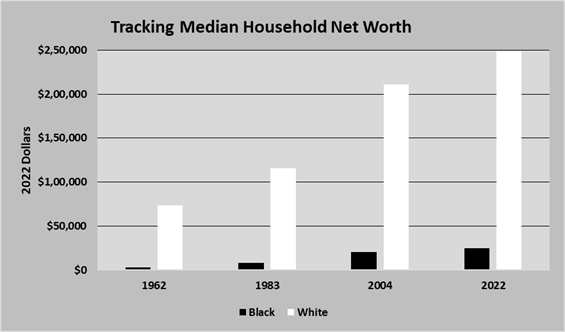
Yet the evidence suggests otherwise. The graph below tracks the White and Black median household net worth over the past 60 years. The reported figures are all adjusted to 2022 dollars to exclude the obscuring effects of inflation. While Black wealth has increased over the period, White wealth has grown even more. The absolute difference between White and Black median household wealth has tripled from about $70,000 in 1962 to over $210,000 today. This trend stands in stark contrast to the perception of typical Americans and to the theories of orthodox economists.
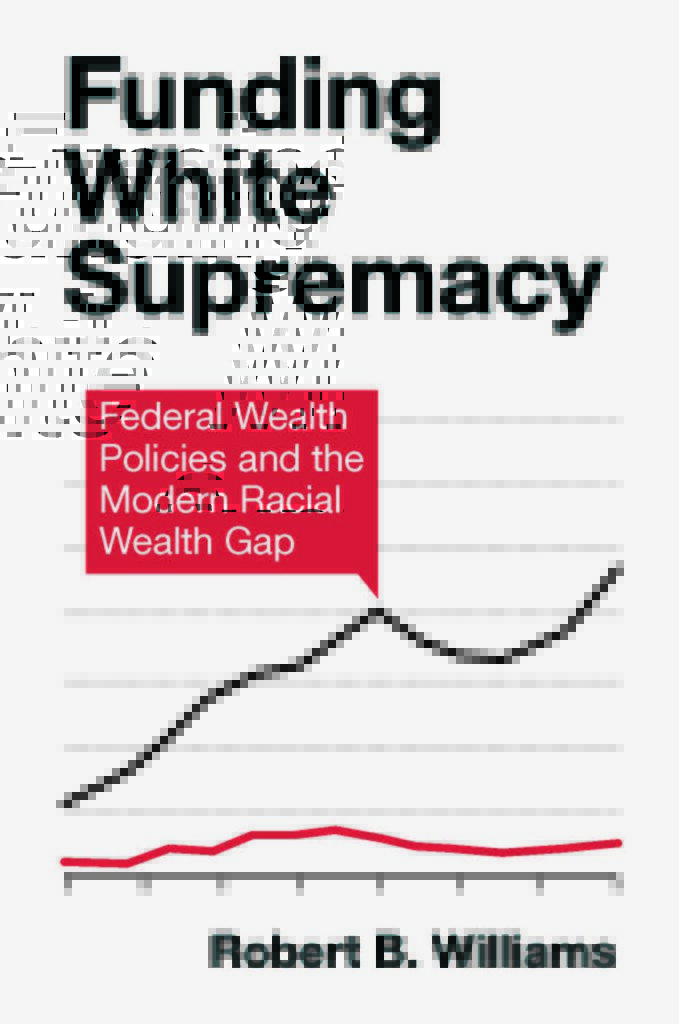
Providing an explanation for this expansion of the modern racial wealth gap is the motivation for writing my book, Funding White Supremacy: Federal Wealth Policies and the Modern Racial Wealth Gap. To do so, I use the lens of stratification economics. I contend that household wealth functions as a source of power that offers many benefits. Stated bluntly, “Ownership carries with it domination; its absence leads to subordination” (Franklin, 1991, p. xviii). Moreover, wealth’s durability and transferability makes it uniquely positioned to assure such stratification extends across generations.
Consider learning more about how federal wealth policies, past and present, have created and expanded the racial wealth gap and thereby continued to fund White (wealth) supremacy.

Robert B. Williams is the Stedman Professor of Economics at Guilford College. He is the author of The Privileges of Wealth: Rising Inequality and the Growing Racial Divide (2016). ...
View profile >Keep up with the latest from Cambridge University Press on our social media accounts.




Latest Comments
Have your say!