
Products and services


Corruption is often treated as an obvious problem with an obvious explanation. Public officials, driven by self-interest, abuse their positions; to stop this behavior, we need better incentives, stricter enforcement, and stronger institutions. This way of thinking has shaped decades of research and policy, producing global rankings, reform toolkits, and a vast anti-corruption industry worth billions of dollars. Yet despite this sustained effort, corruption remains remarkably persistent across much of the world. This persistence raises a troubling possibility: that the problem lies not only in corruption itself, but in how we have come to understand it.
A closer look at how corruption works in practice complicates this familiar story. In Cambodia, for example, people selling land routinely rely on fixers r low-level officials who guide transactions through a complex and often dysfunctional bureaucratic system. These intermediaries collect lump-sum payments that cover both official fees and informal payments to multiple offices. To reduce costs, land is frequently underpriced on paper, lowering tax obligations and freeing up resources to keep the process moving. From a conventional perspective, this looks like straightforward rent-seeking. But from the ground up, it reflects deeper conditions: newly established property rights, unclear and contested rules, weak bureaucratic capacity, and a political order organized around patronage. In this setting, informal payments do not simply obstruct formal procedures; they often make them work at all.
Seen this way, corruption is more than individual wrongdoing or moral failure. It is embedded in broader social, organizational, and historical processes. Practices labeled corrupt may respond to institutional gaps, sustain bureaucratic coordination, and become integrated into political hierarchies over time. What appears as deviance from formal rules may instead reflect how people navigate uncertainty and power differentials in everyday interactions with the state. Understanding corruption therefore requires moving beyond abstract definitions toward examining the conditions under which particular practices arise and persist.
This perspective also helps explain why standard anti-corruption prescriptions so often fall short. In the early 2000s, international organizations recommended familiar reforms in Cambodia: raising civil servants’ salaries, promoting them on the basis of merit, increasing transparency, and requiring asset declarations. These measures look sensible on paper. Yet, they assume a state with both the capacity and the political will to implement them faithfully. They also assume that corruption is primarily a problem of low pay or weak oversight, rather than one rooted in patronage networks that span ministries, bureaucratic ranks, and political parties. Higher salaries may reduce individual desperation, but they do little to release officials from obligations to superiors or from expectations to channel resources upward through informal hierarchies.
In our edited volume, Comparative-Historical Sociology of Corruption, we develop an argument for analyzing corruption a socially embedded phenomenon. Rather than offering a new definition or typology, the volume advances a process-oriented approach that embeds corruption in social relations, traces its historical development, and compares cases by the dynamics that produce different corruption environments. The chapters span an unusually wide range, from early modern imperial formations to contemporary states and transnational governance regimes, showing how corruption takes different forms as configurations of power shift across time and space. Taken together, they demonstrate that corruption is neither a timeless pathology nor a problem unique to any one political system, but a historically situated mode of action shaped by changing relations between rulers and subjects, states and markets, and national and global authorities. Seeing corruption in context, we argue, is a necessary first step toward thinking more realistically and more productively about how to address it.
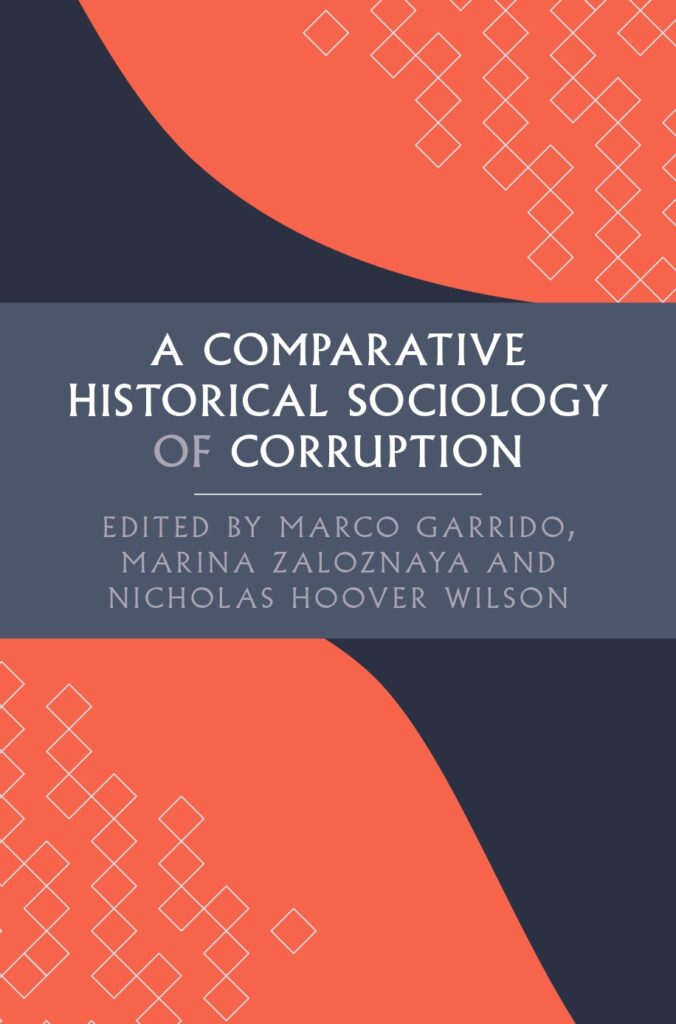

Marco Garrido is Associate Professor of Sociology at the University of Chicago. He is the author of The Patchwork City: Class, Space, and Politics in Metro Manila (2019)....
View profile >Marina Zaloznaya is Associate Professor of Criminology at Arizona State University and Executive Director of Corruption in the Global South Research Consortium. Her research explor...
View profile >Nicholas Hoover Wilson is Associate Professor of Sociology at Stony Brook University. He is the author of Modernity's Corruption: Empire, Morality, and the Making of British India ...
View profile >Keep up with the latest from Cambridge University Press on our social media accounts.


Latest Comments
Have your say!