

Products and services

If you’ve ever spent any time with kids, you probably know the drill: “Why are leaves green?” “How does the microwave make food hot?” “Why is snow cold?” “How do airplanes stay in the sky?” Our own kids can turn the simplest observations into an unending chain of hows and whys. And while these moments can test a parent’s patience, we also think they reveal something deeper about all of us: humans are naturally driven to understand how and why things work.
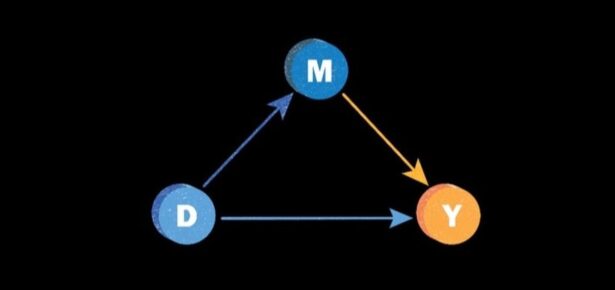
Causal mediation analysis is the grown-up, scientific version of this childhood curiosity. It tackles questions like: Why does a new medication reduce the risk of disease? Why does attending college reduce depression later in life? How does a job training program increase employment and earnings—is it because it imparts skills, boosts confidence, or builds network connections? Mediation analysis focuses not just on whether a cause affects an outcome, but how and through which mechanisms that effect unfolds.
Understanding these mechanisms enriches our understanding of the world around us. Knowing why job training boosts earnings—whether through skills, confidence, or networks—helps us see how the intervention actually worked. This deeper understanding doesn’t just satisfy our own curiosity about how the world works, important as that is. It also provides a stronger foundation for decision-making, and it helps us refine interventions so they can be more effective in the future.
Mediation analysis also improves theory. Many theories posit specific causal chains linking one phenomenon to another, and competing theories often provide different explanations for the same observations. By investigating mechanisms, researchers can test and refine these theories to help make them more reliable guides for both scholarship and practice.
But figuring out why something works is more complicated than just showing that it works at all. Even when randomized experiments can identify whether a treatment causes an outcome, uncovering the pathways in between requires assumptions that must be carefully articulated and scrutinized. Moreover, experiments specifically designed to reveal causal mechanisms are challenging to execute, and observational studies make it difficult to rule out alternative, confounding explanations.
Nevertheless, although mediation analysis is hard, it is not hopeless. Humans have been reasoning about causal chains for millennia—often quite successfully, even without the advantages of modern science. The task before contemporary researchers is simply to do so more rigorously. With the right conceptual framework and analytic tools, it is possible to accurately learn about the mechanisms that connect causes to their consequences.
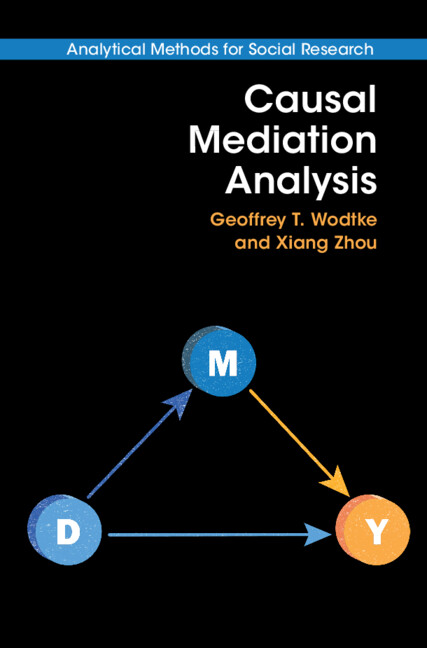
Our book aims to provide exactly these tools. By introducing core concepts, guiding readers through increasingly sophisticated methods, grounding our explanations in real applications from across the social sciences, and offering comprehensive software for implementation, we aim to help researchers answer one of the most enduring, and most human, questions in science: why?

Geoffrey T. Wodtke is a Professor in the Department of Sociology and Committee on Quantitative Methods in Social, Behavioral, and Health Research at the University of Chicago. He i...
View profile >
Xiang Zhou is Professor of Sociology at Harvard University, where he is also affiliated with the Institute for Quantitative Social Science and the Harvard Data Science Initiative. ...
View profile >Keep up with the latest from Cambridge University Press on our social media accounts.




Latest Comments
Have your say!