

Products and services


First, in China, mediation is not the “soft periphery” of law but one of the system’s operating cores. It is embedded across institutions: from people’s mediation at the grassroots, to court-led or court-annexed programs, to specialist venues in commercial, labour, and family fields. Even in Shanghai, China’s most developed and open city, the majority of civil and commercial disputes accepted by the courts are commonly resolved through mediation, with a reported rate exceeding 60%, and even higher reliance in less developed regions. These figures do not include the numerous other forms of mediation that exist across society. Mediation is not a way around law; it is a principal way Chinese law takes concrete form. Unlike common-law systems that heavily emphasise appellate reasoning and precedent, to overlook mediation in China is to miss how law in action actually works.
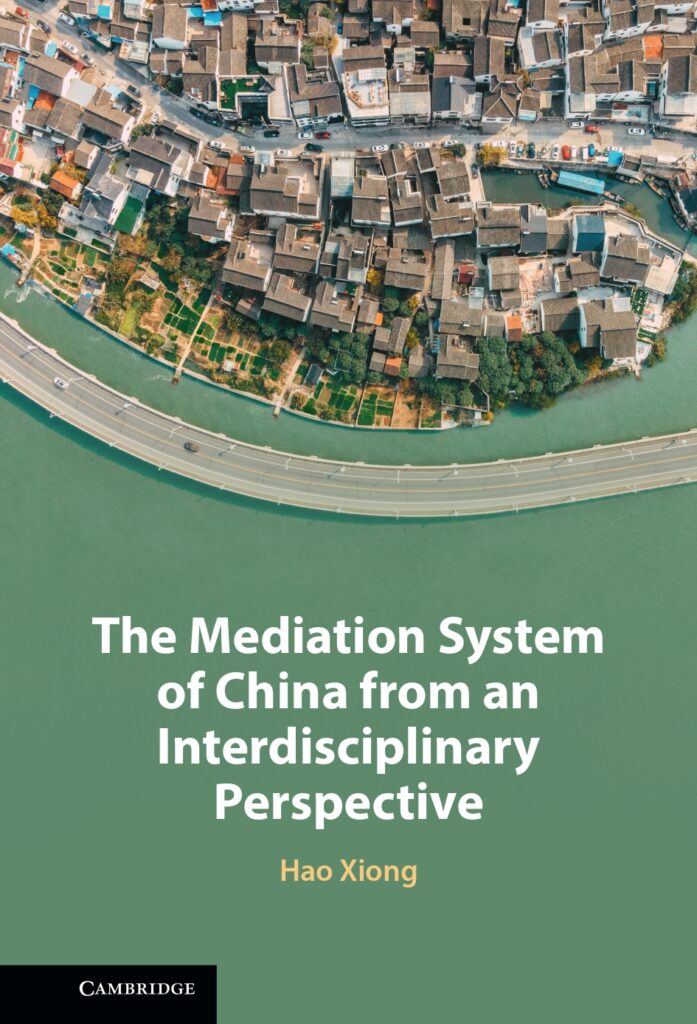
When many outsiders hear “mediation in China,” they picture village worthies, moral exhortation, and informal compromises. Contemporary practice is far more structured and surprisingly instructive for anyone who studies how law actually works. In my new book, The Mediation System of China from an Interdisciplinary Perspective, I examine the cultural foundations of mediation, its historical trajectory, the legal and policy architecture, and how courts and grassroots institutions actually deploy this mechanism, including its strengths and constraints. The aim is to reconnect doctrinal law with lived practice and to demonstrate how, in a country with a vast population and extensive administrative capacity, mediation serves cultural, political, and legal purposes: resolving disputes, maintaining social harmony, and fostering order and compliance.
Second, the book demonstrates the potential of an interdisciplinary approach and highlights the “Chineseness” of Chinese law, specifically China’s social-institutional context. Classic socio-legal and legal-anthropological insights, combined with a century of legal development in China, suggest a simple claim: it is not law that determines China; rather, Chineseness shapes the law. This is not cultural essentialism but an empirical point about how legal meaning is produced. If we confine ourselves to black-letter analysis, focusing only on sliced-up “legal cases” rather than on people, structures, interactions, and the jointly constituted “problem”, we risk mistaking law for something that can exist apart from context. Only by fusing lenses, legal analysis (principles and authority), sociological and anthropological attention to processual texture, and political-institutional analysis of incentives and performance metrics, can we understand mediation and, through it, more fully refract the Chineseness of law.
Third, the book employs two case-centred chapters to address a common misconception about “statism.” A popular line in Chinese commentary calls China “a civilisation disguised as a state”, a rhetorical shorthand for striking regional variation within a unitary polity. Because the ideal of equality before the law does not always register such variation sensitively, mediation, being exposed to culture-bearers and micropolitics, often foregrounds local knowledge. This vantage moves us beyond a monolithic image of Chinese law: not “Chinese law is X,” but that within China, the same national rules can be practised in very different concrete forms. It situates China as a highly heterogeneous organic whole, where vibrant differences should not be obscured by the curtain of political unity.
Mediation is not a detour from the law, but one of the law’s primary operating modes in Chinese society. To grasp Chinese law and to reflect on our own systems, we must watch not only how judges decide but also how institutions help people turn rules into workable harmony after conflict. Seen this way, mediation functions as a governance technology that links black-letter rules to everyday compliance and relationship repair, shaped by the country’s social-institutional context while allowing, and disciplining, local variation. In short, mediation is where law most visibly moves from text to life.


Hao Xiong is Associate Professor of Law at Fudan University and a Fulbright Scholar (Harvard Law School). Trained at the University of Hong Kong (PhD), he studies mediation, legal ...
View profile >Keep up with the latest from Cambridge University Press on our social media accounts.




Latest Comments
Have your say!