

Products and services


One afternoon, having just clocked in, I sat down next to a resident of the care home where I worked in the mid-2010s and asked her what she thought about the programme she was watching on TV. Looking away from me, with a wry smile, she answered, “Well, I can relate to it”. The programme in question was the much-loved 1970s sitcom Porridge, starring Ronnie Barker as a recently convicted prison inmate.
This was not the first time she had expressed this sentiment. More than once, I’d heard her tell a resident, after introducing herself, that “it’s a bit like prison here: I have to ask what you’re in for”. And this was not an attitude isolated to a single person. Much about residential care homes is reminiscent of punishment, rather than treatment, and this is especially true of those that house people living with dementia. To this point, dementia self-advocate Christine Bryden has referred to this familiar part of our social care infrastructure as “dementia prison”.[1]
As a care home employee, it was not uncommon for me to feel more like a prison guard than a therapeutic professional. Most people with even a passing interest in social care will have heard the much rehearsed arguments about staffing and time pressures, but few other than those who have worked under those pressures can know the strain on the carer’s moral decision-making capacities and the visceral sense of disempowerment they face when they cannot attend to all of their charges’ needs unless they cut corners and do the bare minimum.
Caring in such circumstances makes it all but impossible to view the work as collaborative. There is no time to slow down to meet a person living with dementia’s own pace. There is little space to empower people to meet their own needs or to work creatively to identify and remove sources of anxiety or stress. The relationship, instead, becomes oppositional, with anything short of total acquiescence becoming an obstacle to the carer’s completion of tasks that are notionally being performed for the benefit of their charge.
Dementia carers wield power. Because of the nature of the condition, that is to some extent inevitable. But the circumstances in which they provide care, very often, compound that inequality of power with an inequality of status. The person living with dementia becomes the inferior, mere dependent, whose choices are overridden and whose wider interests are ignored, while their carer becomes something of a tyrant: ordering them around, forcing them through tasks at a speed they struggle to keep up with, and treating them as a problem to be solved.
In my time working in social care, I never met a single carer who relished holding this power. And I was not the only one who tried to do what I could within the strictures of the role to care in a different way. But dementia carers cannot relate to their charges as equals in a wider social context that casts them as inferiors. Solving this problem requires addressing the social processes and structures that shape our dementia care services, and implementing social care reform that places egalitarian relations at its heart.
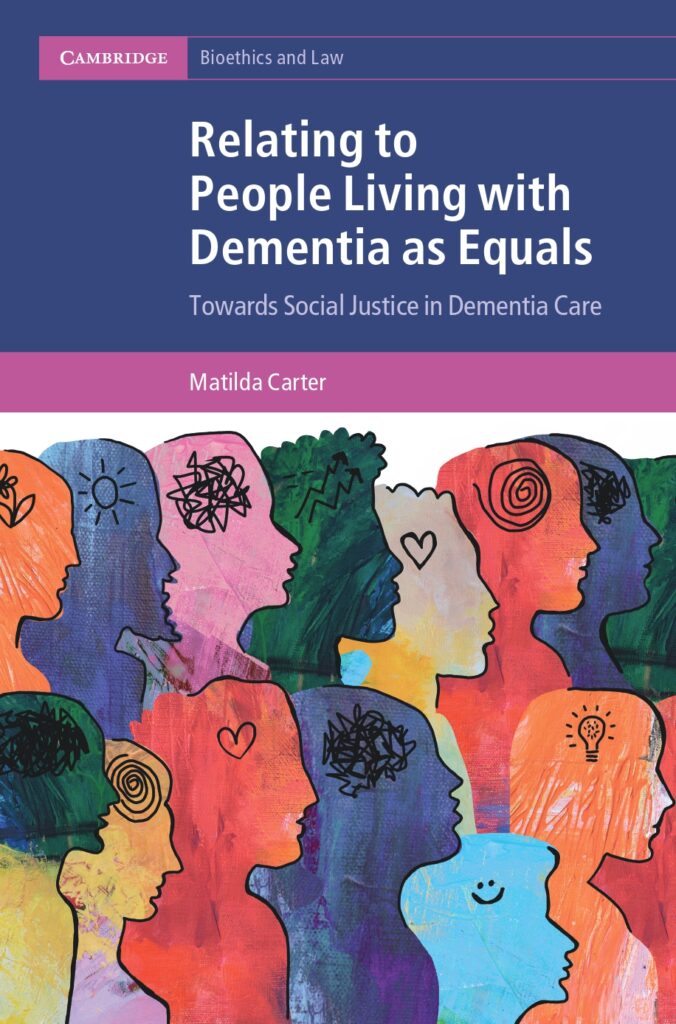
These issues, among others, I explore in detail in my new book, Relating to People Living with Dementia as Equals: Towards Justice in Dementia Care, from Cambridge University Press.
[1] Christine Bryden, Nothing About us, Without Us!: 20 Years of Dementia Advocacy (London: Jessica Kingsley Publishers, 2015), 185-187.

Matilda Carter is a Lecturer in Applied Ethics at the University of Leeds, with a decade of experience in professional social care. She has published in leading journals like Analy...
View profile >Keep up with the latest from Cambridge University Press on our social media accounts.




Latest Comments
Have your say!