

Products and services


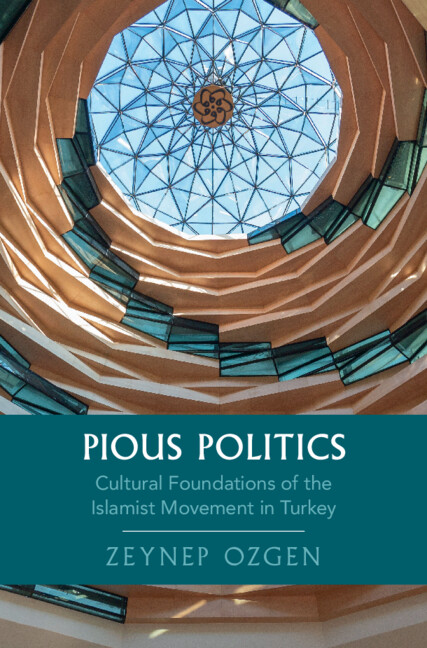
In 2002, the Justice and Development Party (AKP), a group with deep roots in religious politics, won a decisive electoral victory in Turkey. The party secured a majority of the national vote, formed a single party government, and subsequently remained in power for more than two decades. To longtime observers of Turkish politics, the idea that a party with deep roots in Islam could both gain state power in a secular country and endure for this long would have seemed far-fetched. Since Turkish Republic’s establishment in 1923, secular laws have periodically denied legitimacy to religious ideas, publications, and civic organizations, thus forcing them underground. Meanwhile, military coups in 1971, 1980, and 1997 shut down Islamist parties, jailed or banned their political leaders, weakened Islamist grassroots organizations, and marginalized their sympathizers. Yet, the Islamist actors reconstituted themselves after each crisis and returned to the political scene most notably in 2002, a mere five years after the 1997 repression. Explaining the Islamist movement’s political rise and resilience is the primary aim of Pious Politics: The Cultural Foundations of the Islamist Movement.
Based on two years of ethnographic and archival research in Turkey, Pious Politics argues that Islamists’ seizure and enduring control of state power depended, among several factors, on the cultural groundwork they laid and the ensuing sociocultural transformations they effected over the course of the twentieth century. This cultural groundwork grew in the context of the secular state’s ambivalence, which alternated between suppressing and tolerating political opposition. Islamist leaders reacted to shifting rules of the political landscape by adapting to it. The adaptive responses were embodied in what I call a dual model of mobilization, which rested on working within the secular system to gain a legal foothold, to influence its policies, and to avoid repression, while continuing to work outside of it through a vast network of aboveground and underground organizations designed to socialize individuals into dissident visions. The extended networks established by Islamist groups sought to strengthen individuals’ piety (takva) and subsequently enlist them in pious activism (tebliğ). This reform and recruitment centered on a long and gradual process of socialization and habituation that I call dispositional training. Through dispositional training, activists cultivated daily habits and achieved a tacit agreement on a comprehensive vision of Islam. The scope of transformation Islamists generated has been vast, including changes in individual demeanor and physical appearance, principles guiding family life, spousal roles, interactions between sexes outside the home, standards of leisure and consumption, rules of financial transactions, and modalities of artistic and intellectual engagement, among others.
But while dispositional training targeted lifestyles, it also cultivated the Islamist political subject. Islamists accomplished these goals by linking individual choices to macro social problems. Following the Sunni revivalist critique articulated by prominent Muslim thinkers in the twentieth century, activists urged people to become more pious in order to solve the problems they attributed to secularism, Western domination, and ensuing internal religious decline. In particular, Islamists leveraged dispositional training to teach people to act politically in everyday life, situating personal choices on dress, speech, comportment, entertainment, or social relations against a particular sociopolitical worldview (e.g., secular, socialist, liberal, feminist, or atheist) and a form of political representation (e.g., leftist, progressive, and, in some cases, nationalist). Building on these empirical arguments, Pious Politics expands our understanding of how culture works politically. It argues for disaggregating the less studied but equally relevant cultural processes of politics, such as habituation and socialization, that movements leverage to bring macro-political concerns to bear on individual practices. Specifically, it suggests shifting our focus from a narrow conception of power as coercive force or voluntary submission to a broader notion of power as the ability to impose a particular understanding of reality, demarcate the limits of normalcy, and prevent the emergence of alternatives. What is at stake for Islamists, as with other world-making movements, is the power to impose definitions that shape personal practices as much as to gain the capacity to organize sanctions that ensure willing obedience. Pious Politics shows that such movement work, while certainly less visible than engaging in legislative politics or in public demonstrations can be just as effective for creating sociopolitical change.

Zeynep Ozgen is Associate Professor of Sociology at New York University Abu Dhabi. Her research interests include the role of culture in politics, with a regional focus on the Midd...
View profile >Keep up with the latest from Cambridge University Press on our social media accounts.




Latest Comments
Have your say!