
Products and services

Any resident of the United Kingdom will have undoubtedly noticed the proliferation of St George’s Crosses and Union flags of late. Whereas I used to see a few such flags on my drive to work – often rather tired looking remnants from some sports tournament or royal celebration – I now see many more hanging from lampposts and, in the case of the St George’s flag, newly painted on roundabouts.
Flags mean different things to different people. For some, the St George’s flag represents a straightforward and sincere expression of national pride; others see this symbol as a means of making a point about immigration or even intimidating those they perceive as in some way un- or less English or British. A clear example of the latter occurred in a town not far from where I teach, when St George’s Crosses were sprayed near a mosque and Islamic centre in Reading. The power of flags in many respects lies in their ability to achieve a wider resonance by evoking patriotic and nationalist sentiments yet also allowing individuals to affix their own particular visions of a nation’s past, present and future to them. Their power, put simply, lies in both their symbolism and malleability.

A St. George’s Cross painted near a mosque and Islamic centre in Reading, UK.
Credit: BBC (https://www.bbc.co.uk/news/articles/cy858r9zk47o)
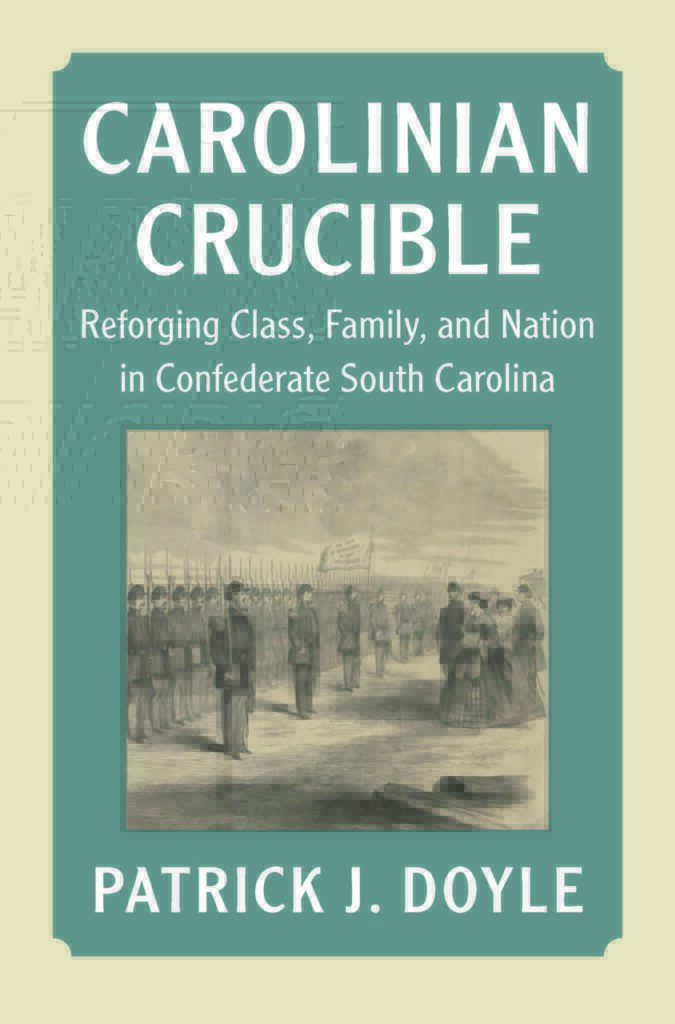
It may seem strange to try and better understand the current fixation with flags in the UK by rolling back 165 years and jumping across the Atlantic, but the US Civil War offers some interesting parallels and points of contrast. In my new book, Carolinian Crucible: Reforging Class, Family, and Nation in Confederate South Carolina, I discuss the role of flags and flag presentations in the mobilization for war. With states such as South Carolina having seceded from the United States and created the Confederate States of America, national allegiance found itself in a state of flux during the winter of 1860/61. Moreover, the outbreak of war in April 1861 meant that this new southern nation needed men to volunteer and fight for it. Flags and their accompanying presentations to volunteers by local communities in the spring and summer of 1861 proved a valuable tool in helping to define and solidify support for the enslavers’ republic.
To be clear, the flags I am talking about in this blog post were not national flags. Instead, these were bespoke creations that women manufactured or otherwise procured before gifting them to local military organizations. This was an era in which national flags couldn’t be purchased with a few clicks on a smartphone and, more to the point, the flag of the new Confederate nation at this time, the “Stars and Bars,” had existed for mere months and proved somewhat divisive because of its resemblance to the US flag. The wider context, then, was rather different.
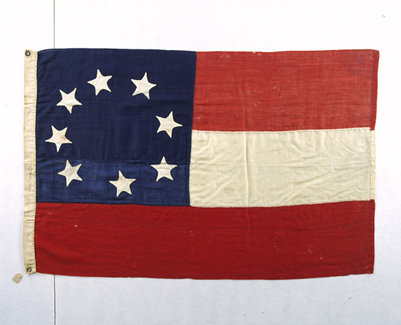
The first national flag of the Confederate States of America, adopted in March 1861. The flag was known as the “Stars and Bars”.
Credit: Smithsonian National Museum of American History (https://americanhistory.si.edu/collections/object/nmah_461713)
The flags prepared for and presented to early volunteers nonetheless remain revealing, for they suggest how flags can encapsulate different views on and constructions of patriotism. These flags, and the speeches which accompanied their presentation to local military organizations in South Carolina, often evoked and even wove together an array of allegiances. Beginning closest to home, the fact that these flags were produced by local communities meant that they in some respects embodied ties of kith and kin. But they also stood for broader attachments to state, nation, and religion, whether that be accomplished through overt symbolism on the flag itself or oratorical embellishments when it was presented. Regardless of whether an individual volunteered to defend their family, their state, their new nation and the racial slavery it was built upon, their god, or a combination of all these motivations, many could see their cause – sometimes quite literally – in these flags.
Albeit in different ways and in different contexts, both Civil War South Carolina and modern Britain show how flags can promote a sense of a shared past and national identity but that they do so in a fuzzy way that enables people to still hold on to distinctive, even competing, visions of self and nation. For this reason, flags remain beguiling symbols capable of fostering unity and disunity, then and now.
Keep up with the latest from Cambridge University Press on our social media accounts.




Latest Comments
Have your say!