

Products and services

Two enduring truths shape the study of human rights. First, states violate the rights of their own citizens at an alarmingly high rate. Second, these same states are rarely held accountable for their actions. Despite decades of international advocacy, treaties, and tribunals, impunity remains the norm.
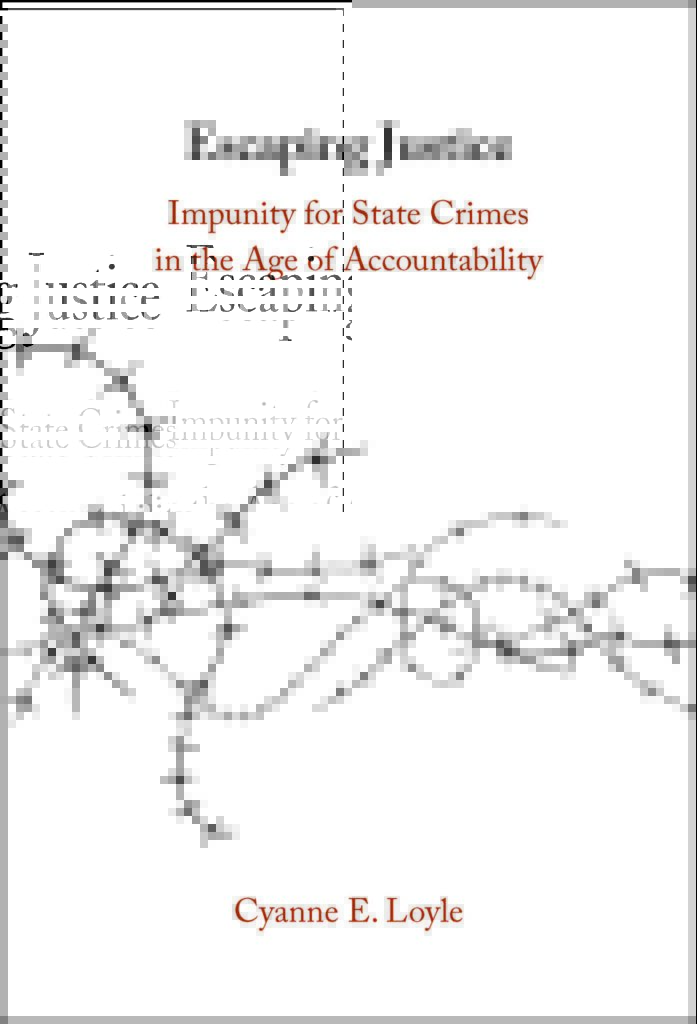
My new book, Escaping Justice: State Impunity in the Age of Accountability, examines this paradox. It asks a deceptively simple but politically charged question: justice for whom? In particular, who is held accountable for gross violations of human rights, and who escapes scrutiny? The book explores how transitional justice institutions—those mechanisms created after armed conflict or political upheaval—are structured and how their design determines whether government actors are ever held to account for their past wrongdoings.
The Politics of Accountability
Transitional justice institutions—truth commissions, tribunals, reparations, and memorialization initiatives—are often presented as technical responses to past violence. Yet, they are profoundly political. Their structure reflects not just moral imperatives or legal norms, but the balance of power that exists when violence ends.
After conflict, political transitions are moments of both opportunity and vulnerability. Governments face pressure from international and domestic actors to pursue justice, but also from their own political base to protect those responsible for violence. In this context, institutional design becomes a strategic act. Decisions about what counts as a crime, who counts as a perpetrator, and which events are remembered are rarely neutral. They are choices that shape the boundaries of accountability—and, often, preserve impunity for those in power.
This interplay between international norms and domestic politics lies at the heart of the book. While global movements for human rights have generated what Kathryn Sikkink calls a “justice cascade,” this same wave of accountability has produced counterstrategies. Governments increasingly respond to international pressure not by rejecting it, but by adapting to it—creating institutions that signal compliance while ensuring that state actors themselves are shielded from responsibility.
When Compliance Becomes Evasion
In theory, the growing international consensus around accountability should make it harder for governments to ignore past abuses. Transitional justice mechanisms have multiplied across the globe, offering new avenues for victims to seek recognition and redress. But in practice, the expansion of these institutions has coincided with the persistence—and in some cases the deepening—of state impunity.
Why does this happen? One explanation lies in how governments interpret and implement global norms. Transitional justice has become a normative expectation—a signal of membership in the community of legitimate states. Yet, the same governments that face calls to account for their violence often perceive such accountability as politically destabilizing. Admitting culpability risks undermining the state’s legitimacy and, by extension, its right to rule.
The result is what I term strategic compliance: governments create transitional justice institutions that conform to international expectations in form but not in substance. These institutions may document violence and offer symbolic gestures of reconciliation, but they do so in ways that exclude or minimize the state’s own role in perpetrating abuses. Transitional justice, in this sense, becomes a mechanism not for accountability, but for escaping it.
Case Studies: Rwanda, Uganda, and Northern Ireland
To understand how states use transitional justice to evade responsibility, Escaping Justice examines three cases: Rwanda, Uganda, and Northern Ireland.
Each of these countries represents what should be a favorable case for accountability. All experienced significant violence; all faced sustained international attention; and all implemented transitional justice. Yet in every instance, state actors avoided meaningful scrutiny for their own wrongdoings.
In Rwanda, the post-genocide government established a powerful narrative of justice through the Gacaca courts—but these mechanisms overwhelmingly targeted members of the defeated regime, leaving abuses committed by the victors largely unexamined. In Uganda, the government embraced transitional justice discourse amid ongoing conflict with the Lord’s Resistance Army. Yet, despite international support for accountability, the state’s own abuses in the north were never seriously investigated. In Northern Ireland, the peace process institutionalized a delicate balance between truth and reconciliation. While extensive efforts were made to document past violence, political compromises ensured that prosecutions remained rare and that state security forces faced limited exposure.
Across these cases, the pattern is clear: transitional justice mechanisms were implemented, but their design reflected the political imperatives of those in power. Each government selectively engaged with the norm of accountability to maintain legitimacy while protecting itself from blame.
Institutions as Instruments of Power
This dynamic highlights a broader point about institutions. They are often understood as neutral structures designed to solve collective problems and promote order. Yet institutions are also instruments of power—products of negotiation, contestation, and strategic choice.
Following Moe (2005), we can think of institutional design as inherently political: actors create and shape institutions to serve their interests and protect their positions. Understanding transitional justice through this lens reveals that impunity is not an accidental failure of accountability, but a predictable outcome of the political incentives facing governments after conflict. In post-conflict contexts, these choices have profound implications. They determine not only who is punished and who is forgiven, but also how societies remember violence and rebuild legitimacy. International pressure may constrain states, but it rarely overrides their domestic priorities.
Rethinking Transitional Justice
The international enthusiasm for transitional justice reflects an important normative commitment: the belief that accountability is essential for sustainable peace. Yet enthusiasm alone cannot overcome the realities of political power. If transitional justice is to fulfil its promise, scholars and practitioners must grapple with its dual nature—as both a tool for justice and a strategy for control.
Escaping Justice argues that the persistence of state impunity is not simply a matter of weak institutions or lack of political will. It is a product of the very way those institutions are designed and deployed. Recognizing this helps us move beyond the assumption that more transitional justice automatically means more accountability. Instead, it invites a more nuanced understanding of how justice is negotiated, constrained, and, too often, strategically avoided.
Who gets to tell the story of past violence? Whose demands for justice are heard, and whose are silenced? These are not just moral questions—they are political ones. In examining how governments shape transitional justice to escape responsibility, we gain insight into the broader relationship between international norms and domestic power. Accountability, far from being a neutral process, is itself a site of contestation—one where states continue to fight, and often win, the battle to escape justice.

Cyanne E. Loyle is the Political Science Board of Visitors Early Career Professor of Political Science at Pennsylvania State University and a Senior Researcher at the Peace Researc...
View profile >Keep up with the latest from Cambridge University Press on our social media accounts.




Latest Comments
Have your say!