
Products and services

Particularly in Western countries, where the so-called secularization supposedly hit harder than in other parts of the world, many people do not really engage with Christian liturgy. But that does not mean that they do not have opinions about it, to the contrary. The statements made are mostly influenced by commonly shared patterns of thought, claiming to be modern, enlightened, illumined, or otherwise advanced. The point, however, is that, whether the ideas are born from ignorance about or disgust towards the Christian faith, the ones holding them place themselves incomprehensively above or beyond religion. They suppose that religious practice is either a merely private affair, or a relic of the past, or a strange mixture of both.
On the other side of the spectrum, one finds people fiercely defending traditional Christian ritual praxis. They are somehow scandalized by cultural, intellectual and spiritual developments in late modern societies and see an intrinsic value in preserving things like sacraments and services. They want to safeguard them against relativist tendencies or to protect them against what they interpret as decay or decadence. Moreover, it is often the case that an apology for Christian rites goes hand in hand with strong moral and political convictions.
Interestingly, other, mainly non-Western, parts of the world deal with the Christian liturgical heritage differently. Histories of mission and a variety of cultural exchanges, benign as well as less fortunate ones, have resulted in a plethora of worship customs. It is not exaggeration to say that the numerous religious traditions with Christian elements, whether only at the surface or deep into the bones, directly impact the lives of millions of people throughout the world. However, there exist sharp contrasts between the sociocultural positions of Christians. Sometimes they are a tiny minority, either leading or undergoing things, perhaps in a hostile environment, but in other cases the context is more hospitable, or tolerant at least. Sometimes, however, Christians form the majority and dominate the political as well as the economic scene. Sometimes their majority is seriously threatened (or they experience it such), or tested, or contested, or actually already a past reality, with resultant feelings ranging from anger and resentment over nostalgia and misplaced pride towards sheer indifference.
In all these contexts, Christians celebrate and continue to celebrate the liturgy through prayer, ritual, singing, and different kinds of gatherings and symbolic actions. That is evident, of course, but strangely enough all too often overlooked. The Christian faith is mostly approached as a set of beliefs, or else as a system of norms, intriguingly enough both by Christians themselves and by non-Christians, and both by those benevolent towards the Christian religion and by those more critical towards or even dismissive of it. Yet there is a reality deeper than doctrine, ethics and a possible answer to the human search for meaning, from which all of these arguably emerge, and that is liturgy, or indeed public Christian worship.
Put differently, there may be something like a pervasive forgetfulness of liturgy or Liturgievergessenheit. This phenomenon is recognizable in various degrees among the ordinary crowd as well as in academia. Strikingly, in academic theological circles, there is even a long and strong history of downplaying liturgy. It has been looked upon as something merely practical, the assumption being that it is therefore unimportant, including things like the meaning of liturgical vestments’ colors or the details determining the use of a thurible on certain occasions. If it was taken more seriously, it was not so much for intrinsic reasons but only through the aura of thorough historical research, e.g., to determine the origin of a feast (like Epiphany) or the reading of a certain pericope from Scripture at a symbolic moment (like the visit of the magi on Epiphany, in the Roman rite).
Rare were (and still are) the occasions where liturgy was considered to (co-)constitute the essence of the Christian faith and religion. That essence was usually taken as something invisible, as something a set of people, Christians, think is the case, e.g., that God exists and that Jesus Christ is the Savior. Most attention of intellectuals reflecting on these things, theologians no less than philosophers, was directed to either the underpinning or the undermining of convictions, propositions and ideas. Most of the labor invested in thinking about the truth (claims) Christians hold on to appeared in the shape of learnt texts. These texts were analyzed, compared, discussed, disputed, rejected, agreed upon, used as a source of inspiration, etc. But very often soon put aside or forgotten, too.
The liturgy itself in the first place, but also contemporary trends in studying it, are helpful to overcome these persistent text- and idea-focused approaches typical of occidental intellectual traditions and academic cultures. There is indeed a very healthy growing awareness of the relevance of liturgy, whereby liturgy is not just one singular object about which a specified expertise is both possible and necessary, depending on one’s disciplinary perspective and education. Rather, Christian liturgy is increasingly considered, together and beyond interdisciplinary conversations, as a genuine theological reality of paramount importance.
The Cambridge Companion to Christian Liturgy aims at capturing the developments who see this and at aptly communicating about them at the right time. Liturgy is not just the ritual repertoire of traditional Christians. It is that, too, of course, but it is it only because it is also the mystery of the divine-human encounter, the beating heart of the economy of salvation, the locus of commemorating Jesus Christ’s passion, death, and resurrection, the Church’s prayer, the wellspring of Christian spirituality, the fount and apex of the life of faith, and so much more.
This puzzling richness makes liturgical scholarship, and definitely liturgical theology, the ideal anchor point for scholarly explorations of the history of faith practices, of the texts and prayers used in support of those, of ecumenical growth, of interreligious dialogue, of the caritative, kerygmatic and homiletic dimensions of the Church’s mission, of Christian spiritualities, and – not to forget – of Christian art. The liturgy has generated so many human expressions of craftmanship, creativity, ingenuity and true art, from hymns and songs over the visual arts to the interior and exterior design of buildings.
Putting all of these things together, it is impossible not to conclude that public Christian worship is highly relevant today, as a matter of fact, as relevant as it has always been and will continue to be. So, the future is to an always more intensive, interdisciplinary, and decidedly theological approach to liturgy, both in academic circles and beyond.
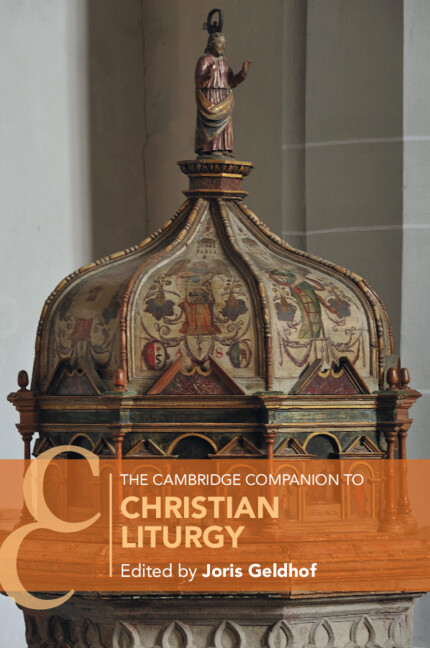
The Cambridge Companion
to Christian Liturgy by
Joris Geldhof

Joris Geldhof is Catherine F. Huisking Professor of Theology at the University of Notre Dame, Indiana, USA. Previously, he was Professor of Liturgy and Sacramental Theology at the ...
View profile >Keep up with the latest from Cambridge University Press on our social media accounts.


Latest Comments
Have your say!