

Products and services


The past ten years have been surprising, to say the least, for observers of the Latin American right. There was a time where the left was the star of the show in the region; in the 2000s and 2010s, leaders of the “Pink Tide,” such as Luiz Inácio Lula da Silva, Evo Morales, and Michelle Bachelet–much less Hugo Chávez–were far more likely to appear on the international stage (and in political science textbooks). Yet figures from the right are now the ones making their mark internationally, from Jair Bolsonaro convincing Donald Trump to levy tariffs on Brazil to Javier Milei (and his chainsaw) literally and metaphorically taking center stage at the Conservative Political Action Conference. If you were to emerge from a time capsule–and indeed, even if you weren’t–such scenes might require a fair bit of explanation.
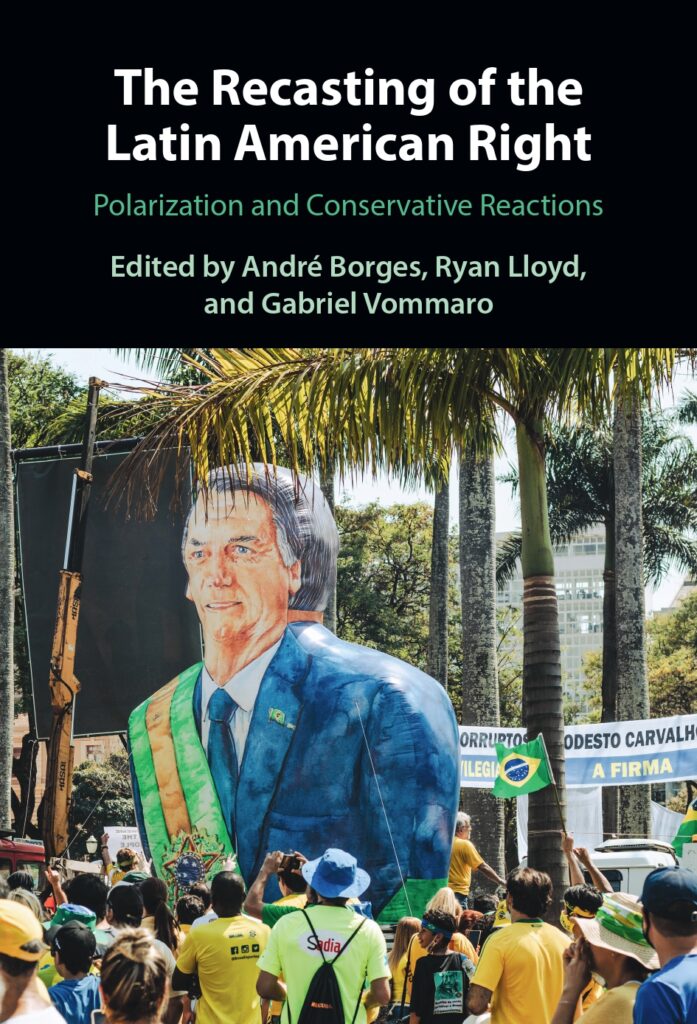
In The Recasting of the Latin American Right, we show how the right in Latin America has emerged from the Pink Tide with new faces, new characters, and new priorities, but some of the same threads from prior generations. We analyze this resurgence by mapping the different strategies used by the right wing in Latin America after 2000 and their outcomes. The first part of our book investigates the supply side of the right: how right-wing parties adapted to the preeminence of the left, rebranded themselves, and at times built entirely new parties. The second part of our book analyzes the demand side, focusing on how socioeconomic and cultural changes shaped the electorate in Latin America and created opportunities for actors, both old and new.
Some observers might be surprised to note the variety within the right in Latin America nowadays; not all parties are structured the same way or behave the same way. To better frame this diversity, we begin the book by establishing a framework centered on programmatic strategy and organizational investment. While some parties pursue more moderate programs, prioritizing pragmatism and the median voter, others have more radical profiles, prioritizing ideological extremism and espousing anti-establishment stances. Likewise, while some parties invest heavily in party brands and organization, others consist of loose electoral coalitions around specific (sometimes populist) leaders. As such, while they all might be card-carrying members of the right, a member of the the Partisan Moderate Right (moderate program, high degree of organizational investment) such as the National Party of Uruguay presents themselves and behaves very differently than a party that is a Radical Right Movement (radical program, low degree of organizational investment) such as the Liberal Party of Jair Bolsonaro in Brazil.
Although there is substantial variation among the right-wing parties and movements that emerged after the turn of the century, some important similarities can also be identified. Compared with the previous wave of right-wing parties ranging from the 1950s to the late 1990s, the post-2000 political right is more conservative and emphasizes non-economic issues such as LGBT rights and abortion to a much larger extent. Furthermore, despite wide variations in levels of organisational development, our book demonstrates that several right-wing parties formed in the last two decades have been much more successful than previous waves of conservative party-building in Latin America in establishing clear ideological identities and creating strong party brands. Our empirical findings therefore suggest that the reimagining of the right has fostered the creation of resilient parties with a better chance of cultivating programmatic linkages with voters and thus establishing deeper roots in society.
We supplement this general framework with three chapters analyzing the general dynamics of policy change and party adaptation within the region and seven case studies from a variety of countries in South America. Written by specialists who are originally from and/or based in the countries in question, these case studies analyze the specific dynamics at play in Argentina, Peru, Colombia, Chile, Brazil, and Venezuela, zooming in on the particularities of each country in more detail. They show how the experiences of these countries both adhere to more general regional trends or diverge from them, and thereby help us paint a more comprehensive picture of the new right in Latin America.
As the political right continues its resurgence in Latin America, adopting new strategies to connect with voters and international actors, it becomes ever more important to understand its origin and trajectory. The Recasting of the Latin America Right shows how right-wing actors have adapted their offerings to satisfy new types of demands in societies that are growing ever more polarized. It has become more crucial for researchers and practitioners to understand the implications that new types of right-wing parties will hold for democratic systems; this volume provides the reader with both a framework and a diverse set of examples to help them do so.

André Borges is Associate Professor at the University of Brasília, Brazil. He received his Ph.D. in Political Science from the University of Oxford. His latest research has appea...
View profile >Ryan Lloyd is a Policy Specialist at Google. He received his Ph.D. in Government from the University of Texas-Austin, was a postdoc at the University of São Paulo, and a Visiting ...
View profile >Gabriel Vommaro is Professor at the Universidad de San Martín and Researcher at the CONICET in Argentina. He received his PhD from the Ecole des Hautes Etudes en Sciences Sociales...
View profile >Keep up with the latest from Cambridge University Press on our social media accounts.



Latest Comments
Have your say!