

Products and services


Politicians are notorious promise breakers. A British prime minister vows to cut net migration to the “tens of thousands,” only to discover that EU free‑movement rules, domestic demand for migrant labor, and global shocks keep the numbers high. A US president pledges to bring back manufacturing jobs, but global supply chains and trade rules blunt the impact of tariffs and subsidies. In France, candidates promise to preserve pensions while “modernizing” the system, then face streets full of protesters when reforms lengthen working lives under the watchful eye of international investors. German leaders announce rapid green transitions, only to find that constitutional debt brakes, energy‑price spikes, and industrial lobbying make it impossible to keep these commitments.
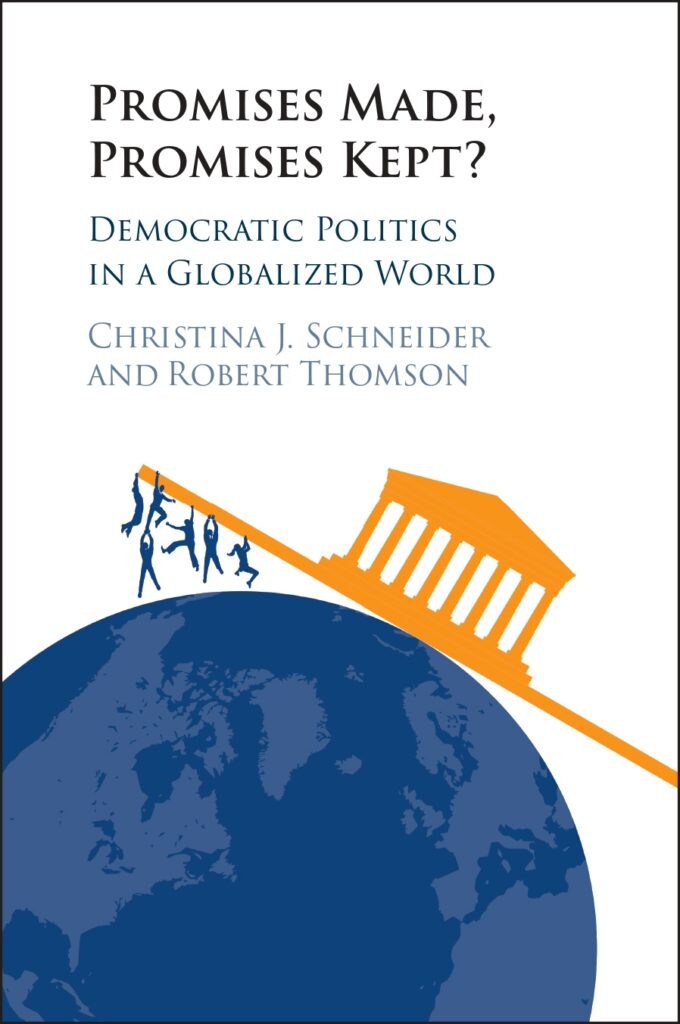
In Promises Made, Promises Kept? we argue that these episodes are not just about feckless leaders or “lying politicians.” They reveal how economic globalization has altered the basic bargain at the heart of representative democracy: parties make promises, elections are read as mandates to pursue them, and governments are rewarded or punished according to what they do in office.
Why promises matter
We focus on the idea of promissory representation. During campaigns, parties and candidates set out what they will do; once the ballots are counted, winners invoke those commitments as mandates for their policies. Parties’ election programs or manifestos are the scripts that legitimate governments are expected to follow.
Globalization scrambles this simple story. As economies become more tightly integrated through trade, capital flows, and international rules, national governments lose room to maneuver on many of the policies that matter most for voters. At the same time, citizens expect governments to do more, not less: to shield them from job losses, wage stagnation and sudden crises that spill across borders. They increasingly judge governing parties on whether they are competent in this harsher environment.
When promises meet global constraints
To see how this works in practice, we examined thousands of campaign promises in twelve democracies over more than four decades. The pattern is clear: the more economically globalized a country is, the smaller the share of pledges its governing parties manage to fulfill.
Several mechanisms sit behind that finding. International laws, such as trade agreements and EU rules, narrow the set of policies governments can adopt. Mobile firms and investors can threaten to shift capital or jobs elsewhere. Economic shocks appear between the campaign and the time of governing. And all the while, citizens demand more protection from economic risks, which encourages parties to promise more than they can realistically deliver.
The Conservative pledge to cut net migration in the UK is an insightful example that we explored through conversations with party elites. The pledge played well in an election context marked by concern about immigration and competition from an anti-immigration right-wing challenger. Once in office, the party faced EU free‑movement rules, employers who depended on migrant labor, and a volatile post‑crisis economy. This fatal combination meant that the pledge was doomed to fail.
Voters’ response and parties’ adaptations
You might expect voters to be more forgiving and say, “Well, that’s globalization.” Our evidence suggests otherwise. Across countries, governing parties that keep a lower share of their promises tend to lose more votes than those that deliver on more of what they said. In a survey experiment in the United States, we presented respondents with politicians who either kept or broke a clear promise and, for some respondents, we spelled out international constraints that made fulfillment difficult. In both scenarios, voters punished the promise‑breaker. Voters expect politicians to anticipate global constraints when they make their commitments, not to discover them afterwards.
Interviews with French citizens who had supported the Socialist government that reversed course in the early 1980s tell a similar story, and vividly illustrate the long-term effects of promise breaking. Many did not see that U‑turn as an unfortunate necessity, but as a loss of trust that shaped how they view mainstream parties decades afterwards.
Parties, of course, notice these reactions. We show three ways in which they adapt. First, they adjust what they promise. In more globalized economies, center‑right parties move toward the center on socioeconomic policy and talk more about expanding social programs than they once did. Second, they adopt more populist rhetoric, the language of “the people” against distant elites, or of nation‑first priorities, as a way of acknowledging discontent without promising change. Third, mainstream parties resort more frequently to vagueness. Election programs in highly globalized settings are noticeably fuzzier, and our experiments show that breaking a vague pledge is electorally safer than breaking a precise one. That may be smart politics, but it blurs accountability.
“More democracy” but of the right kind
So where does this leave democracy? Our response is reminiscent of the line attributed to Alfred E. Smith, the four‑term governor of New York and the Democratic Party’s 1928 presidential candidate: “All the ills of democracy can be cured by more democracy.” But only if “more democracy” is understood in a specific way.
If parties want to sustain trust, they need to promise less and keep more. That means being open about what international constraints allow, avoiding the temptation to offer everything to everyone, and making clear, testable commitments where governments still have real discretion. Then following through. For their part, citizens, journalists and scholars should treat promise‑keeping as one of the key indicators of democratic health, not as an afterthought.
Our book provides evidence that when parties respect the basic bargain of democracy by saying what they will do, then doing it, voters respond. When they do not, voters look elsewhere: to populists with simple stories, to cynicism, or to disengagement. In a globalized world, keeping promises has become a lot harder, but it has also become more important than ever.
Available to read now through Open Access

Christina J. Schneider is Professor of Political Science at University of California, San Diego and author of Conflict, Negotiation and European Union Enlargement (Cambridge Univer...
View profile >Robert Thomson is Professor of Politics at the University of Hong Kong. His research focuses on international comparisons of democratic representation, policymaking and internation...
View profile >Keep up with the latest from Cambridge University Press on our social media accounts.




Latest Comments
Have your say!