

Products and services


As a historian of war, I’ve always been curious about how wars have been fought–not just on the impersonal levels of strategy and operations, but also in the much more intimate terms of the everyday. I am especially interested in that most primal and immediate of human concerns: what and how did soldiers eat? Where did their food come from? How was this food procured, transported, stored, distributed, and prepared for consumption? How did these banal processes set the rhythm of daily life for both combatants and civilians, and how did they determine one’s prospects of survival?
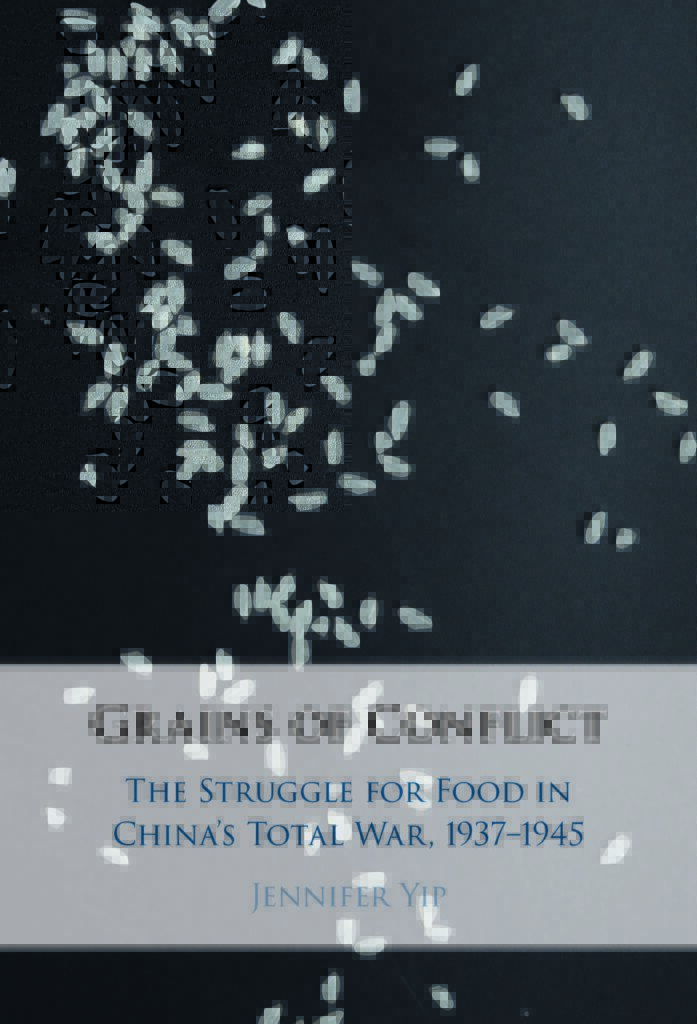
Such curiosity was the starting point for my book, Grains of Conflict: The Struggle for Food in China’s Total War (1937–1945). What began as a casual foray into fun facts about food in war (initial search phrase: “Did soldiers in wartime China eat rice or noodles?”) turned into a full-blown research project about wartime food provisioning. How did China, a deeply agrarian society in an age of industrialized warfare, feed some five million men?
What fascinated me most was the revelation that military supply in wartime China seemed to rest primarily on civilian effort. Every link in the supply chain depended directly on the organization of local civilians and their resources. It was ordinary Chinese people who not only planted and harvested foodstuffs, but who then also transported and delivered it to military consumers. The more I investigated, the more it became clear that such civilian mobilization for military purposes took place on a nationwide scale, and often as a matter of central government policy.
I perused archival collections on key agencies such as the Ministries of Grain and Transport to reconstruct the Chinese (Nationalist) government’s army provisioning policymaking process. I also mined treasure troves of digitized print material–magazines, internal army or government agency publications, manuals–for details on the execution of these policies. These materials are obscure: they were meant for specific and limited audiences, and several have yet to be used in historical scholarship. Yet, they offer tantalizing glimpses into the grievances of officials who staffed every stage of the army grain provisioning process. A thorough exploration of English-language archives also reveals that British and American observers paid astute attention to the food situation within both the Nationalist and Chinese Communist Party (CCP) forces, and amongst the civilian population. Japanese-language materials illustrate how the Imperial Japanese Army attempted to extract grain from the fertile Yangtze Valley. Together, these materials enabled me to trace land tax collection practices, granary networks, transport circuits, and the power of the struggle for food to militarize every aspect of life.
I found that it was food, not weaponry, that served as the lynchpin of China’s war effort. This was the consequence of two decisive factors that distinguished China from other World War II theaters: China’s agrarian constitution, and the protracted nature of the conflict. For most of the war, all sides–Nationalist, CCP, Japanese–understood that a military decision was out of reach, and that the main imperative was simply to keep armed forces in being. Thus, food emerged as an overriding strategic objective. To compensate for its lack of modern infrastructure, the Chinese government relied instead on mass civilian mobilization to carry out all stages of grain provisioning, from procurement to transportation and storage. China’s survival hinged on the ruthless extraction of civilian resources. Consequently, it was the struggle for grain, not territory, that embroiled the most civilians in violence.
These observations have ramifications for the broader discourse on total war. “Total war” has elicited a wealth of historiography. Yet, China is absent in virtually all these works. I would argue that China deserves a central place in this scholarship. Firstly, Chinese policymakers of the 1930s and 1940s viewed themselves as part of total war discourse. Secondly, and more importantly, China’s experience challenges the widespread conflation of total war with modern war. The China theater is a powerful example of how total war could also be waged with starkly preindustrial resources and methods–namely, by treating its civilian population as a bottomless reservoir of raw labor and materiel. It also overturns the predominant scholarly and popular images of World War II as one of technological prowess.
Immersing in the rich base of primary sources was a poignant experience. Official records could be dry, impartial, and stuffed with tables and numerical figures (a humanities scholar’s nightmare). But beneath the stiffness of bureaucratic formalities were sharp tinges of humanity. Government reports could be surprisingly detailed, offering glimpses into the workings of grain provisioning at the county or even sub-county level. They often linked names to cases, grounding grain provisioning work in the reality of individual lives. For instance, a report by a county land tax management office recorded how Bo Siyan, a civilian granary worker in Yongshun county, Hunan province, died on the job (p. 79). He had spent many hours keeping guard over the grain collected as land tax in the granary and caught a bad chill. (Land tax, paid in kind after 1941, was a key source of military grain.) Bo was a war refugee; he had originally resided in Jiangsu province. Specialist print publications often featured expositions by officials intimately involved in everyday provisioning operations. Tian Xueqiao, whose job was to escort military grain convoys, contributed to the Army Management Magazine, complaining that his work was both thankless and unbearably stressful (p. 92). Even after accounting for their tendency toward sensationalism, foreign observers–journalists and ambassadors alike–offered sobering anecdotes about the difficult decisions people had to make to survive. Put together, these sources present a picture of imposed state sacrifice, friction between multiple levels of administration, and everyday life laced with hunger and violence.
Excavating the minutiae of military grain provisioning has deepened my understanding and appreciation of logistics. To me, logistics–questions of supply and transport–is fascinating precisely because it is about the mundane. It is through logistics that the operational and strategic calculations manifest in the banality of everyday life. It is logistical work that draws together combatant and civilian spheres and exposes the most civilians to the crossfire. For any student of war, regardless of time and place, logistics is an indispensable factor in analyses of not just how conflicts unfold, but also the costs they impose on civilian societies.
Keep up with the latest from Cambridge University Press on our social media accounts.




Latest Comments
Have your say!