

Products and services


Nebulae are those star nurseries familiar through the fabulous Hubble images like the one above. Languages are also born – indeed every language is reborn, quite literally in the nursery. In my new book The Interaction Engine, just like the astronomers I turn the focus not onto language itself but onto the systems that gave rise to it. In particular, I focus on a suite of special interactive abilities that are distinctive in humans – just the things systematically impaired in autism, like taking rapid turns at talking, constructing relevant responses, gesturing in helpful ways and gazing back at interlocutors. I call this distinctive suite of abilities ‘the interaction engine’, and argue that it is this that lies at the roots of language, both in terms of language evolution and language learning.
The book itself was born during the Pandemic, when human interaction was curtailed, and its centrality in human experience and social life was brought home to me. Our dearest delights and greatest dreads are felt in interaction with others. It is a book that celebrates the role of social interaction in the life of the mind as well as the social world. But it looks beneath the surface and tries to delineate exactly how communicative interaction works. I start with the observation that communication is possible without language, as shown by the case of isolated deaf individuals. I go on to point out that there is a central evolutionary puzzle: how can we have evolved all this specialized anatomy and neurobiology for language when the target exhibits so much kaleidoscopic diversity? Languages can vary fundamentally at every level, so how can selection mechanisms pinpoint a target? I argue that, instead, the mechanisms have in part rather targeted the machine that makes the tool, as it were: the interaction engine.
I go on to delineate the major properties of the interaction engine. Some of them seem quite simple, but they add up to an impressive machine. There’s multimodality – the fact that when we talk, we gesture, gaze, wink, shrug and so on, which provides an important set of ancillary channels. Then there’s the property of contingency – one act is tied to the prior, as in question-answer sequences. But these sequences can get complicated, with deep internal embedding (much deeper than anything found in syntax, by the way). Then there’s the metronome of timing. We take rapid turns at talk. Conversational responses are expected to be fast, close to the speed of the minimal human reaction time. This can only be achieved by early preparation, even as the other person is still speaking – a skill the toddler lacks, with the frustrating consequence that she can’t easily get her turn at talk! Most important of all, there is this motivation-seeking machine – why did she say that now? This intention attribution or ‘mind reading’ seems to happen more or less involuntarily.
Quite a bit of the book is concerned with how these properties evolved. One of the advantages of deflecting attention from language itself to the interactional foundations that support it, is that we can much better see the continuities with our cousins, the other primates. For example, turn-taking can be found (spottily) right across the primate order. Human turn-taking has a fast temporal signature, with responses within a quarter of a second, a pattern approximated in infant ‘proto-conversation’. The great apes have a similar timing, but only in their gestural communication system (their vocalizations tend to be other than in the fast negotiations of everyday interaction). The fact that all our fellow great apes are primarily interactional gesturers also suggests a gestural origin for language. That in turn may offer an explanation for the tendency of languages to draw on spatial concepts for their grammatical machinery – for gesture is a spatial mode of communication and largely communicates about space. In this sort of way, looking at the infrastructure that supports language may offer important clues to that abiding puzzle, the evolution of language. I speculate that a range of facts allow us to guestimate that language as we know it goes back much further than usually thought, over half a million years ago.
The human propensity to ‘mind read’, to attribute motivations and intentions, is a critical part of the interaction engine. Of course, animals have this to some degree, but circumscribed to domains like sex and aggression. However, all mammalian mothers have additional needs to discern the sources of infant distress, and there may lie the roots of a much broader empathy. Chimpanzee mothers can’t lend out their infants because of the real danger of infanticide, and as a result they breed much more slowly than humans. But humans routinely outsource child-care, and can do so safely because humans have generalized the empathetic response out of the mother-infant relation. This is aided by our susceptibility to cuteness, a feature I argue that, by promoting outsourcing of childcare, has evolved to allow humans to reproduce twice as quickly as chimps.
One big puzzle about human communication is why we do so much of it! Comparison with other primates suggests we do an inordinate amount of it largely to juggle our complex human relationships. The delicacy of this handling of relationships is reflected in a lot of additional complexity in human languages – all the indirectness, politeness phenomena and honorifics. I explore the sensitive matter of social teases and how face is quite literally at issue. Here again you can see pale but tell-tale parallels with other species. Human relationships are largely structured on two dimensions, by relations of hierarchy on the one hand and a close-distant relationship of peers on the other. These patterns are very visible in the use of names, titles and honorific pronouns, but you can also see them in, for example, the grooming relationships in other primates. By modulating social interaction, we can build the complex social structures that typify human societies.
In sum, the book traverses lightly a huge range of phenomena, from little details of language and interaction structure to the grand sweep of human evolution. Much of our conscious thought is, as Socrates put it, an inner dialogue with the self, and, one may add, imagined interactions with others. The field of communicative interaction is, in contrast to language itself, a relatively neglected field of study and I hope this book may help to get it more of the attention it deserves.
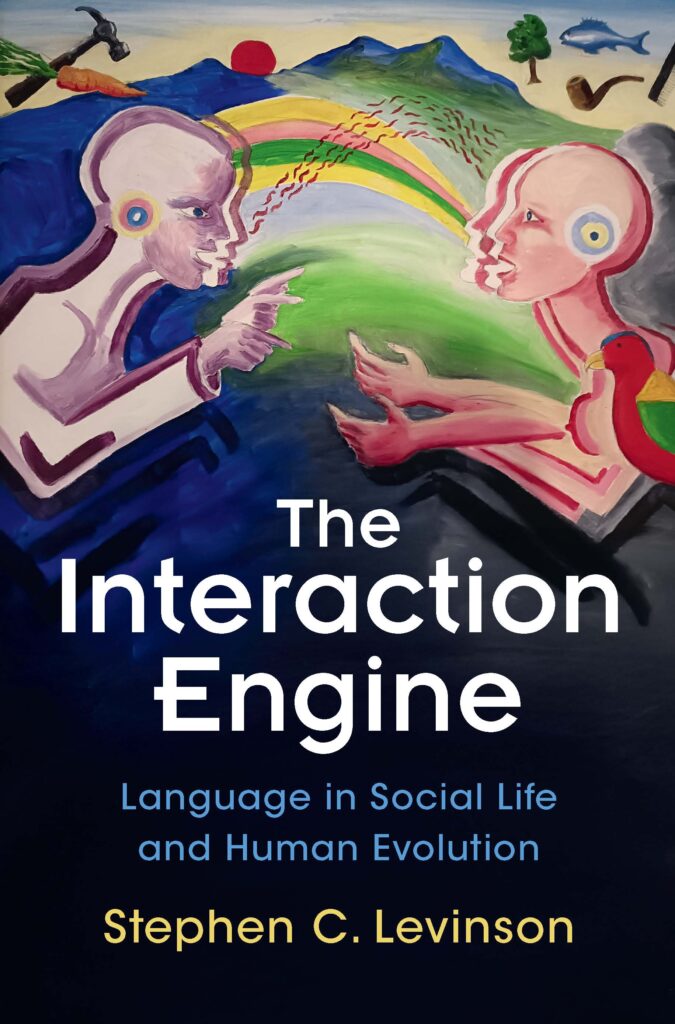

Stephen C. Levinson is Emeritus Director of the Max Planck Institute for Psycholinguistics and author of over 400 publications on language, culture and cognition. He holds an honor...
View profile >Keep up with the latest from Cambridge University Press on our social media accounts.



Latest Comments
Have your say!