

Products and services


When we hear that the United States is facing a health care provider shortage, the most common response is: We need more doctors. It sounds intuitive. When it seems like we don’t have enough doctors, the natural response is to try to produce more of them: add medical school seats, expand residency programs, and grow the physician pipeline.
But this framing may miss something important.
The challenge is not simply the number of people with medical degrees. It’s how the system tends to define who “counts” as a provider, what roles they are allowed to hold, and which forms of care are supported or reimbursed. Many professionals, including nurses, counselors, community health workers, mid-level clinicians, peer support specialists, telehealth professionals, and local public health practitioners, are already prepared to meet many care needs. Yet regulatory structures and reimbursement rules often constrain the scope of what they are empowered to do.
In other words, the concern is not just capacity, but how capacity is recognized and enabled.
If someone living with diabetes needs help managing medication, a nurse practitioner is fully trained to support that. If a family is navigating ongoing stress or mental health concerns, a licensed counselor or community mental health worker may be the most trusted and accessible resource. If someone needs early education, monitoring, or encouragement to seek treatment, peer support or community health workers can make a meaningful difference.
Yet many of these professionals work within systems designed when health care looked very different. These structures can unintentionally limit care rather than expand it. This creates what some describe as artificial scarcity: a shortage that emerges not from a lack of people who can help, but from how we structure the use of their skills.
Ironically, many of the most promising solutions already exist in professions and care models that are well-established but not fully integrated into core credentialing and reimbursement systems. Nurses, counselors, community health workers, peer-support specialists, and other allied health professionals are often trained more quickly than physicians, enter the workforce sooner, and tend to practice in the very communities where access gaps are most acute.
These professionals do not replace physicians; they expand the reach of care. They are the clinicians and support staff who see patients regularly, understand local contexts, and often represent culturally relevant and trusted sources of guidance. Yet when policies restrict their authority to practice fully, or when insurance structures undervalue their contributions, the system becomes more limited than it needs to be. What could be a broad network of accessible care becomes narrower because the rules about who is permitted to provide it are slow to adapt; not because care is unavailable.
If we shift the question from “How do we produce more physicians?” to “How do we make better use of the care resources already in place?”, the path forward begins to look more promising:
A healthier society grows not only by expanding the pipeline into medicine, but by widening the circle of people we trust to care for one another. So, how do we make full use of the care capacity that already exists around us? The answer to the provider shortage may already be here — if we choose to embrace it.
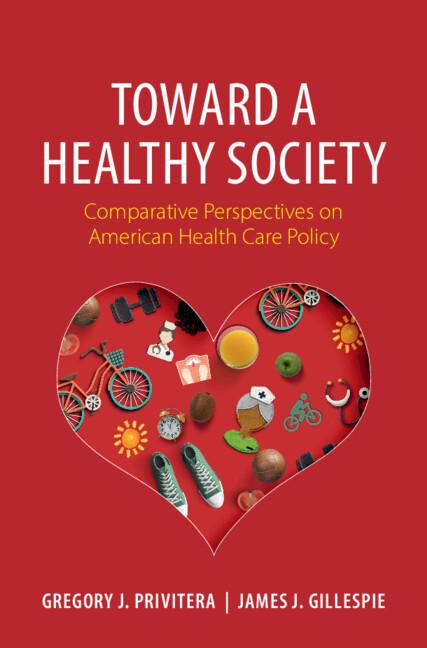
Title: Toward a Healthy Society
Author: Gregory J. Privitera & James J. Gillespie
ISBN: 9781009625852

Gregory Privitera is a Professor in Psychology at St. Bonaventure University, where he is a recipient of its highest teaching honor and its highest honor for research and scholarsh...
View profile >James Gillespie is an Assistant Professor in Business and Management at Saint Mary's College, a Senior Advisor at McKinsey & Company, and a Senior Advisor at Stanford School of...
View profile >Keep up with the latest from Cambridge University Press on our social media accounts.




Latest Comments
Have your say!