

Products and services

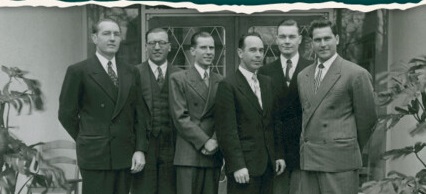
“We will have to undertake one of the most difficult tasks facing the Church in our day,” wrote Cline Paden, the young pastor of the non-denominational, evangelical Church of Christ in Brownfield, Texas, before departing for Italy in late 1948. “That of replanting New Testament Christianity in a land where it has not existed for more than 1,500 years. We are going into the very city in which the great apostasy, predicted by the apostles and now a matter of history, had its beginning … We are going into the city where the ‘Mother of Harlots’ has taken up her residence and from which she seeks to rule the world. We are going into the city which has been aptly called the Capital of Satan, Rome, Italy. What a place in which to preach the Gospel. What a settlement for a New Testament Church! How great the need for both.”
Paden was part of a broader movement that led hundreds of thousands of U.S. evangelicals to embrace foreign missions and, in the process, to engage with the wider world-transforming both the scope and the character of American Protestant missionary activism. Among the driving forces behind this movement was the struggle for religious freedom and pluralism, which often intersected with the virulent anti-Catholicism characteristic of many evangelical churches, including Paden’s own Church of Christ. Italy appeared a natural choice: a country where the Catholic Church maintained a near-monopoly over religious life, formalized through its agreement with the Italian state, and where so-called “a-Catholic” churches were subject to restrictive regulations rooted in Fascist-era legislation.
In principle, the post-World War II republican Constitution had superseded such laws. In practice, however, post-Fascist governments dominated by the Christian Democratic Party continued to enforce them, systematically discriminating against non-Catholic Christian denominations. Upon arrival in Italy, Paden and his fellow Texans established themselves in the “Castelli Romani,” a few miles southeast of Rome. From their base there, they launched an aggressive campaign of proselytism, which quickly drew the attention of the Catholic clergy, the local police, and the Ministry of the Interior, responsible for religious affairs. The missionaries were harassed, subjected to discrimination, and on several occasions physically attacked by Catholic mobs. Initially receiving little or no support from the U.S. Embassy in Rome, they turned to the media and successfully mobilized the Texan congressional delegation in Washington.
This marked the beginning of a protracted conflict that lasted until the mid-1950s, when Paden was de facto expelled from Italy. His story became entangled with broader dynamics of the Cold War, U.S.–Italian relations, and the contested question of religious liberty and pluralism in postwar Italy. It illustrates the ways in which religion could shape the conduct of U.S. foreign policy, highlights the role of non-governmental actors-even small ones such as the Texan Church of Christ-and underscores the pervasiveness of Cold War categories, which all the parties involved-from missionaries to Italian and U.S. officials to members of Congress-invoked to justify their positions and demands.

In the Shadow of the Vatican
by Mario Del Pero

Mario Del Pero offers a compelling lens on this long-overlooked story through which to explore the early history of the Cold War and the complex dynamics between geopolitical align...
View profile >Keep up with the latest from Cambridge University Press on our social media accounts.



Latest Comments
Have your say!