

Products and services


In response to insufficient climate action from the legislative and executive branches of government, there has been a marked rise in litigation as a key means of ensuring accountability and advancing climate responses. With more than 2,500 climate-related cases filed globally to date, this area of law is experiencing rapid growth across continents and jurisdictions, as well as in the range of legal issues addressed. The surge in climate cases – over the last decade in particular – represents more than a mere uptick in litigation, but rather, reflects a strategic movement focused on achieving systemic, transformative changes capable of confronting the climate crisis.
There have been a number of high-profile victories along the way. Cases such as Verein KlimaSeniorinnen Schweiz and Others v Switzerland, State of the Netherlands v Urgenda Foundation and Leghari v Pakistan helped establish that governments can in fact be held legally accountable for failing to take sufficient climate action. Inspired by these groundbreaking decisions, many similar cases emerged in other jurisdictions, with courts ordering governments to increase their emissions reduction efforts, further clarify their climate plans, and implement their current targets. Most recently, the advisory opinions on climate change from the International Court of Justice, the Inter-American Court of Human Rights, and the International Tribunal for the Law of the Sea further confirmed that governments have a responsibility to take stronger climate action. These outcomes have also sparked policy discussions and public debate beyond the courtroom, leading to the development and implementation of more ambitious policies. However, despite climate litigation’s increasing visibility and real-world impact, there has not been a consolidated resource that comprehensively unpacks the recurring, complex issues in this area of law.
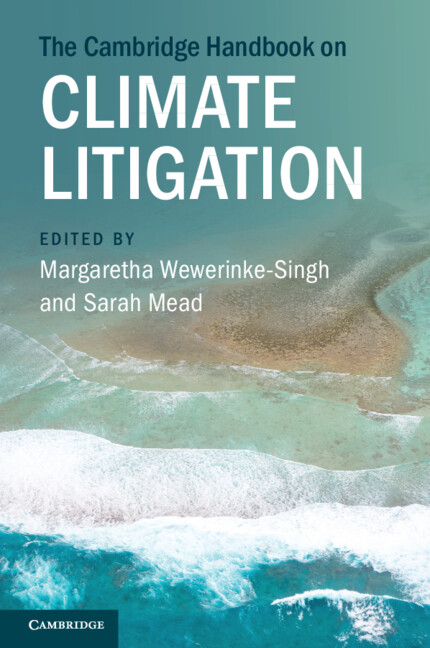
The Cambridge Handbook on Climate Litigation serves to fill this critical void. Edited by Margaretha Wewerinke-Singh (co-editor), Sarah Mead (co-editor) and Joe Udell (assistant editor), and authored by recognised experts in the field, this publication provides an authoritative guide to the increasingly dynamic landscape of climate litigation. The Handbook’s 20 chapters provide in-depth analysis of key issues currently shaping the contours of contemporary climate litigation, including admissibility, separation of powers, extraterritoriality, intergenerational equity, causation and remedies. Each chapter draws on a vast array of cases to examine relevant jurisprudence from the courts, highlights emerging best practices from various significant and lesser-known judgments, and assesses the extent to which these findings can be replicated in different jurisdictions.
Through this analytical approach, the Handbook represents a rich source of guidance for judges, lawyers, scholars, policymakers, stakeholders and other actors involved in climate litigation. Fully aware of the myriad cultural, legal, political and socio-economic contexts in which climate litigation takes place, this book consciously avoids presenting universal solutions. Rather, it offers a comparative analysis that underscores common themes and critical differences across jurisdictions within this dynamic area of law. In so doing, the Handbook provides practical guidance, sheds light on the future trajectory of the field, and explores how climate litigation has the potential to shape law and policy – all while contributing meaningfully to the survival of our planet and the well-being of its inhabitants.
The Handbook is now freely available online at Cambridge Core and in paperback, hardback, and on Adobe eBook Reader.
Margaretha Wewerinke-Singh, Sarah Mead, and Joe Udell

Margaretha Wewerinke-Singh is Associate Professor of Law at the University of Amsterdam and Adjunct Professor of Law at the University of Fiji. Her publications, including her book...
View profile >Sarah Mead is a New Zealand-trained lawyer who specialises in international environmental law and human rights law – with a focus on States' obligations in light of the climate c...
View profile >Keep up with the latest from Cambridge University Press on our social media accounts.




Latest Comments
Have your say!